
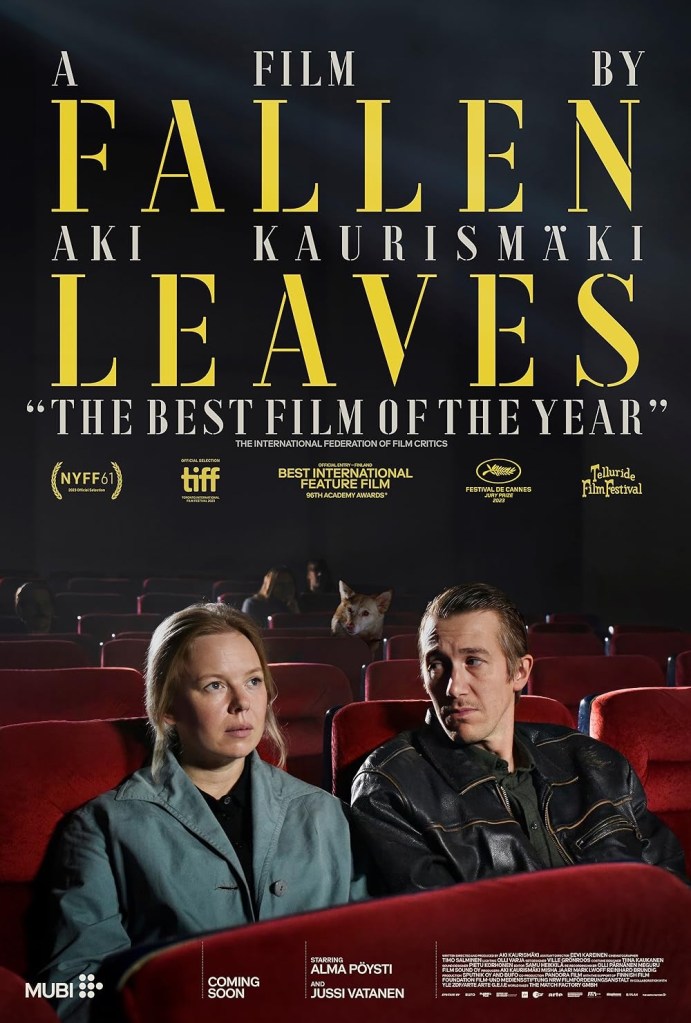
This experience will leave audiences asking, “What does it mean to improve and to thrive? and “What does it take to establish a connection?” Fallen Leaves is all about connection coming about in unlikely places. Director and Writer Aki Kaurismaki’spoetic film is set in Helsinki, Finland. He uses lighting to reflect frustration and shame in the beginning. As the film progresses, it reveals more aspects of the reality of the period in which it takes place. Fallen Leaves is a film where personality melds with frustration—because it links two individuals. Both characters will bring the world of fascination and realization into a new and unforgettable light in Fallen Leaves.
The film’s opening focuses on a lady named Ansa (played by Alma Poysti). She is dealing with some financial mistakes as well as struggling to hold down a job. The film begins with her job in a supermarket that falls apart. Then the film jumps to Raunio (played by Martti Suosalo). He is a construction worker who has alcohol abuse issues and deficits at his own job. While consistently falling behind at work, and not having his act together, more tension comes into Raunio’s life. Ansa goes to a karaoke bar, and Raunio goes to that same bar. The film turns into a journey of Ansa and Raunio building a friendship out of nowhere. Their relationship is portrayed with a sense of believability and a humanistic nature. Their eyes for each other are one-of-a-kind.
The film’s writing highlights the errors of Ansa and Raunio, but also on building their self-esteem. The tone of frustrated human beings is pervasive through the dramatic directing in Fallen Leaves. The bonding between Ansa and Raunio is somewhat sporadic. There is a moment where Ansa finds Raunio passed out by a bus station and from there the friendship deepens in the most empathetic way.
Ansa and Raunio go to a cinema and see the movie The Dead Don’t Die which is a film directed by Jim Jarmusch (one of my favorite directors for his artistic talents and creative vision). This part of the film spoke to me because of the way Jarmusch uses cinematography in his projects that is quite like the cinematography used in Fallen Leaves. There is that unique connection in the cinema, the place where movies can create memories and bring people closer together. Fallen Leaves is a gem of fine cinema with unforgettable depth.
The bond between Ansa and Raunio is one that is tested—their own errors test the boundaries of their evolving friendship (which might become a relationship). It is enthralling in the sense of two individuals doing the best they can at a time when they are dealing with several obstacles. Together, there is a spirit of encouragement to change their routines for a better life. The lighting helps to capture the essence of vulnerability in the authentic direction of Fallen Leaves.
Fallen Leaves is a faithful portrait of what it means to take on life’s unexpected challenges. I love the fascinating connection between Ansa and Raunio who are inseparable despite their flaws. Fallen Leaves is one of the most artistically triumphant films I have seen in a long time. Fallen Leaves proves that change can make a positive impact on someone’s life. For example, if Raunio were to stop drinking, Ansa would have more faith in him as a kind soul and he would have more faith in himself. The film is an empathetic look at going through turmoilto find what is right. Four out of four stars for Fallen Leaves.
 Movies with Tarek
This blog post beautifully captures the essence of Fallen Leaves and its exploration of connection and personal growth. I was particularly intrigued by the use of lighting to reflect emotions throughout the film. It made me wonder, how did the lighting choices evolve alongside the characters’ journey? Can you share any insights into the director’s intent with the use of lighting?
LikeLike