
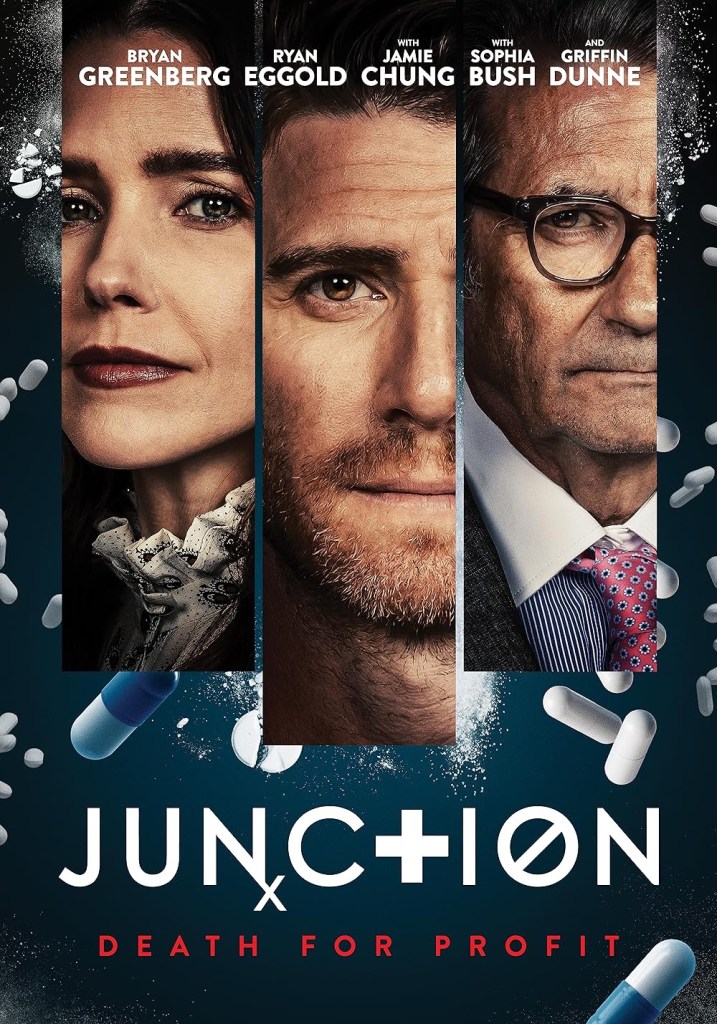
This film is focused on medicine and pharmaceuticals, as it explores the modern-day opioid crisis which is a continuous crisis in today’s world. Junction is directed by Bryan Greenberg, and he is also one of the leads. Greenberg not only directs a thorough representation of the flaws of pharmaceutical operations, but also successfully plays a character with severe withdrawal problems. Junction is one of the most realistic and descriptive experiences I have witnessed this year. The film opens with elements of suspicion and anxiety which carry on throughout the film. Junction is filled with multiple moving parts which find themselves misconstrued politically and ethically. The writing stays on point though in dealing with this controversial hot bed of a topic.
The film opens with Lawrence, the CEO of a pharmaceutical company, played by Griffin Dunne. He has multiple lawsuits building against his operations and foundations. His son Jacob, played by Ryan Eggold, is his assistant in his operations. Lawrence is a man of prestige and believes his operations are accurate and run with integrity. What he does not realize though, is that the opioid crisis has brought on loopholes in the law. Therefore, he falls responsible for many damages based on how his operations have impacted other states with distribution and costs. Junction is faithful in its portrayal of Lawrence’s attitude of superiority and his assumptions of his image. It is what distracts him from looking at the bigger picture…that fatalities and hospitalizations keep going up in many states.
The writing continues with a trend of suspicion and aspects relating to the era of opioid crisis. It goes deeper with intense subject as it shifts to Michael. Michael is played by Bryan Greenberg. Michael is one who is suffering from withdrawals from oxycodone. It impacts his life in a terrifying way. He is distracted by how focused he is on finding ways to get oxycodone. So distracted that his business fails an inspection check. In this story, Michael is impacted the most by feeling withdrawn without oxycodone. Michael and his addiction to oxycodone marks the revolving door of troubles in Junction. His ex-wife Allison (played by Sophia Bush) tries to be a help to him for the sake of their child, but is her help enough to save him?
With Junction strongly focused on errors with opioid troubles and oxycodone, its other character of focus is Katie (played by Jamie Chung). Katie is a doctor that is trying to follow the rules of medicine within the CDC and FDA. She gets a slew of patients trying to abuse the system. Many of which will say they are having trouble sleeping—the common problem where patients feel is an easy way to be prescribed medicine so they can abuse. Katie realizes that her patients come back often and it raises red flags. Katie is at odds with herself and her practice as she feels the rules are complicated when it comes to meeting the needs of her patients. There is only so much she can do.
The three characters of components of the troublesome scenario in Junction are Lawrence (the CEO of a pharmaceutical company), Michael (an individual that has drug-seeking behavior), and Katie (a doctor that cannot determine the right steps for her patients). The moving parts of medicine practices and laws are always on the track of transparency—the profits are the bigger factor than the actual problems that need thorough attention. The fact that Michael is plateauing from not having oxycodone, medicine is expensive, and healthcare workers are at odds as well. The obstacles of stressors are what create Junctionto be an intense experience on how finances and medicine abuse can have a mental toll on those who do not go by the rules.
This film is a politically driven rollercoaster ride of anxiety-provoking elements. The phrase, “misbranding of oxycodone,” goes a down a long and daring rabbit hole in Junction. There is moving parts where politics and operations face big risks—there are failures to reach agreements, doctors becoming irresponsible, and more fatalities due to prescription drugs being so accessible. The film’s writing focuses in the direction of time for change being lost— settlements are halted, overdosing among individuals worsens, and nothing is being done to limit fatalities or hospitalizations. The sophistication of Junction is its eerie depiction of the negative impact of pharmaceutical drugsbeing abused—once the withdrawals start, it is hard to find the means to help it subside. The foundation of the opioid crisis isdepicted in a very real and raw way in Junction. The truth hits hard. Three-and-a-half out of four stars.
 Movies with Tarek