
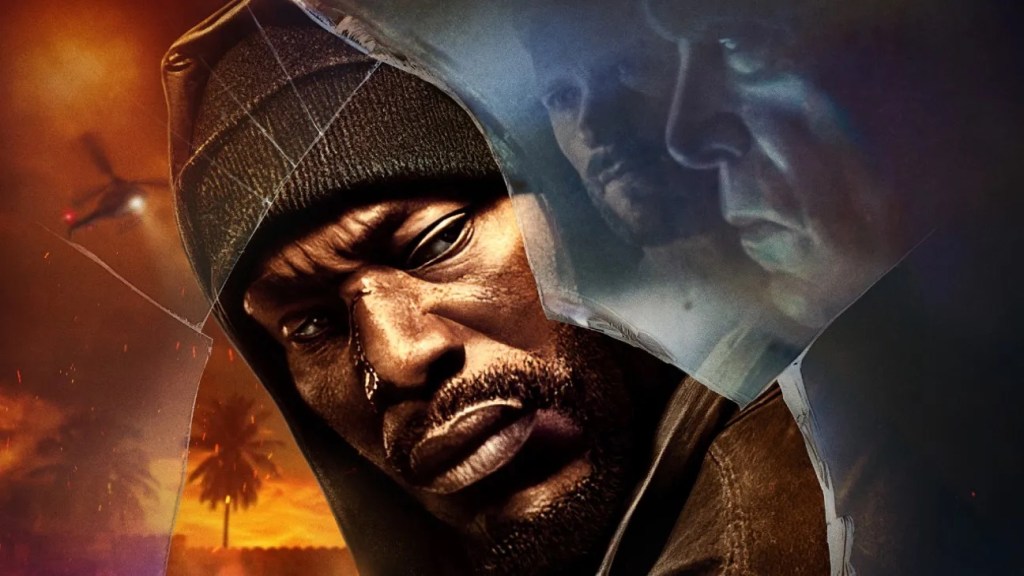
The dangers of Rodney King’s era come with an added layer of pressure. 1992 has a trail of strain. There is a lot that goes bonkers. Directed by Ariel Vromen, the pattern is a boxing match between Tyrese Gibson and Ray Liotta (who died in 2022). The aptitude for vengeance reached for the sky in 1992. It is a film that falls in the era of the Rodney King riots. The added conflict is a heist. Who makes it out alive is the question in 1992.
Gibson plays Mercer, who has been released from prison. His priority is his son Antoine (played by Christopher Ammanuel). Mercer works at a factory. In the future, this is a rough dynamic. There is another mixed relationship. Liotta plays Lowell. Lowell has many years of a bad relationship with his sons Riggin (played by Scott Eastwood) and Dennis (played by Dylan Arnold). Its dynamics are faithful to the harsh times of the past. The reality of criminality (in the California setting) displayed a vigorous presence in 1992.
The conflict of the film is three moving parts. The riots outside, Mercer trying to keep Antoine safe, and a heist. The heist is in the operations of Lowell and his sons. Mercer feels taking his son Antoine to the factory (due to the riots) will help keep them safe. It leads them into a death match of survival. Lowell chooses to do the heist during the riots. This is the tactic because it creates a window where backup cannot stop their operation. Lowell wants to steal catalytic converters from the factory. The value is steep in the platinum of the catalytic converters. Chaos hits its anarchy once Mercer and his son are up against Lowell and his sons. It builds frequency with a clicking tock. The moving parts of the heist and the city going down under are a brawl. One that keeps audiences on the edge of their seats.
The madness of tension boils solid in 1992. The robbery hitting plateaus is the added layer of detrimental scenarios (calculated). The performance of Gibson and Liotta possesses the power of authority for the opposite circumstances. Gibson’s role is to protect his son, and Liotta’s role is to pull off a criminal operation with his sons. Both the choices of fathers lead to this unexpected circumstance. The only chance is to fight. Many punches go back and forth in 1992. The ruthlessness leaves a monumental mark of cinematic achievement.
In 1992, the stakes were critical. It begins with Mercer thinking the only safety conflict is the riots outside. He tells his son, Antoine, “We just got to stay the course.” That quote brings the dynamic to a ten-question level of safety concerns. When the audience thinks Mercer is keeping his son out of danger, they walk into it (at the factory). The rough population of the livelihood has density in 1992. Its environment with detrimental infrastructure links to resilience. “Resilience” is how choices have consequences, and how some choices of harshness must be made.
Who is more at risk? Is it Mercer’s son? Is it Lowell’s son? Do the riots create any more layers of questions? How many conflicts come around with the heist? Find out in 1992. Three-and-a-half out of four stars.
 Movies with Tarek