
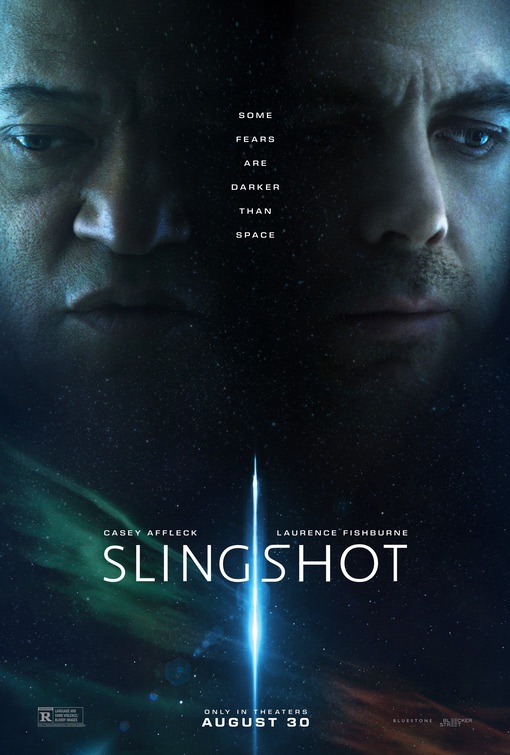
The title seems to be over-viewed as space peril. It has the odyssey and landscape of a vast setting to the moon. There is a sense of frustration and disconnect many miles away from home. Slingshot has all the legitimate innards for its plot of a mission. Sadly, it does not know how to pull off (its plot) cinematically. Directed by Mikael Hafstrom, the approach to mental conflicts (taking place in space) tries to be the moving part of a critical mission on a spacecraft. It comes around as compelling, but then it hovers to be shaky.
The film focuses on three astronauts: John (played by Casey Affleck), Captain Franks (played by Laurence Fishburne), and Nash (played by Tomer Capone). They are making their way to Saturn’s moon, Titan. The spacecraft has conflicts and underlying technical glitches. John and Nash question the mission’s continuation. However, with Captain Franks in charge, he insists they have no choice. He keeps pushing like it is required to complete what they started. The spacecraft continues to mess with the heads of the astronauts. John is the astronaut of purpose in Slingshot.
The film is a blur with its focus on John. He continually thinks about what home is. The woman he loves is Zoe (played by Emily Beecham). As John is tolerating turmoil on board, Zoe keeps floating in his mind. When that happens, the personal conflicts between Captain Franks and Nash keep deteriorating. The mental state of John and his vulnerability are the compelling factors in Slingshot.
Its writing has the sense of reconnection waiting to happen. It does a stellar job of shifting the moments of happiness, sadness, and hopelessness (through John’s thoughts). What is the film’s focus for John? Is it to get back home to Zoe? Is it for him to take his chances with reaching Titan? There are many vivid thoughts (out-of-focus) about John’s backstory.
As Slingshot has the continuity to seem that being in a spacecraft is the norm, it tries to rush its severe conflicts. Those are the ones with Nash and Captain Franks. The thought of making it home keeps falling to the lowest priority for Captain Franks. That messes with the mental states of John and Nash. However, it is redundant. The repeated use of the astronauts going to a coffin mode of hibernation frequently leads them to the same mediocre situation. That “mediocre situation” is at the standstill of their spacecraft in disagreement with their leader (Captain Franks).
With all these bizarre moving parts, Slingshotseems to try to grasp its feel as psychological. It does not know how to correlate its Tetris mode with a poorly written screenplay. The spacecraft, the world of outer space, and the environment are all wonderful. The characterization of focus is where the brakes hit a pause. The common ground of love (in the eyes of John) continues to be unclear in Slingshot. The reliance on boredom and agitation (in space) seems to take over to fill in the voids of dramatic depth. I still felt there were empty slots with no fulfillment. I rate it two out of four stars for Slingshot.
 Movies with Tarek