
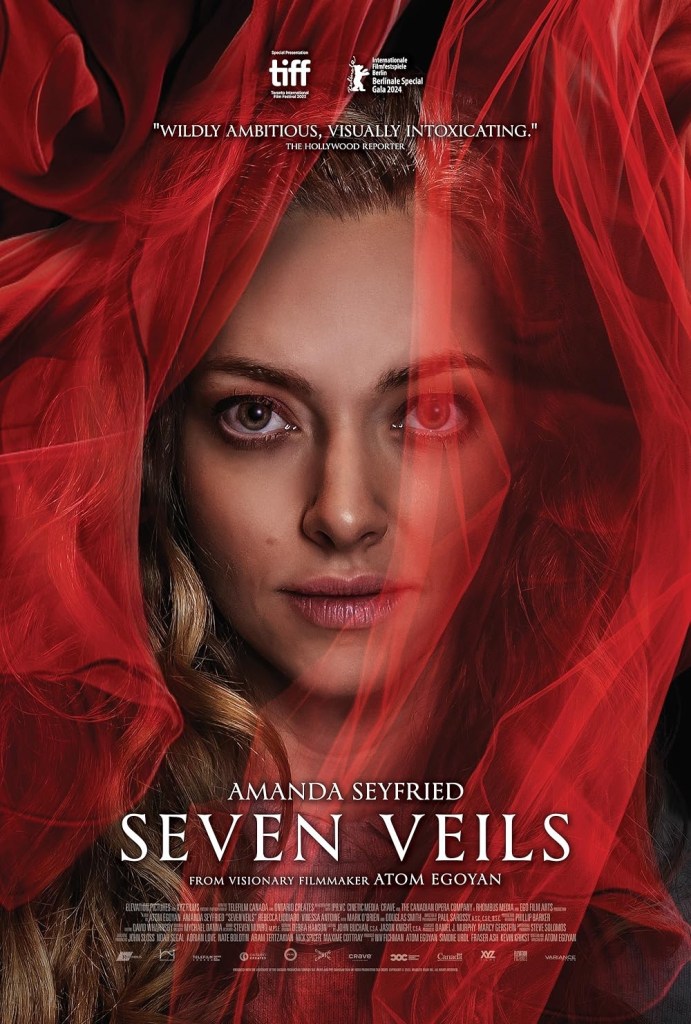
This is one of those rare experiences that feels like a project is the height of the masses. Seven Veils exercises anxiety and pressure to the point of disgust and the chances of having a meltdown. It also leads to a cinematic storyline of what thrives to make a portrait personal. “Personal” as to incorporate past moments to make a show breathtaking. Written and directed by Atom Egoyan—he has a background with parents that were artists. His inspiration for visual audaciousness is one of a natural element—it is present in Seven Veils.
The film’s main character is Jeanine, and she is played by Amanda Seyfried. Seyfried worked with Egoyan in the 2009 thriller Chloe, and she played the role of an escort. Her attitude shifts to the more serious and mind-boggling approach as she plays an opera director in Seven Veils. Her task is to put on an opera that was under the direction of a previous director. This task of hers is one that is mentally and visually overwhelming—both those elements grasp with a form of continuity that boils the film’s tension. Going forward, the film also introduces us to Clea, and she is played by Rebecca Liddiard. Clea is the props assistant, who creates crafts for many theatricals. The film has slews of narrations from both the performances of Seyfried and Liddiard—this paints the portrait that putting on a production and the stage has its own tensions off the stage.
The film had my mind wondering consistently about the artistic value in the sense of impact. Jeanine is written to be a person who is passionate about her work but also has problems at home. A lot to do with on and off relationships with her husband Paul (played by Mark O’Brien). Both their priorities are shifted, and that is the additional stressor for Jeanine (on top of directing an opera). The sense of exploration to tie in “personal” begins to become fiercer on and off the stage in Seven Veils. It is irresistible. Then there is a point where support comes from a fellow friend named Luke (played by Douglas Smith). He is one that is inspired by Jeanine. Overall, though, the ethics of what creates a performance to feel immersive thrives in an immense mode of prestige.
I found the film to be a study of a pattern. One that is faithful but also tries to focus more on the negative over what is positive. To an extent though, I respect this pattern, since it is one focusing on taking on a challenge (not anticipated). The ultimate question is do the outside moving parts truly fuel the narrative? Is there a reason for what is creating weird conflicts before the opera? Are their personal and competitive politics coinciding with Jeanine or Clea? The arts are a place of deception (in some circumstances). Ultimately, it is about if there is a light that sparks in the minds of those putting forth production. Almost, executed with a well-written craft, but still maintains its subtle speed in tone. Two-and-a-half out of four stars.
 Movies with Tarek