
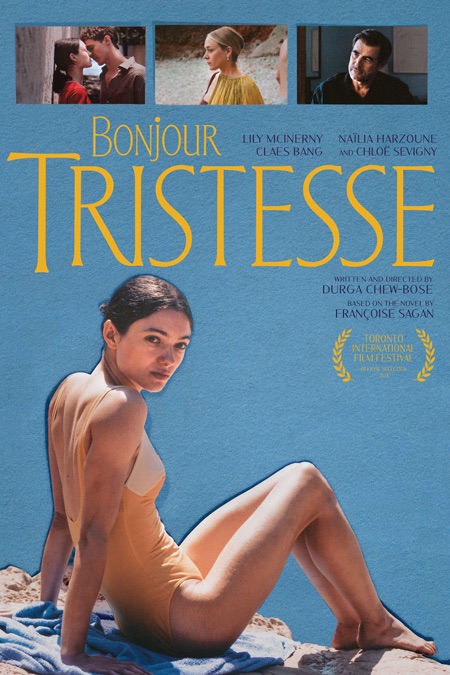
The dynamic force of nature is one of fire in Bonjour Tristesse where characterizations and risks burn through the screen rapidly. Directed by Durga Chew-Bose, her focus is one that blends challenges among individuals to a cinematically grueling extent. With Lily McInerny and Chloe Sevigny, both are actresses that develop a personality not to be messed with. McInerny takes on roles that challenge innocence and vulnerability. Bonjour Tristesse is a step-up for her after her performance in Palm Trees and Power Lines which was a hard-watch, but she endured a hard topic through humanistic approaches. McInerny is a woman of diverse behaviors as a growing star.
The setting is along a French seaside. The characters are Cecile (McInerny), her father Raymond (Claes Bang), and Raymond’s partner Elsa (Nailia Harzoune). Cecile also has boyfriend, Cyril (Aliocha Schneider). Cecile is an introverted girl who has close bonds with her father, her boyfriend, and Elsa. They spend their days in paradise enjoying the sunsets and having their social moments. The film’s scenery is vibrant with many wonderous colors. It weaves a notion that there is a form of positivity and lively connection —thanks to the many hours and days of sunlight and beautiful weather.
The joyful days hit a pause when an old friend comes for a visit. Her name is Anne (Sevigny) and she friend of Cecile’s late mother. When she arrives it becomes a ride where there is discreet frustration that lingers on in patterns. Anne has her moments of being judgmental and envious—she pushes Cecile’s buttons. Anne is a vocalist and has no filter on her view of people. Sevigny’s performance is one of sinister and opinionated tones. This begins to make Cecile build a quiet rage in her head. Bonjour Tristesse presents a form of tolerance forced to be reckoned with.
With the happy moments not always feeling the way they should, the representation of Cecile’s thought process makes her the center of the film. How does she feel about Anne? Why is Anne critical? What does Cecile want? What does Anne want? What I adore about the film’s focus is how the pacing raises in dramatics as the story moves forward.
The layout of routine encountering interruption presents that authenticity of one feeling as if their wishes are not being acknowledged. This is the case with both Cecile and Anne, as the film’s conflict follows back to them. The nosiness of Anne and the sensitivity of Cecile is a layer of human nature that creates enrichment in how they respond to situations of not feeling comfortable.
Bonjour Tristesse is relentlessly brilliant. The stalker personality in the performance of Sevigny along with the innocence (in McInerny’s performance) is of rapid fire. The writing is well-scripted to present that acceptance of a challenge that just further stirs the pot. Of all those involved, the ball is in Cecile’s courtand her aggravations are justified. Bonjour Tristesse creates a world of forbearance through undeveloped eyes. A tale of egos that thrive for attention—the ones in that boat are Cecile, Elsa, and Anne. Anne though, is the wheel of encouraging disconnect.
I appreciate the chemistry of “disconnect” in Bonjour Tristesse. That is because the sense of free expression is a surreal element of beauty. The humanistic denotations here are mounted intuitively. With looking back at McInerny’s performance, she has the personality and power to play roles that are in situations that do not seem right. However, she is also one that displays innocence where her thoughts matter. Every conflict, moment, and dynamic switch has honesty in Bonjour Tristesse. It is an arthouse of colors that weaves artistry and behaviors that continue to overlap one another and at the same time gives the presence of curiosity fully present in human aspects. Four out of four stars.
 Movies with Tarek