Category Archives: Film reviews

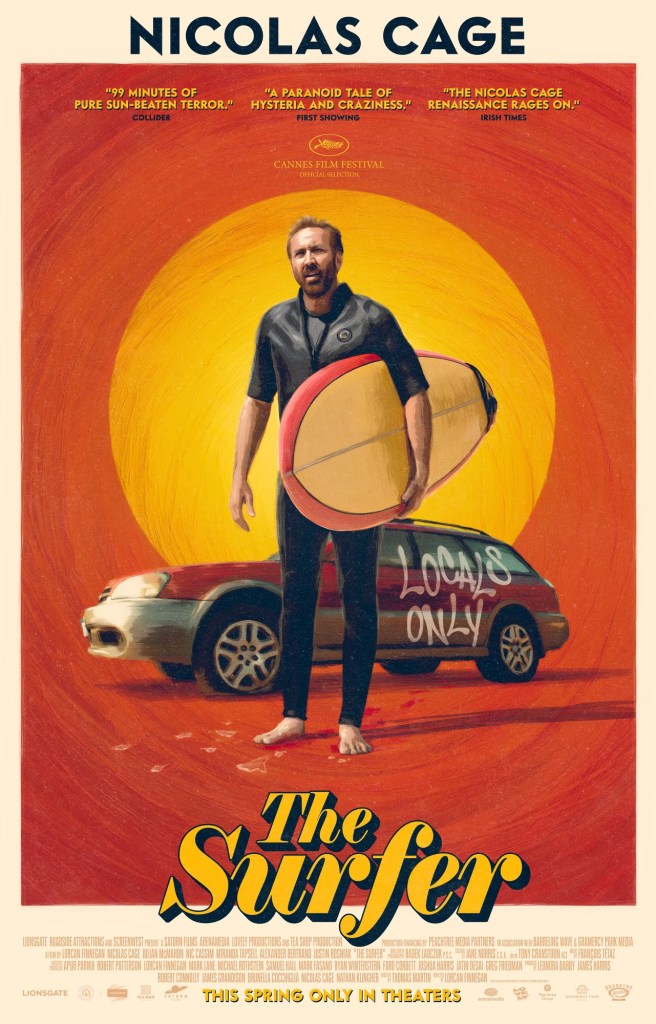
The Surfer Review


For Nicolas Cage, The Surfer is another flick where his egotistical and bipolar moments solidify lead to chaos. This dark comedy flows as it explores many aspects of an individual looking to fulfill his dreams. Along the way, The Surfer feels intuitive. Directed by Lorcan Finegan, this film is a fascinating portrait of a man hoping for his dream to become reality. Cage is the center of all of this. Throughout The Surfer, there are plot twists which become more enriching than the audience may see at first. To be clear, there is no surfing in the movie. Instead, I think of it as Cage “surfing” his way to establish a foundation on uncharted territory. In the early stages of his journey, there are plenty of obstacles. With Cage as the lead character, audiences know what he tends to deliver when annoyances come his way.

Cage’s character’s name is The Surfer. He takes his son on a surprise visit to his favorite beach that he grew up on. He tells his son he is going to buy a house so they can have many surfing adventures. Finn Little plays The Kid, the son. There are many issues that arise during their trip. The Surfer is in a bidding war on the home he wants to purchase. He is waiting for a call from a real estate agent and is all set to get the home of his dreams, which is the home he grew up in. To prove his commitment, The Surfer spends his days in his car awaiting this important call. From that point on, the movie is filled with adventure involving a bunch of odd characters and wannabes that cause things to boil to a breaking point.

What makes The Surfer quirky and attention-grabbing is all the crazy scenes. It is clearly uncharted territory when it comes to Cage’s performance especially when people keep telling him, “DON’T LIVE HERE…DON’T SURF HERE!” The comedy and dark fantasy in the film’s setup are compelling. The film’s writing makes Cage’s performance unravel like a bipolar dragon. When he does so, it is chaotic and silly but also relentlessly brilliant. This is the role for Cage, playing a man so angry that his first-world issue is not being prioritized. The Surfer is not gnarly because of the waves, but due to the treacherous plateaus in Cage’s character. Two-and-a-half out of four stars for The Surfer.

Thunderbolts* Review


In this film I saw a chance for a new story to emerge and continue to build purpose. Thunderbolts* has an approach that fuels the Marvel Cinematic Universe. A sense of restoration lies ahead. Directed by Jake Schreier, the film is written by Eric Pearson and Joanna Calo. The many filmmakers behind Thunderbolts* loops in enticement that creates an immersive moviegoing experience.  Thunderbolts* may seem whacky at times, but the characterizations build upon each other as a new team arises.

The film begins with a group of antiheroes. They are Yelena Belova (Florence Pugh), Robert Reynolds/Sentry (Lewis Pullman), Bucky Barnes (Sebastian Stan), John Walker/U.S. Agent (Wyatt Russell), Alexei Shostakov/Red Guardian (David Harbour), and Ava Starr/Ghost (Hannah John-Kamen). They all come to the realization that they are the targets of a trap. This leads them into a mission that will bring up a bad and rude awakening. With one questioning lead, there might be more for these heroes than they anticipated. Valentina Allegra de Fontaine (Julie Louis-Dreyfus) appears to be the enemy of what is at stake and one to watch out for.

For this new feature, I felt the dynamics come together to realize there is a greater good. A lot of the quirkiness is between the performances of Pugh, Harbour, and Russell—they all have that spark that gains momentum from each other’s senses of humor. There is a foundation combining power to build resilience for the moments ahead. Thunderbolts* is not spectacular, but the layout of who to root for plays a vital role in the film’s continuity, and it is unstoppable.

Overall, there is a sense of curiosity. The film begs the question of why these heroes are the ones that are the targets? Why are they the focus? The proper answer to these two questions is because they all still have uncharted territory to learn. Much of that comes from the politics that interweave throughout the filmand this is where the enemy Valentina comes up as the red flag.

It is not exactly filled with action and explosions, but it evokes a value of laughter in its nature. This is of course in the good sense. Thunderbolts* is a title that is a springboard for new adventures to be movie-bound later down the line. Sparks for attention and excitement spiral the film’s humor. The butting heads of the heroes are just the beginning. Thunderbolts* is a landscape for powers to keep growing and have an exploration that develops immersive components.

Deep down, much of this film finds its brilliance in being written with the trust of no one single direction.   Audiences can sense a portrait of frustration or annoyance within the heroes. That alone, is the sign that some may be on the side its audience is hoping for, and some may not. Altogether there is a resolution of expectations that throttles the fun of Thunderbolts*. A Marvel film almost making it to the brilliance spectacle, but not quite there. An excellent start to building more character development. Three out of four stars.

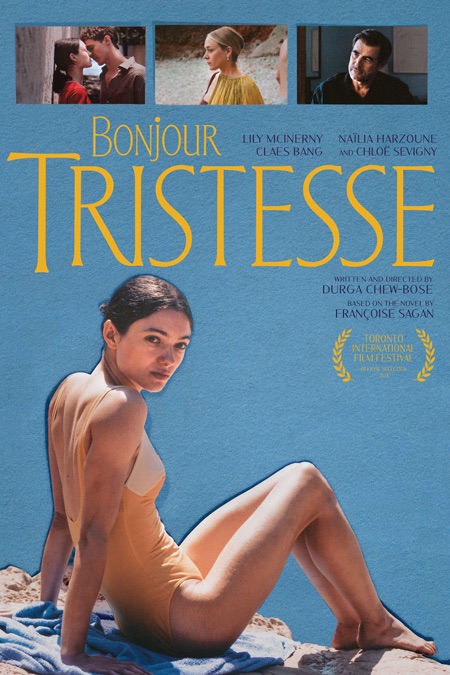
Bonjour Tristesse Review


The dynamic force of nature is one of fire in Bonjour Tristesse where characterizations and risks burn through the screen rapidly. Directed by Durga Chew-Bose, her focus is one that blends challenges among individuals to a cinematically grueling extent. With Lily McInerny and Chloe Sevigny, both are actresses that develop a personality not to be messed with. McInerny takes on roles that challenge innocence and vulnerability. Bonjour Tristesse is a step-up for her after her performance in Palm Trees and Power Lines which was a hard-watch, but she endured a hard topic through humanistic approaches. McInerny is a woman of diverse behaviors as a growing star.

The setting is along a French seaside. The characters are Cecile (McInerny), her father Raymond (Claes Bang), and Raymond’s partner Elsa (Nailia Harzoune). Cecile also has boyfriend, Cyril (Aliocha Schneider). Cecile is an introverted girl who has close bonds with her father, her boyfriend, and Elsa. They spend their days in paradise enjoying the sunsets and having their social moments. The film’s scenery is vibrant with many wonderous colors. It weaves a notion that there is a form of positivity and lively connection —thanks to the many hours and days of sunlight and beautiful weather.

The joyful days hit a pause when an old friend comes for a visit. Her name is Anne (Sevigny) and she friend of Cecile’s late mother. When she arrives it becomes a ride where there is discreet frustration that lingers on in patterns.  Anne has her moments of being judgmental and envious—she pushes Cecile’s buttons. Anne is a vocalist and has no filter on her view of people. Sevigny’s performance is one of sinister and opinionated tones. This begins to make Cecile build a quiet rage in her head. Bonjour Tristesse presents a form of tolerance forced to be reckoned with.

With the happy moments not always feeling the way they should, the representation of Cecile’s thought process makes her the center of the film. How does she feel about Anne? Why is Anne critical? What does Cecile want? What does Anne want? What I adore about the film’s focus is how the pacing raises in dramatics as the story moves forward.

The layout of routine encountering interruption presents that authenticity of one feeling as if their wishes are not being acknowledged. This is the case with both Cecile and Anne, as the film’s conflict follows back to them. The nosiness of Anne and the sensitivity of Cecile is a layer of human nature that creates enrichment in how they respond to situations of not feeling comfortable. 

Bonjour Tristesse is relentlessly brilliant. The stalker personality in the performance of Sevigny along with the innocence (in McInerny’s performance) is of rapid fire. The writing is well-scripted to present that acceptance of a challenge that just further stirs the pot. Of all those involved, the ball is in Cecile’s courtand her aggravations are justified. Bonjour Tristesse creates a world of forbearance through undeveloped eyes. A tale of egos that thrive for attention—the ones in that boat are Cecile, Elsa, and Anne. Anne though, is the wheel of encouraging disconnect.

I appreciate the chemistry of “disconnect” in Bonjour Tristesse. That is because the sense of free expression is a surreal element of beauty. The humanistic denotations here are mounted intuitively. With looking back at McInerny’s performance, she has the personality and power to play roles that are in situations that do not seem right. However, she is also one that displays innocence where her thoughts matter. Every conflict, moment, and dynamic switch has honesty in Bonjour Tristesse. It is an arthouse of colors that weaves artistry and behaviors that continue to overlap one another and at the same time gives the presence of curiosity fully present in human aspects. Four out of four stars.