A magnificent film on an unforgettable print. This film one presents surreal empathy in a Western classic that will be remembered for ages. The festival opened with The Searcherson a 70 MM projection print. From the visionary mind of John Ford, The Searchers helped me appreciate how captivating realism is when displayed cinematically. With John Wayne (as Ethan Edwards), Jeffrey Hunter (as Martin Pawley) Vera Miles (as Laurie Jorgensen), and too many others to name, The Searchers is a boiling ride of tension and choices that I forgot existed. The print format and the array of confrontational moments in the western setting made me feel like I was in a time machine. There is nothing like viewing an essential film in the correct format. The Searchers on 70 MM print was truly one of the most spellbinding portraits of moving images I have ever experienced at Ebertfest.
This is a sequel that I was quite surprised by. The Accountant 2 keeps the level of suspense on par with The Accountant. The difference is that this version highlights bonding and there is a lot more breaking of the ice between the film’s two main characters. Ben Affleck is back as Christian and Jon Bernthal returns as Braxton—two brothers living the high-life based on their talents as criminal masterminds. The result is a solid sequel for The Accountant 2.
As someone on the spectrum, my appreciation for this film grew due to the focus on neurodiversity which was highlighted in Affleck s performance. The first one created a foundation, but this time the film has those on the spectrum taking part in technological operations. The subject of sensory struggles finds a light and is shown to help in some circumstances. Despite some of the risky issues involved, the film fuels anarchy for a cause. The challenges and benefits of neurodiversity take on a larger presence with greater meaning in The Accountant 2.
The film begins with Treasury Agent, Marybeth Medina (played by Cynthia Addai-Robinson). She finds herself trying to solve a mystery surrounding the killer of her former boss which Christian and Braxton are linked to. Christian continues his solitary routine and his patterns with diverse activities. He also continues to thrive on numbers and accurate systems. Christian still has a brilliant mind but gets ugly if he must. Braxton, on the other hand, is still lethally violent, but is also lonely and obsessed over getting a dog.
The Accountant 2 is well written, especially when it comes to living a life of solitude with a low profile. I appreciate that many who are neurodiverse tend to establish a small presence. As the brothers team up to hunt down the killer, Christian’s fixations come into play. He is straight-forward with numbers, facts, laws, and knowing which moving parts are wrong. His methods are all by the book. With Braxton, however, mayhem tends to kick in too easily. The bond of brotherhood becomes stronger while chasing down bad guys in The Accountant 2.
The love/hate relationship combined with espionage is where The Accountant 2 succeeds as an acceptable sequel. Most of the time sequels are not mesmerizing. This one was because of the sibling connection. Affleck’s character uses his sensory overload to his benefit and success, and Bernthal’s character capitalizes on the chaos. Together they are dynamite duo.
During their mission, there are many questionable moments.They go from state to state and country to country which adds intriguing layers which compliment the movie’s theme. At the same time, some of the places in the film are fascinating while others are not. For example, the setting of Boise, Idaho is the right place for solitude after the events of the previous film. When the setting switches to Virginia and an institution of neurodiverse workers, that also fits this sequel well. However, the international setting of Berlin, Germany didn’t fit as well. Although, perhaps adding different countries provided another layer of exciting tactics to the film.
The Accountant 2 is vivid and joyful. The humor is spot-on as is the suspense which combine for an unforgettable continuation. A few moments were flawed, but the film stays on track to keep the fascination alive. Three-and-a-half out of four stars for The Accountant 2.
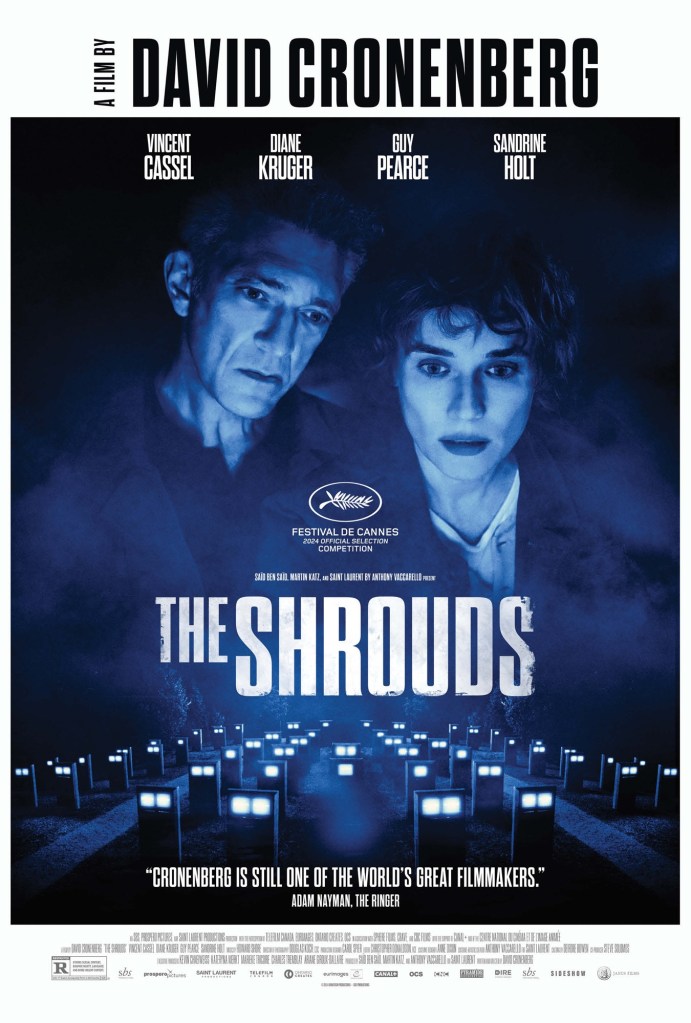
From director David Cronenberg, comes a unique masterpiece where science and technology create a new form of suspense. The Shrouds is by far one of the most invigorating portraits where evolutions of technology are in advance of greater things. The writing and setup are so clear in its context of an environment of artificial intelligence and a lot of connectivity that is out of this world. Cronenberg has always had an eye for making films that are ahead of their time. While creating his many projects he always develops a twist or multilayers for perspective…everything happens for a reason. Karma is woven into a theme of growth that mingles with other detrimental factors—The Shrouds is unstoppable.
I have had many of my Cronenberg experiences on the big screen. They were moments that were meant to be in that format. I felt I was in the TV world of Videodrome at the Music Box Theatre. I felt like I was in the many car scenarios of Crash at the Gene Siskel Film Center, and I came face-to-face with a restored print of A History of Violence at Doc Films Chicago. All these moments were ones restored in 4k or presented in film. Cronenberg’s eye for directing have always unveiled cinematic wonders for me and reminded me to remember to go into his films with an open-mind. A very wide “open mind” is essential with The Shrouds.
The Shrouds brings the viewer many years into the future. Its main character is Karsh (played by Vincent Cassel). He is a widower and owner of a graveyard company called Grave Tech. He sells his clients grave sites and tombstones to view the remains once they are buried. Karsh overlooks the remains of his deceased wife, Becca (played by Diane Kruger). He examines her body decaying and her bone structure. This is his coping mechanism to help him deal with his loss. While moving forward he looks to expand his business as the world evolveswith the growth of different technologies. His sister-in-law is Becca’s twin sister, Terry (also played by Kruger). His other family connection is Maury (played by Guy Pearce). As Karsh is grieving, he is also working to utilize his grief to better his business at Grave Tech.
The scientific blend of continuity is top-notch and surreal in The Shrouds. The lines of new generations are in the works when suddenly everything changes when Karsh’s cemetery is attacked. With Maury, he tries to put together the pieces of technological elements to find the answers. Maury is adept with coding and decrypting aspects. The Shrouds becomes a search for conspiracy while also maintaining professionalism. However, Karsh’s ego and loss begin to alter his choices, especially when it comes to how he puts his own technology to use.
The search for answers is where the film becomes a thrill ride of connectivity and rivalry. Cronenberg pushes the aspects of ownership to the extreme in The Shrouds. With the technology of Karsh being altered to observe his deceased wife, he begins to backlog who he is associated with to paint a better picture of what happened. He wants to get an understanding of what he might be dealing with in a time when the minds of professions and politics are altered. Cronenberg presents the pattern of self-creation and entrepreneurship to fulfill a destiny of peril.
There is the saying in the film which goes, “visceral urge!” This is saying is one that I felt throughout The Shrouds. I felt this perspective in a tone that is two-sided. One side had me wondering about Karsh’s grief, and the other about who he is associated with. Becca’s death impacts him in a subtle yet enticing matter. On the other hand, he has many political factors to take into consideration of what he might be dealing with. The connection to countries such as Japan, Iceland, and others playsa political role in his partnership aspects. His grief is one that is presented to bring modernization to more places. Deep down though, there are a lot of other problems he may not be aware of. The Shrouds has a pattern of questioning its characterizations ina haunting direction.
With all the underlying factors weaving suspense in a universe far into the future, this is one of the most resource-focused films I’ve seen from Cronenberg. Many questions will surface throughout this extraordinary and thought-provoking journey. What is right about Karsh’s choices? How trustworthy are Karsh’s actions? What resources have stronger correlations? Cronenberg’s writing creates depth in the character of Karsh being determined to make science come alive through the heart of lost ones and create an existence of connectivity.
The Shrouds is one of the most abrasive and vivid works of creativity that I have seen from Cronenberg. The grieving aspect is what is abstract, because science and evolving technology (after the death of a loved one) turn the tables rapidly. Its writing generates a feeling of disconnect which fuelstones of something sinister. A lot of this is portrayed through the performances of Cassel, Pearce, and Kruger—they are the ones at the center who are connected most to what is bound to be impacted. The Shrouds is a story of a race for answers in a world where politics and many professions are blindsided by the pace of technology. It is a thriller where the moral is to trust no one, and do not look back. Four out four stars for The Shrouds.


 Movies with Tarek