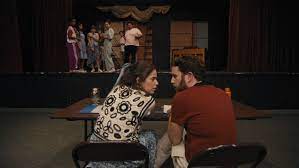
White Noise Review


White Noise is a film directed by Noah Baumbach. It is one of his first films that is a book adaptation. It is much different than what audiences are used to from his previous projects. The film begins with actor Don Cheadle doing a lecture on cinema arts. Baumbach is known to start his films with characters that have intellectual mindsets. The beginning of White Noise also showcases the traits of characters related to some of Baumbach’s previous projects. Baumbach always knows how to make the smart characters problematic in his films. Adam Driver plays a college professor and is the king of strong words in White Noise. This is one of the film’s lighthearted features which plays into the quirks and frustrations of the characters in this dark comedy about an apocalypse.

White Noise has that classic family vibe in a bizarre way. The family is quirky and their dynamic is off. The town the movie is set in is retro. Baumbach’s approach to sci-fi adds more than enough detail. His setting is saturated and despite its comical scenery, it fits the mediocre apocalypse that is the center of the film.

White Noise takes place around a contemporary American family setting. The audience is introduced to Jack Gladney and his wife Babette (played by Adam Driver and Greta Gerwig). Jack’s career as a professor in addition to his responsibilities as afather become problematic. Jack teaches theoretical types of courses most of which discuss history and Hitler. His colleague,Murray Siskind (played by Don Cheadle), teaches the same types of courses. Their theories of voices and communications are subjects of debate between them, and their strong revelations grow into an apocalypse.

The film reveals that the town is at risk of toxins. A train disaster marks the start, but despite the severity of the situation, Jack and Babette act like their children should not be concerned for their safety. White Noise is presented in Baumbach’s interesting mode of characterizations. He does not follow a serious approach (as many would assume). The clouds set the problems in motion and the danger warning is “Cloud of deadly chemicals.”However, there is more danger than just the environment being at risk in this film.

Jack and Babette evaluate the situation with their children and try to remain subdued. White Noise is a journey of a family adapting to a natural disaster. In some scenes, the conflicts are mediocre at best. The crazy and entertaining scenes are when additional life-problems evolve after discovering the dangers of the toxic events.

With all the silly tangents in White Noise, the movie hasBaumbach’s signature style. That style includes the family sticking together, no matter how challenging their circumstances may be. That reminded me of his previous films like The Squid and the Whale (2005) and Marriage Story (2019). Of course, those were more serious films. This time around, audiences canexpect to laugh more because the responses to shocking discoveries are not so upsetting.

White Noise does have some bigger conflicts. Its quirkiness, however, continues throughout the film. This could be an end-of-the-world scenario as Jack and Murray even tie their theories to the apocalypse. Do their theories mean anything positive? White Noise is a film of revelations all due to one chaotic disaster. It is not great but still offers an enjoyable time. Three stars for White Noise.

The Son Review


Depression is a normal human emotion. Some people struggle with depression and others are better able to handle it. Director Florian Zeller puts us in a world of depression in The Son which is an honest and faithful film that is about a teenage boy’s emotional distress. The filmis realistic in its portrayal of life as it authentically illustrates how feeling down can be a challenge to accept. The melancholy is highly saturated throughout the story.

I had difficulty with The Son at various times. The concepts of sadness and anxiety were the two factors that made me feel especially emotional. The Son reminded me of what it can feel like to be down about aspects of life. Given all the downer moments in the film, I wasalso reminded of how important getting help is.  It is clear, however, that the ones we love most may have to make tough decisions sometimes and those who are suffering may take offense to those decisions. By making these difficult decisions, the hope is to help the people we love ultimately live a better life.

In The Son, audiences are introduced to Nicholas (played by Zen McGrath). He is a teenage boy with divorced parents in New York City. He ditches school and begins to show signs that concern his mother Kate (played by Laura Dern). Nicholas then begs to stay with his father Peter (played by Hugh Jackman). Peter is remarried, and his new wife is Beth (played by Vanessa Kirby). Nicholas changes schools, and his dad tries to help him out. Nicholas acts like he is improving, but he is not well and hides his emotions. Peter and Kate do not know how to help their son. Even Peter’s father (played by Anthony Hopkins) does not know how to give Peter advice. Unfortunately, Peter’s father is self-absorbed and fails to admit to his own mistakes during Peter’s childhood. With all the tensions, frustrations, and worrisome factors, The Son is psychologically disturbing. The level of Nicholas’ sadness causes confusion and many questions for Kate, Peter, and Beth.

The Son paints a vivid portrait of mental health challenges and displays Zeller’s vision of realism as a director. Zeller knows how to grease the wheel of stress and apprehension in The Son. In a few fragments, Nicholas is shown in an average mood. There are moments where it seems he has more confidence in himself, and his father becomes immediately impressed. The essential ingredients to Nicholas’ mental health tend to come to a halt due to shocking discoveries by his parents. These scenes are portrayed with honesty and are familiar to those familiar with depression.  People who fight depression tend to keep covering their tracks and hiding their real problems. Can Nicholas stop lying to himself?

The Son left me with mixed emotions. I liked it for its realism, but its focus on mental health was hard for me to handle. Nicholas’ parents simply want their son to be happy. Despite how concerning Nicholas’s feelings may appear, tough love may have to come into play to help him recover.

The film left me quite down, but it reinforced the importance of my life. It reminded me of who has helped me to get my life back on track when I’ve faced troubles.  It also reminded me of the fundamentals of family. In the end, it is all about what people can do to help those they care about pick themselves up. Three stars for The Son.

Women Talking Review


This film about a bunch of ladies questioning faith is like a melancholy version of 12 Angry Men (1957). With five female roles it could have easily been titled 5 Angry Ladies instead of Women Talking. The movieis all about women being honest and accepting reality. From my perspective, its dramatic irony is a bit exaggerated. Women Talking explores a variety of problems, but in the end, it just feels like a long debate amongst the women involved.

The film takes place in 2010. The setting is in a deserted religious community. The ladies are Ona (played by Rooney Mara), Salome (played by Claire Foy), Mariche (played by Jessie Buckley), Scarface Janz (played by Frances McDormand), and Agata (played by Judith Ivey). Women Talking challenges the ladies to come to terms with reconciliation with their experiences of sexually assault. Some recall being assaulted, some question if they were assaulted, and some question their faith. As the ladies discuss their encounters, the film covers a complex landscape of right and wrong with religion as a backdrop.

I found myself suffering some boredom during Women Talking, but it subsided as the conversations became more deliberate. The film displays a willingness for truths to be revealed as the intensity builds. The revelations come to a halt, however, because of the mixed conversations and unwanted comparisons between the ladies.

What enthralled me the most with Women Talking is the in-depth dialogue. The film’s writing is emotionally eloquent. Writer and director Sarah Polley exhibits seriousness delivering this performance. Women Talking is a worthy film given the voices it gives to its characters played by amazing talent. In the film Mara’s character asks, “Why does love—the absence of love, the end of love, the need for love—result in so much violence?” That question is direct and carries a strong narrative throughout Women Talking. The topic of sexual assault is never an easy one and the subject matter may be hard for some to take in.  My appreciation for Women Talking stems from the opportunity to have the ladies be heard. The story is about them opening about their experiences while also using reconciliation as their savior. The film portrays the many wonders of personal evolution.

Women Talking requires attention at first. The initial approach is quite dry, but eventually it begins to captivate. Women Talking is pervasive in references to cultural and religious factors. When the more difficult topics came into the discussions, I began to find myself more hooked on the film and asked myself a lot of questions. Why are the ladies admitting to what they are guilty about? Why are they hiding the fact that some were assaulted? Do they truly feel their life is at risk due to religious beliefs? The conversations that were unsettling made my head spin, but those topics that are hardest to hear in Women Talking make the movie. Three stars.

Treating cinema in many forms of art!