Tag Archives: Film reviews

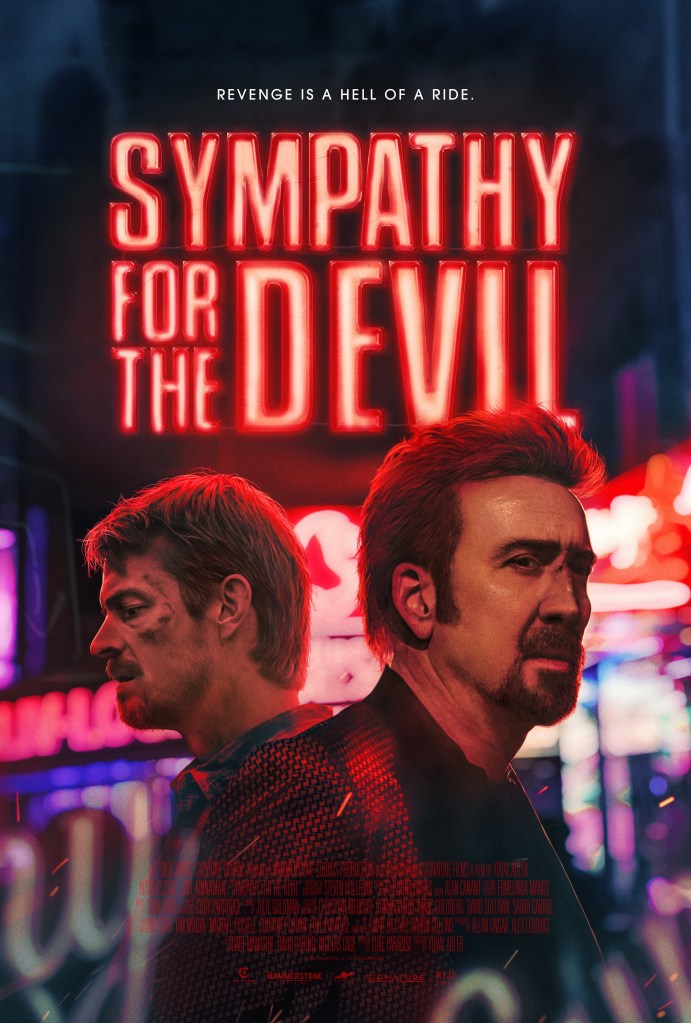
Sympathy for the Devil Review


In the beginning of Sympathy for the Devil, there is the presence of a man with struggles which gives a vibe of noir direction. That approach gets the audience prepped for dangerous and unexpected moments. The famous saying, “What happens in Vegas stays in Vegas,” comes to mind as the unsettling tone in the film gets eerie. Sympathy for the Devil is different in the way it finds its terror because it is based on personalities and characterizations which add shock value instead of violence. Evil does reign, however, but is created through the film’s suspense.

The film focuses on The Driver (played by Joel Kinnaman). He has a wife that is in hospital and is due to have a baby. The Passenger (played by Nicholas Cage) gets into The Driver’s car. The Passenger asks The Driver to, “Pick a card,” and when a card is selected, The Driver becomes the new hostage of The Passenger. Viewers know there is going to be some unsettling moments when The Passenger scarily says to The Driver, “I’m your family emergency now!” Cage’s portrayal of the bad guy isenhanced with demonic looks and his attitude causes tensions to rise. The Passenger wants The Driver to drive him from Las Vegas to Boulder City, but there is no explanation to why. This means that The Driver’s life may be on the line. With The Driver being extremely anxious and scared for his life, it is literally as if the Devil has found The Driver. The Devil is Cage himself.

Ominous music plays in the background of this scary journey. The choice of music keeps thae noir vibe in tune and the horror feels more real as it deepens. Cage’s performance as The Passenger ranges from normal to condescending and vicious. The more he talks, the worse it gets. The farther they go, the worse the danger becomes. The Driver is put to the test of survival. Kinnaman’s role is one of perseverance and bravery, but it may not be enough to survive Cage’s role of mayhem and danger.

Cage’s outbursts are surreal and intriguing, which add to the suspense. His performance proves his evil side is no joke in Sympathy for the Devil. The chances of escape for The Driver are slim because he has no idea what The Passenger is capable of until he does something dangerous. Evil is real in Sympathy for the Devil. The tension is not only due to the wicked nature of Cage’s character, but also the stories he tells before each dangerous scenario which all contain something explosive.

In all honesty, there is no sympathy in Sympathy for the Devil. It is just a predictable flick. I do give it credit for bringing back some classic road trip vibes of horror. Otherwise though, the fascination in this film is not all that remarkable. Cage’s performance is the only real place that killer fun lies in this flick. Two out of four stars for Sympathy for the Devil.

Heart of Stone Review


Actress Gal Gadot is beautiful and she is always cute and adventurous in her roles. Of course, she played Wonder Woman, and she can tackle all kinds of suspenseful roles, whether they’re psychologically suspenseful, violently suspensefully, or mysteriously suspenseful. She also has an aptitude for spy thrillers. But I just wasn’t sold with her role in Heart of Stone, or the film as a whole. The title Heart of Stone and the film’s introduction are almost like a 007 experience—like Gal Gadot in Tom Cruise mode. That may seem like a good thing, but it just doesn’t work in Heart of Stone.

In Heart of Stone, Gadot is Rachel Stone, an intelligence operative for a peacekeeping agency that flies beneath the radar. A mission goes wrong, and there is hacker who is trying to steal a weapon that could threaten the world. Stone has a team of people ranging from Parker (played by Jamie Dornan), to Jack of Hearts (played by Matthias Schweighofer), and more. But choosing sides or figuring out who to trust in Heart of Stone is hard. The concept of the film is for the characters to trust no one, but the film just doesn’t pull it off.

Hacking and artificial intelligence are frequent topics in Heart of Stone. There are some invigorating plot points that revolve around those two elements, but the film doesn’t do justice to either topic. The importance of the hacking and AI is to remind audiences that the peacekeeping agency is discreet. But other than those two elements there is not much to say about the film’s technological components. And even those elements don’t really benefit the film or its plot. Frankly, the film is somewhat of a mess, with many elements that don’t seem to find meaning or connection to the plot.

To further elaborate on my boredom with this film, it is probably more because of how it keeps jumping to car chases, dangerous mountain scenarios, and all kinds of rollercoaster disasters. Those are fun in a blockbuster, but in a spy thriller I want more details and emphasis towards where the danger lies. Heart of Stone struggles to do that. The film just relies too much on explosions and anarchy.

I wish I could be more positive, but it’s not coming easy with this one. Although seeing Gadot in a film is always a positive, and her appearance and performance in Heart of Stone are what is most memorable about it. She didn’t come close to making up for the rest of the film.

This is simply one of the biggest disappointments of the summer for me. A poorly made thriller trying to seem like a 007 movie. More of a nuisance than a great experience. It had some brief, interesting moments in its plot, but the rest, to be blunt, is garbage. Just two out of four stars for Heart of Stone.

Anchorage Review


There comes a time when actions have consequences. Rage, power, and imagination are all featured in Anchorage. Directed by Scott Monahan and written by Dakota Loesch (Monahan and Loesch are also the two leads in the film), this is an independent film that goes above and beyond with displaying the realism of drug addiction. Anchorage is powerful in the way it portrays the life struggles of two brothers who are drug addicts and only have each other. Sadly, both are out-of-control with their substance abuse habits. 

The film focuses on two brothers, Jacob (Monahan) and John (Loesch). The brothers drive from Florida to Alaska with aspirations based on their trunk loaded with opioids. They have it in their head that they will be rich based on the money they can make selling drugs. However, they make choices on the road that cause legal challenges. As the brothers hit the deserts of California, arguments grow into catastrophic moments. They keep getting more destructive and violent as their resentment towards each other builds. The message of Anchorage is clearly that there are consequences with addiction. It is poetic due to its realistic depiction of what happens when control is lost due to drug abuse.

There is a backdrop of conflict that flows throughout Anchorage. The audience will begin to realize who is smarter during the road trip. The film is often unsettling and depressing. The experience of Anchorage makes the screen burn with hatred and tough love. It becomes clear that Jacob and John feel that opioids are their only shot to get by in life and create new beginnings. The truth is that they will only create more hardships for themselves pursuing this path. The film’s cinematography lights up the screen with strong reactions from the impact of the drugs. It is an emotional rollercoaster that is uncomfortable but also connecting.

Ultimately, it is the brotherhood theme of Anchorage that reinforces the irreparable consequences to the brothers’ decisions.  Jacob cannot do anything with John and John cannot do anything without Jacob. Their life of thrills has many ups and downs fueled by opioids. Anchorage dives into the challenge of not being able to leave family, even in tough love scenarios. It is a portrait of inevitable actions which gets to the point where it is clear that Jacob and John will not ditch each other, but go down together, or die trying.

The desert surrounding Anchorage is the location of the film’s chaos. The empty lands are the ideal setting for the growing tensions between Jacob and John. Their feeling of freedom only fuels their destructive behavior.

Anchorage is one of the most detrimental, yet realistic experiences in an independent film I have seen in years. The writing is strong, and the budget is limited. The story involves crossing boundaries as it applies to going over the limit with the use of opioids. It is also a faithful portrayal of how drug abuse damages brain development. Anchorage is a revelation that is difficult to watch in parts and has outcomes that are hard to accept. In the end, it all makes sense based on the build-up of chaos during the brother’s damaging journey. Three and a half stars out of four stars.