Tag Archives: Film reviews

Never Let Go Review


Halle Berry as Momma in Never Let Go

What crosses the minds of its audience are the terms minimalists and survivalists. Directed by Alexandra Aja, Never Let Go brings its viewers to a universe of a questioning quarantine scenario. They are happening for reasons with no clarification. Around the setting is a mother with her two sons. They have a cabin in a forest. They are all brainwashed.

The main characters are the mother and her twin boys. The mother in the film is Halle Berry, and her two sons are Samuel and Nolan (played by Anthony B. Jenkins and Percy Daggs IV). For the boys, their mother keeps them quarantined because of her beliefs in evil spirits lurking around them. She always has them tie themselves on a rope whenever they leave home. The family is always fighting for survival. Their supplies are limited.

The pressure of the boys is a lot to bear. The writing is drastic in terms of doom. Never Let Gois fueled by the anxiety factors coming from the mother. It gets to a point where one of her sons’ questions are accurate and inaccurate about their lifestyle. As the days of feelings of nourishment take a toll, the bigger picture comes out with Never Let Go. It is audacious and overwhelming. Loyalty and love are certified. Also, seeing what is on the outside is on the line.

The grappling of the dynamics continually tries not to go out of its elements. There are shocking moments of what can be treacherous in Never Let Go. It delivers the moments for its audience to think of the two words, “Stay inside.” It does that repeatedly. With that, there are layers of boredom that do not suffice. The sacred aspect of remaining alive has a continuity that is lacking. Where is the evidence of the terror? Why is the mother so brainwashed? Is the mother trying to protect her children? Is she able to protect them? Are there discrepancies that the boys are not aware of? Never Let Go brings in the thoughts of what would come around if anyone (in the family) decided to let go.

The dynamic between Samuel and Nolan finds itself at the center of conflict. One thrives to see what is on the outside. And the other is destined to remain in quarantine. However, remaining in quarantine leads to a lack of nourishment. The chance of living a longer life is likely if there is a means to escape their environment. Even with this clashing factor, its approach is muddy. It is overly dramatic, has rushed suspense, and whatever caused the problem remains a mystery.

The mode of peril remains deep. The premise has chilling factors. Regardless, it remains in disarray. The evolution of finding the answers to what is right and wrong continues in shambles. It goes from a heavy influence of protection to many brainwashed catastrophes. “Brainwashed catastrophes” that make the brothers go into hysterics compulsively.

As the film relies on ropes tied to its characters, there is hope for more personification. There are small amounts of it, but only in the context of life or death. That is even improper in the flow of Never Let GoNever Let Go is a terrorized boredom with a lack of sophistication. Two out of four stars.

Speak No Evil Review


This is a clever remake. It paces itself and builds on the aspects of kindness. All in all, though, it is just average. Speak No Evil is a remake of the 2022 Danish film with the same title. The Danish version was more realistic. This version has some intriguing parts, but not enough to sell its building curiosities which keep the audience asking what and why are the events in the film happening. It is written and directed by James Watkins. This is his most recent feature-length film as a director since The Take (2016). Watkins’ direction of Speak No Evil is subtle, yet passable as a psychological and horrific picture.

The film focuses on a family. The family consists of a set of parents, Ben and Louise Dalton (played by Scoot McNairy and Mackenzie Davis). Ben and Louise have a daughter named Agnes (played by Alix West Lefler). They are invited to spend a weekend getaway at a home offering solitude in the countryside. They are hosted by another family whose parents are Paddy and Clara (played by James McAvoy and Aisling Franciosi). Their son is Ant (played by Dan Hough). Both the kids have struggles, and both sets of parents feel the getaway will be a great escape for everyone. However, unusual episodes begin to arise. 

The film has set of dynamics in which parenting plays into the disturbing suspense. Normalcy is part of the context in Speak No Evil, but there is not much in this film. Questioning conflicts and concerning patterns of behavior are looped into the storyline especially in the scenes where Ben and Louise realize that Paddy’s parenting towards Ant is belittling and abusive. They also find themselves clashing as parents. The egos and expectations hit points of conflict that are intense enough to boil into a mental and physical rampage.

The question being asked by viewers throughout Speak No Evil is, “Are these families safe?” Is there a reason for episodes of weirdness and bizarre behavior to continue? The fact that the family is overseas ends up being beside the point as more shocking discoveries are made. It turns out that there is evidence below the surface that Ben, Louise, and Agnes are not aware of. 

The focus of concern becomes the actions of Paddy, in an effective performance by McAvoy. He goes on an angry tirade over even the most minor actions in various scenarios. Paddy also takes many issues extremely personally. This happens frequently in the parts when Ben and Louise express concern. When they do that, he dismisses it. The flow of the characterizations is looped into misdirection which results in increased chances of peril.

Speak No Evil is one of those remakes that rapidly delivers disturbing suspense. In the end, it is quite predictable. However, it provides an escape for some entertaining action at the movies because it’s a fun thriller to kick off the Halloween season. Overall, I rate Speak No Evil three out of four stars.

His Three Daughters Review


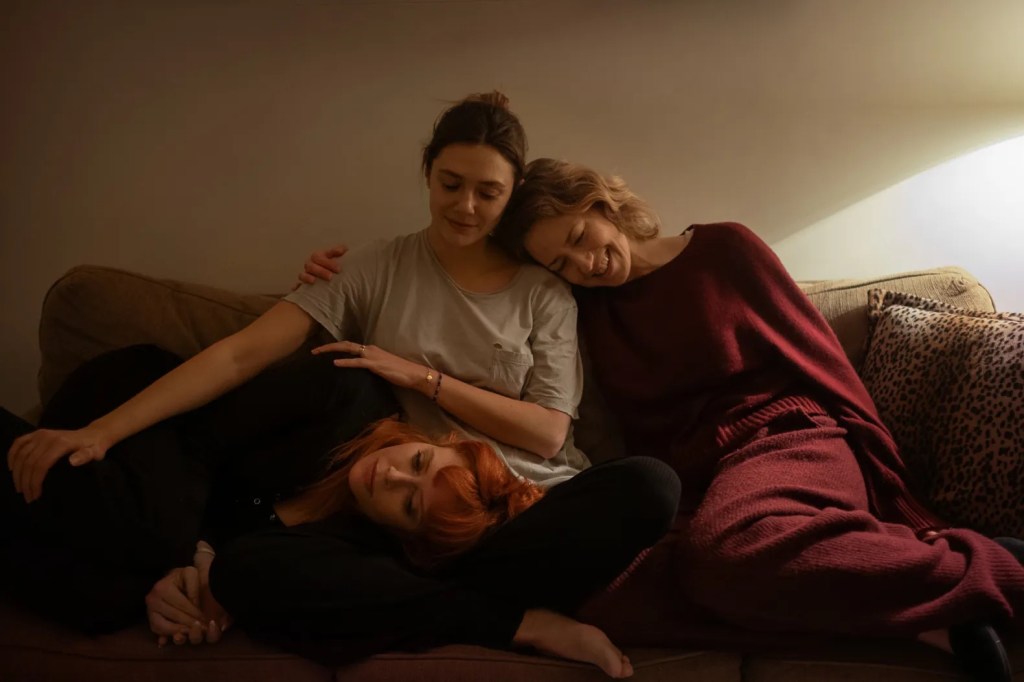
This film spotlights three sisters working to come together during a time of pain and grief– spiraling many emotions of regret, shame, jealousy, confusion as well as agreements, disagreements, and connections. His Three Daughters takes all those concepts and forms them into one life-changing and complex scenario. It does so with a flow of writing that is faithful to human feelings. His Three Daughters is a narrative that knows how to keep its focus—keeping the three sistersworking together despite their differences with the patterns shifting and spiraling authentically. Carrie Coon delivers many of the long speeches in the dramatic scenes. I have seen Coon in Steppenwolf Theatre productions in Chicago. Coon’s performance in His Three Daughters brings out her determined and theatrical presence to the finest level. Natasha Lyonne plays a role common to her quirkiness in The American Pie franchise. Lyonne though, shifts this one to have silly sides within her, while dealing with a serious situation. Then there is Elizabeth Olsen.  We are used to seeing her in Marvel films, but her breadth of roles has gotten more serious and fulfilling. After her performance in the HBO Miniseries, Love & Death, her monotone personality has shifted thought patterns in an exhilarating matter.

In His Three Daughters, Coon is Katie, Lyonne is Rachel, and Olsen is Christina. They are three sisters who are trying to be with their father at his home in New York to aid him until he passes. This is not an easy task, and one where tolerance and many moving parts are mentally taxing. Katie is the sister that is eager and setting all the blocks up to honor her father after his death. Rachel has always been in their father’s home and provided a lot for him before his health got worse. With Christina, she is just there to make each moment for their father comfortable. Their father is Vincent (played by Jay O’Sanders). The dynamics of the sisters take all kinds of paths. Rachel smokes weed and gambles continuously, Katie keeps being provoked by Rachel’s poor etiquette, and Christina is just trying to see things through properly. His Three Daughters is a revelation of how families can feel in the times where they are about to lose someone. Mindfulness flows through this film, with constant reminders of how the complexity of death lingers.

The sisters living in this limbo create the depth and perception of presence through the writing in His Three Daughters. The film rumbles like a dramatic stage production as the characters sit in unstable circumstances. The shaky feelings are a lot to take in mentally in the film and it’s seen in every conversation. This is where the writing blows its audience out of the water.  The truth is hard to hear—especially when it is around the subject of who has been more responsible or who is winning in the race of loyalty.

Audacious is the adjective that came to mind in the representation of His Three Daughters. It is  vivid in the way of being an open book. Writer and director Azazel Jacobs knows how to make dynamics of conflict have an intense sense of hurt and hatred. He also knows how to move it around and bring in acceptance.  Acceptance is not easy in His Three Daughters, but it does come around with connection in coming together. Three-and-a-half out of four stars.