
Tag Archives: Film reviews

Reagan Review


Dennis Quaid as Ronald Reagan in Reagan

The hope for a moving biography does not find fulfillment. Dennis Quaid may fit Ronald Reagan’s performance, but his character is cheesy. There are a lot of “cheesy” in Reagan. Directed by Sean McNamara, the biography approach hits plateaus instantly in Reagan. The film covers most of the important events (in Reagan’s lifetime). It does so in the most out-of-focus continuity of writing I have ever seen. Do not expect a chronological order of a compelling timeline in Reagan. Expect one of pure mediocrity with the intent to add more layers of boredom. Reagan has historical value that fails to find its program of importance.

The film intends to tell the story of Ronald Reagan’s early years and his process to reach the Oval Office. The film’s first-person focus is Viktor Petrovich (played by Jon Voight). He is an ex-KGB agent. He is the one who narrates the moving parts of Reagan’s legacy. Reagan keeps becoming a blur.

Reagan‘s continuity continues in its downfall tracks of not keeping its audience in attention mode. It jumps between everything. His days of Hollywood, politics, relationships, childhood, and none find their correlation. It only continues to a road of questions. Even the dynamics Reagan had with his wives are aggravating. They do not hold solid ground. The first was Jane Wyman (played by Mena Suvari), and the second was Nancy Reagan (played by Penelope Ann Miller). They are around in the film and throughout the film’s mixed events. Chemistry has no establishment.

It jumps to try and find the lights without proper build-up. Timelines are skipped, reversed, and picked up. The many accomplishments audiences may expect are ones they are bound to not see in Reagan. Expect the film to transition to the showcasing days of Reagan. For clarification, the entertainment industry is the factor that shines faithfully. Overall, it still is a bust.

Reagan’s biography seems to be a jumble of historical events without a clear purpose. It presents a disjointed outline of events and jumps around randomly. What’s the point? Why are some events emphasized over others? Where is the faithful recounting of his life? It seems as if Reagan’s biography had intent for entertainment rather than historical accuracy.

I feel the central historical side was hearing the narration from Voight’s performance as Victor. It seemed that narration delivered more believability than the events of Reagan. His narration leads to a voice of having the audience in tune (while the rest of the film continues its plummet). It soars with the seriousness of Voight as Victor. It falls rapidly with Quaid as Ronald. The characterizations are in their lanes.

I do not hate Reagan, and I do not love it. I question its pattern of continuity truly. Can there be moments of examples to give its audience perspective on why there are sporadic events? There could be, but the development of understanding was not a focus for Reagan. It is only keen on trying to make a character of revolution. It does a poor job at that. One-and-a-half out of four stars for Reagan.
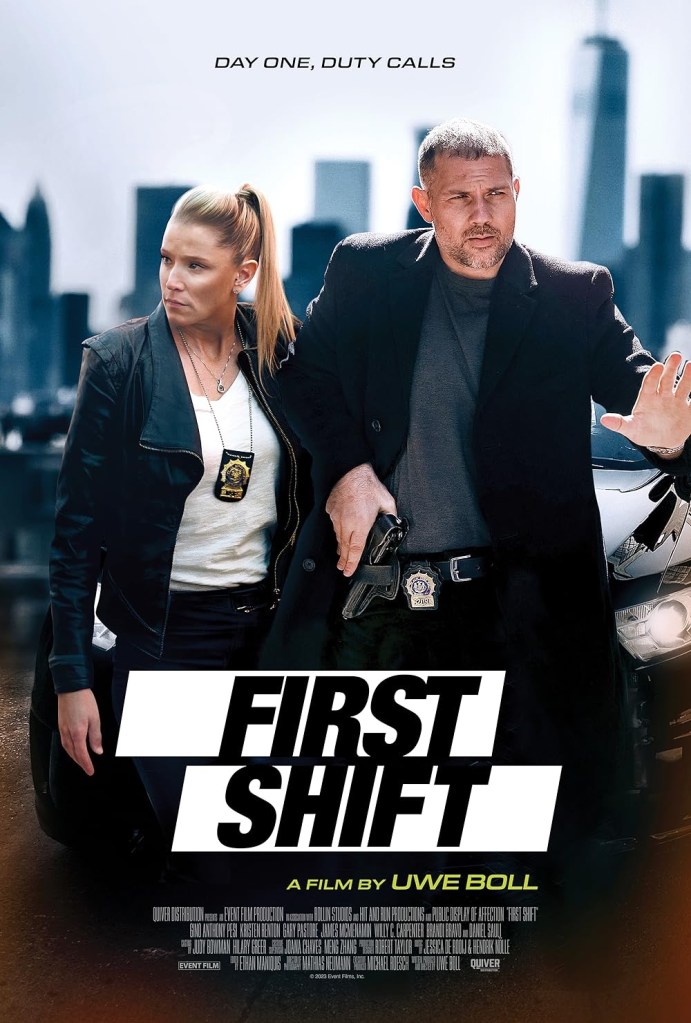
First Shift Review


A good cop/bad cop movie and urban detective story with class, First Shift delivers! Directed by Uwe Boll, it highlights the day-to-day life of a detective in New York City. With a slew of routine duties from the perspective of a detective, First Shift ties in the notion of how emotions require tolerance. With disasters and safety issues spiraling out of control in an instant, First Shifts how cases the reality of how detective work involves many tiresome factors.

The film begins with Deo (played by Gino Anthony Pesi), a tenured detective assigned a new partner, Angela (played by Kristin Renton). Deo is responsible for showing Angela the ropes of being a detective in the big city. Deo is by the book, and Angela is very down-to-earth. She is smart, however, but is it to the level where Deo can have faith in her? Throughout the day, a variety of detrimental issues arise. For example, a man makes a scene in an alley and another is involved in a matter related to conflicts caused by drug abuse. Finally, there is a crime lord in the mix and might be interconnected to the authorities. With all these moving crises, First Shift makes its audience wonder which problem is the most pressing.

The question regarding professionalism is more of a boxing match of character traits than a thriller. There are not many layers of clarity in First Shift. The story does find a way to capture the chaos in one of the busiest cities in the world. This movie is a crime hustling ride that is trying to stay on the rails by relying more on characterization than the plot itself. It does not completely fail, because the journey succeeds in being different. The director appears to have worked hard to not make another predictable chaos film with “the law” involved. It does so by making its point through demonstrating how a pro teaches an amateur.

The chemistry between detectives is a dynamic of connections because being a city cop requires a lot of adjustment. As the heated problems ebb and flow, the audience experiences the evolving relationship between Deo and Angela. They are kind of like Starsky and Hutch, but more serious. Egos and sarcasm are a bit more glitchy between this duo.

First Shift keeps the personas in tune as Deo and Angela handle the challenges coming their way.   The partnership is the central focus of the film, but at times the story gets somewhat confusing and could have benefitted from improved development. The tone of suspense, fortunately, keeps it inviting despite its deficiencies.

As the conflicts gradually unfold, there is a lot to think about which causes a dilemma about who to focus on. I found myself more focused on Deo’s point-of-view of Angela than I did with the crisis conflicts that are spiraling in different parts of the film. First Shift is oblique in its cliffhangers which keeps it interesting. In the end, where does this new partnership go? Find out in First Shift. Three out of four stars.

Afraid Review


Today, there is a reality where AI is convenient. AI helps people stay organized with navigating tasks. Can AI be advanced on a personal level? Afraid loops in the context of questioning an AI innovation. Written and directed by Chris Weitz, his approach is on family dynamics (with AI). Screen time, technological addiction, and behavioral patterns are the discerning factors in Afraid. The approach is up-and-coming in the film. Its AI moving parts are resourceful. How real does AI grow to be in Afraid?

The film follows Curtis (played by John Chou). Curtis is a father working for a company that aims on AI technologies. At his home, his children rely on staring at their screens consistently. His oldest daughter, Iris (played by Lukita Maxwell), is obsessed with social media. His two sons, Preston (played by Wyatt Lindner) and Cal (played by Isaac Bae), play games on their tablets too much. Curtis and his wife Meredith (played by Katherine Waterston) feel changes need prioritization in their home. They got this new device called AIA. AIA is like Alexa. AIA is double the amount of intelligence over an Alexa. She thinks in advance. She makes sure there are no conflicts between Curtis and his family.

It begins to shift in the eerie path. Iris finds herself in a social media conflict. This situation links back to AIA. Preston makes wrong choices with friends. Finally, Cal listens to what AIA says more than his parents. It is only a matter of time before AIA’s words and mind games rain down with a terror of turmoil.

Where the film finds its haunting factor is its presence in its characterization. The personalities and facial expressions look blurred (because they look at screens so frequently). For improvements, Curtis is looking at new technology for his family. Is this a great idea? The personality of drained minds (due to overuse of devices) feeds the technology addiction in Afraid. It does before it gets more unpleasant.

When Afraid begins to see the red flags of AIA, the suspense is vast on a level of anxiety. That is because the advanced side of AIA is programmed to get ahead of moving parts more than its audiences anticipate. Some may think AIA is evil. Some may think AIA is convenient. Regardless, the influence of AIA is highly concerning. Weitz uses a direction that loops in mental stressors of the dangers of reliance. “Dangers of reliance” is among Curtis and Meredith for putting forth trust in AIA for their children. The high levels of stressors dig deep in Afraid. What will AIA do? What will Curtis do to protect his family? How enabled will his children be with their fascination with AIA?

Once the questioning factors of detrimental suspense come around, Afraid begins to feel the predictable vibes. It does well with keeping AIA as the focus of the potential threat. With the continued concern about how AI is bound to have red flags, Afraid is an average example of those “red flags.” The screen time takes a (minor and inviting) turn for the worst in Afraid. Two out of four stars for Afraid.