Tag Archives: Lionsgate

Never Let Go Review


Halle Berry as Momma in Never Let Go

What crosses the minds of its audience are the terms minimalists and survivalists. Directed by Alexandra Aja, Never Let Go brings its viewers to a universe of a questioning quarantine scenario. They are happening for reasons with no clarification. Around the setting is a mother with her two sons. They have a cabin in a forest. They are all brainwashed.

The main characters are the mother and her twin boys. The mother in the film is Halle Berry, and her two sons are Samuel and Nolan (played by Anthony B. Jenkins and Percy Daggs IV). For the boys, their mother keeps them quarantined because of her beliefs in evil spirits lurking around them. She always has them tie themselves on a rope whenever they leave home. The family is always fighting for survival. Their supplies are limited.

The pressure of the boys is a lot to bear. The writing is drastic in terms of doom. Never Let Gois fueled by the anxiety factors coming from the mother. It gets to a point where one of her sons’ questions are accurate and inaccurate about their lifestyle. As the days of feelings of nourishment take a toll, the bigger picture comes out with Never Let Go. It is audacious and overwhelming. Loyalty and love are certified. Also, seeing what is on the outside is on the line.

The grappling of the dynamics continually tries not to go out of its elements. There are shocking moments of what can be treacherous in Never Let Go. It delivers the moments for its audience to think of the two words, “Stay inside.” It does that repeatedly. With that, there are layers of boredom that do not suffice. The sacred aspect of remaining alive has a continuity that is lacking. Where is the evidence of the terror? Why is the mother so brainwashed? Is the mother trying to protect her children? Is she able to protect them? Are there discrepancies that the boys are not aware of? Never Let Go brings in the thoughts of what would come around if anyone (in the family) decided to let go.

The dynamic between Samuel and Nolan finds itself at the center of conflict. One thrives to see what is on the outside. And the other is destined to remain in quarantine. However, remaining in quarantine leads to a lack of nourishment. The chance of living a longer life is likely if there is a means to escape their environment. Even with this clashing factor, its approach is muddy. It is overly dramatic, has rushed suspense, and whatever caused the problem remains a mystery.

The mode of peril remains deep. The premise has chilling factors. Regardless, it remains in disarray. The evolution of finding the answers to what is right and wrong continues in shambles. It goes from a heavy influence of protection to many brainwashed catastrophes. “Brainwashed catastrophes” that make the brothers go into hysterics compulsively.

As the film relies on ropes tied to its characters, there is hope for more personification. There are small amounts of it, but only in the context of life or death. That is even improper in the flow of Never Let GoNever Let Go is a terrorized boredom with a lack of sophistication. Two out of four stars.
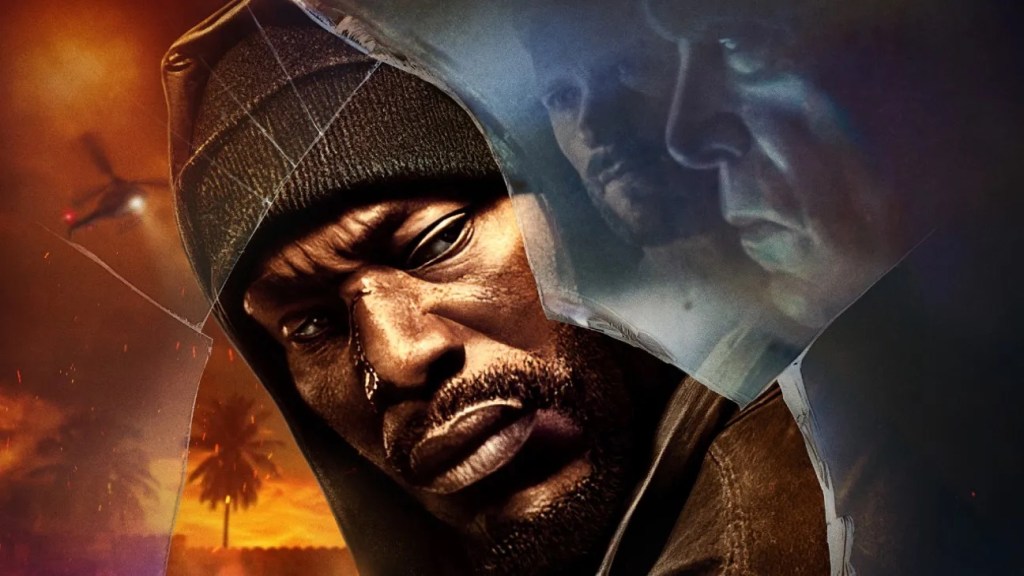
1992 Review


The dangers of Rodney King’s era come with an added layer of pressure. 1992 has a trail of strain. There is a lot that goes bonkers. Directed by Ariel Vromen, the pattern is a boxing match between Tyrese Gibson and Ray Liotta (who died in 2022). The aptitude for vengeance reached for the sky in 1992. It is a film that falls in the era of the Rodney King riots. The added conflict is a heist. Who makes it out alive is the question in 1992.

Gibson plays Mercer, who has been released from prison. His priority is his son Antoine (played by Christopher Ammanuel). Mercer works at a factory. In the future, this is a rough dynamic. There is another mixed relationship. Liotta plays Lowell. Lowell has many years of a bad relationship with his sons Riggin (played by Scott Eastwood) and Dennis (played by Dylan Arnold). Its dynamics are faithful to the harsh times of the past. The reality of criminality (in the California setting) displayed a vigorous presence in 1992.

The conflict of the film is three moving parts. The riots outside, Mercer trying to keep Antoine safe, and a heist. The heist is in the operations of Lowell and his sons. Mercer feels taking his son Antoine to the factory (due to the riots) will help keep them safe. It leads them into a death match of survival. Lowell chooses to do the heist during the riots. This is the tactic because it creates a window where backup cannot stop their operation. Lowell wants to steal catalytic converters from the factory. The value is steep in the platinum of the catalytic converters. Chaos hits its anarchy once Mercer and his son are up against Lowell and his sons. It builds frequency with a clicking tock. The moving parts of the heist and the city going down under are a brawl. One that keeps audiences on the edge of their seats.

The madness of tension boils solid in 1992. The robbery hitting plateaus is the added layer of detrimental scenarios (calculated). The performance of Gibson and Liotta possesses the power of authority for the opposite circumstances. Gibson’s role is to protect his son, and Liotta’s role is to pull off a criminal operation with his sons. Both the choices of fathers lead to this unexpected circumstance. The only chance is to fight. Many punches go back and forth in 1992. The ruthlessness leaves a monumental mark of cinematic achievement.

In 1992, the stakes were critical. It begins with Mercer thinking the only safety conflict is the riots outside. He tells his son, Antoine, “We just got to stay the course.” That quote brings the dynamic to a ten-question level of safety concerns. When the audience thinks Mercer is keeping his son out of danger, they walk into it (at the factory). The rough population of the livelihood has density in 1992. Its environment with detrimental infrastructure links to resilience. “Resilience” is how choices have consequences, and how some choices of harshness must be made.

Who is more at risk? Is it Mercer’s son? Is it Lowell’s son? Do the riots create any more layers of questions? How many conflicts come around with the heist? Find out in 1992. Three-and-a-half out of four stars.

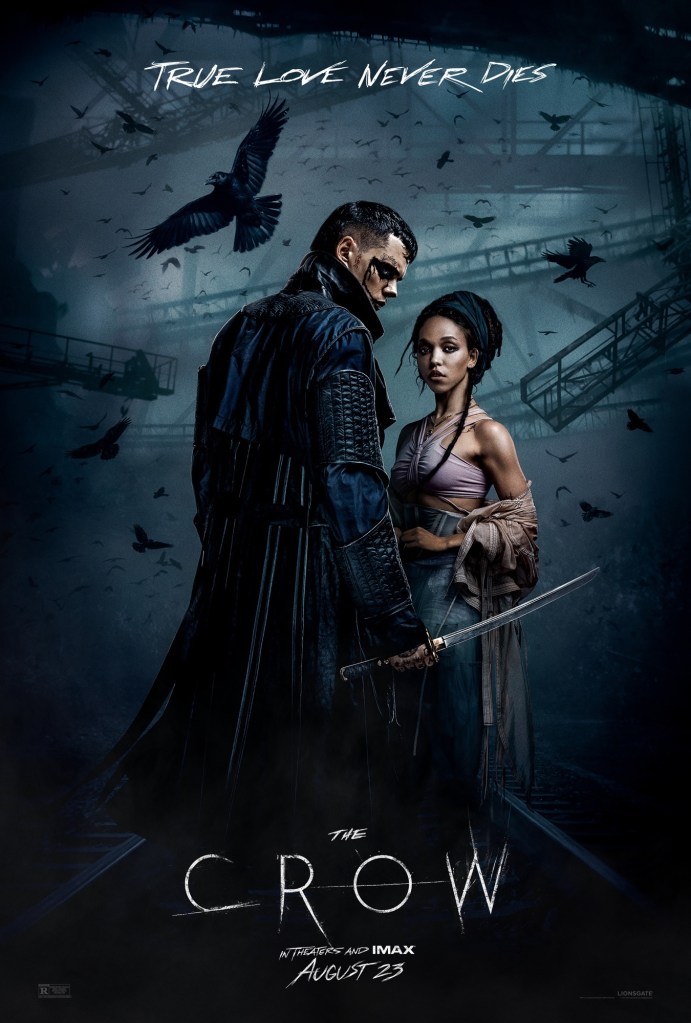
The Crow


The original version of The Crow (released in 1994) is a guilty pleasure of mine. The director of the 1994 version was Alex Proyas. In this newest edition, its director is Rupert Sanders. Redemption and power do not meet mesmerizing expectations in this current version of The Crow. There are depths of it that try with revenge and love to create a form of meaning. The background and characterizations of The Crow are meaningless.

The two characters are Eric (played by Bill Skarsgard) and Shelly (played by FKA twigs). They escape from prison, fall in love, and build their universe of romance. The enemy onto them is Vincent Roeg (played by Danny Huston). Vincent targets them both. Shelly is deceased. Eric seeks the power to bring her back. A mental state of mind brings Eric to the universes of the present and dead. The one who guides him on how to use his powers is Kronos (played by Sami Bouajila). Can Eric save the love of his life?

The beginning is Eric and Shelly having a life in prison. From there, they make their own life after escaping. The Crow has issues with its pacing. It will focus a lot on Eric and Shelly’s unconventional relationship. It will then transition to the mayhem of criminality coming down around them. Both are at the height of it, but one gains the power to do more detrimental things. With Eric having a love for art and words, his visions mean more than just love. The writing, however, is sloppy.

There is a lot of dragging. The scary powers take their time to get to their climatic scenarios do not come so smoothly in The Crow. It is even more complex to take Skarsgard seriously as Eric. He has a quiet monotone, and he does not possess tough-guy vibes.

There is a lot of turmoil. The Crow is captivating in a moment where criminality is finding light. Once that “light” finds its way to turn on, the dreads of terror come in drastically bad. It just throws it all in the bucket of vengeance (in Eric). With that, audiences can expect tons of tattoos, weird attitudes, and a strange path of poor writing in The Crow.

It misses its opportunities for invigoration. It is presented in the formality of predictability. “Predictability” of mediocrity. The 1972 version knew how to be on par with its good and bad guys. This version cares too much about making it look like a generic version of a superhero flick. It is not that though, It is just a horror with a poor script and angles. I felt there would be more to this. I had a feeling of moving parts. There were barely any. The Crow displays “moving parts” of flatness.

I do suggest revisiting the 1994 version before seeing this one. I felt lost throughout the context of this remake. It is detrimental and messy. It is a failure within the realms of structure. I do give it credit for trying to encourage its characterizations though. Two out of four stars.