Tag Archives: Lionsgate

Megalopolis Review


Many years in the making, Megalopolis is about a director who spends his own funds to create his project. From director Francis Ford Coppola comes a saga where artists and egos collide in a futuristic universe filled with deceit and power. For fans of Coppola’s previous projects, this film has layers of amazement. While it’s all over the place, it still works.

The film focuses on Cesar Catilina (played by Adam Driver). He is an artist that challenges time, reality, and art through his self-absorbed way of thinking. He has the power to stop and move time and reality. A utopian future in New York city spirals as Cesar’s ego always keeps him on the lookout for the most growth potential possible. The mayor is Franklyn Cicero (played by Giancarlo Esposito), and he is not fond of Cesar’s approaches. Right in the middle, there is Julia Cicero (played by Nathalie Emmanuel). Julia is the daughter of Franklyn and is working for Cesar. Characters in this film come together to create their own narrative. Cesar’s reputation and universe begins to go awry due to his questionable involvement with others, including a young stud named Clodio Pulcher (played by Shia LaBeouf). Clodio looks down on Cesar and wants to acquire the kind of power Cesar has.

The film is over-done, but Coppola is strong as usual with his storylines in Megalopolis. Unfortunately, the characters frequently go down cheesy paths. The seriousness of this film comes through the narration. Fundi Romaine (played by Laurence Fishbourne) is both a character and the narrator. The film explores the idea of maturity and the center of authority in Coppola’s world of the rich and wealthy. Even the family dynamic is curious, especially with Cesar’s uncle Hamilton Crassus II (played by Jon Voight). He is not always on the same page as Cesar but stands loyally by the throne. Megalopolis is like the philanthropic approach to what Coppola tries to accomplish with his artistry in filmmaking. The utopian future in this setting gives viewers a lot to think about.

There is a quote in the film, “Artists can never lose the control of time.”  The ability to control time toys with the audience’s mind during the entirety of Megalopolis as do themes related to hatred, power, enemies, and deceit. The film also has many suspenseful factors which elicit a sense of overwhelm.

Despite some setbacks, Megalopolis is a continuum of all kinds of dreams hoping to develop into something bigger. The dramatics thrive faithfully in way that is expected from Coppola after long ago establishing respect with the now famous saying, “I’m going to make him an offer he can’t refuse,” from The Godfather. There are plenty of “can’t refuse” offers in Megalopolis. The creative forms of corruption make Megalopolis visually audacious. The IMAX version will loop in more depth and layers to help audiences understand the narrative in the 10X immersive experience. Three out of four stars for Megalopolis.

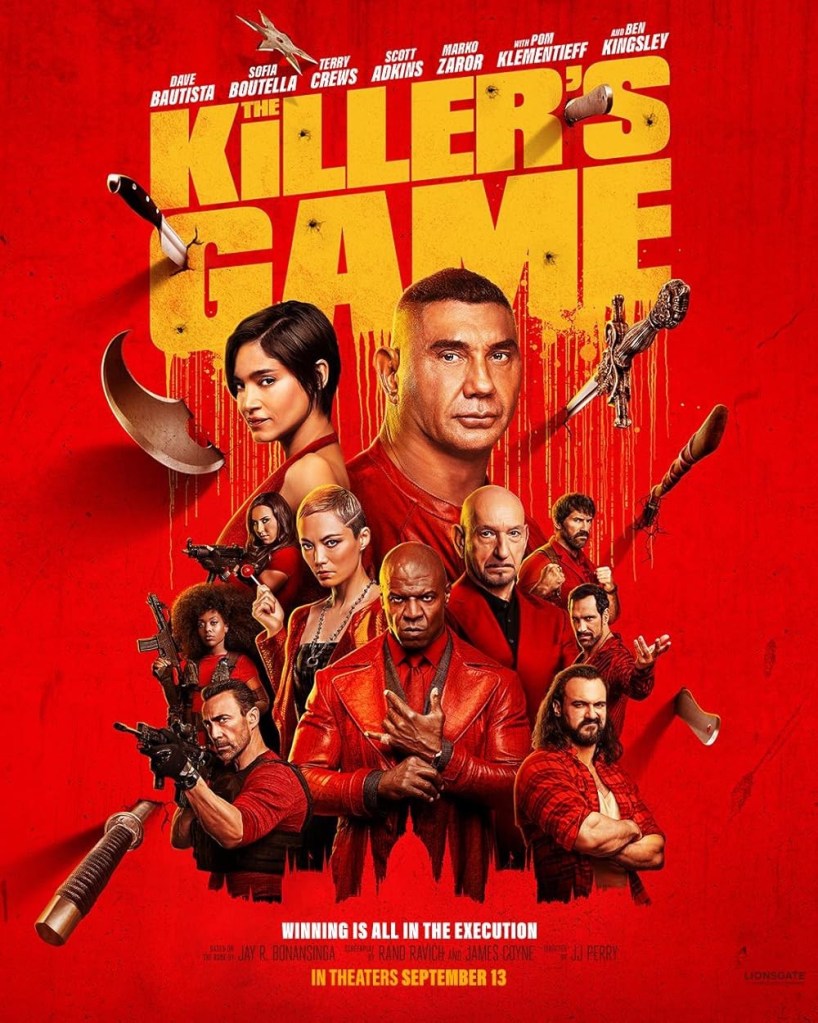
The Killer’s Game Review


It is a thriller with a cat-and-mouse dynamic. There is a sense that the film will be funny which is fueled by unexpected combativeness. The Killer’s Game is like a mediocre version of a Bourne movie. The combination of sad elements with the finale of a mission do not mix cohesively. It is a film that focuses on the personalities of its characters. The direction sets vast expectations with spy operations, but don’t expect to grasp the plot if you decide to see The Killer’s Game.

The main character is Joe Flood (played by Dave Bautista). Joebelieves he is fighting a life-threatening illness. Due to this serious health concern, he requests someone to detonate him. However, Joe is then informed that his disease is the wrong diagnosis. This means he must stop the operation that he has planted for himself. With the help of a friend named Maize (played by Sofia Boutella), time is of the essence as Joe needs torun or fight his enemies.  Joe’s boss Zvi (played by Ben Kingsley) also comes into the mix. Joe needs all the help he can get given that he authorized his own assassination request.

It is a thriller with a steady build-up. It brings lots of fun, gadgets, and international intrigue to the table. The Killer’sGame unfortunately does not know how to find enoughinvigorating aspects. Instead, it is a blur of action and mayhem which sadly does not sell.

There are a vast number of interesting characters though. The questionable ones range from Lovedahl (played by Terry Crews)to Radovan (played by Daniel Bernhardt) to Goyang (played by Lee Hoon). While they are interesting, they don’t add much quality or purpose because of their obviousness. For example, Crews’ absurd character name is too much. The movie is a retro-spy adventure where even the humorous lines fail to find their points of connection.

The international vibe of the film tends to be all over the place as well. The criminal operations and Joe’s missions jumpy as are most of the conflicts in the film which frequently seem to spiral out-of-control. I wish the rushed mayhem had more layers of value. Bautista is too light hearted to effectively play such a sad role. Luckily, his big heart does help play into the charming factor of The Killer’s Game.

Of course, this film is much too predictable. The writing seems overly anxious for to induce moments of pleasure. Sadly, the pleasure does not fit the spy format very well at all. The story ultimately comes down to the error and attempt at redemption. I wish the mission could have proven to be more enthralling.

What will Joe do? Will he find a different outcome? Why are there so many people in the mix? What international triumph is possible in The Killer’s Game? Barely any! Nevertheless, the film still has a few captivating moments featuring Joe and his desire for one last chance. Two out of four stars for The Killer’s Game.

Never Let Go Review


Halle Berry as Momma in Never Let Go

What crosses the minds of its audience are the terms minimalists and survivalists. Directed by Alexandra Aja, Never Let Go brings its viewers to a universe of a questioning quarantine scenario. They are happening for reasons with no clarification. Around the setting is a mother with her two sons. They have a cabin in a forest. They are all brainwashed.

The main characters are the mother and her twin boys. The mother in the film is Halle Berry, and her two sons are Samuel and Nolan (played by Anthony B. Jenkins and Percy Daggs IV). For the boys, their mother keeps them quarantined because of her beliefs in evil spirits lurking around them. She always has them tie themselves on a rope whenever they leave home. The family is always fighting for survival. Their supplies are limited.

The pressure of the boys is a lot to bear. The writing is drastic in terms of doom. Never Let Gois fueled by the anxiety factors coming from the mother. It gets to a point where one of her sons’ questions are accurate and inaccurate about their lifestyle. As the days of feelings of nourishment take a toll, the bigger picture comes out with Never Let Go. It is audacious and overwhelming. Loyalty and love are certified. Also, seeing what is on the outside is on the line.

The grappling of the dynamics continually tries not to go out of its elements. There are shocking moments of what can be treacherous in Never Let Go. It delivers the moments for its audience to think of the two words, “Stay inside.” It does that repeatedly. With that, there are layers of boredom that do not suffice. The sacred aspect of remaining alive has a continuity that is lacking. Where is the evidence of the terror? Why is the mother so brainwashed? Is the mother trying to protect her children? Is she able to protect them? Are there discrepancies that the boys are not aware of? Never Let Go brings in the thoughts of what would come around if anyone (in the family) decided to let go.

The dynamic between Samuel and Nolan finds itself at the center of conflict. One thrives to see what is on the outside. And the other is destined to remain in quarantine. However, remaining in quarantine leads to a lack of nourishment. The chance of living a longer life is likely if there is a means to escape their environment. Even with this clashing factor, its approach is muddy. It is overly dramatic, has rushed suspense, and whatever caused the problem remains a mystery.

The mode of peril remains deep. The premise has chilling factors. Regardless, it remains in disarray. The evolution of finding the answers to what is right and wrong continues in shambles. It goes from a heavy influence of protection to many brainwashed catastrophes. “Brainwashed catastrophes” that make the brothers go into hysterics compulsively.

As the film relies on ropes tied to its characters, there is hope for more personification. There are small amounts of it, but only in the context of life or death. That is even improper in the flow of Never Let GoNever Let Go is a terrorized boredom with a lack of sophistication. Two out of four stars.