Tag Archives: Music Box Films

Kill the Jockey Review


Directed by Luis Ortega, this is a dark comedy where exploration ends up in a bind. Kill the Jockey presents conflicts up front and hurdles along the way after a detrimental disaster. Vivid and thought-provoking, Ortega knows how to create a film that feels two-sided—with conflict and identity. The setup uses impairment to its advantage, but when that tactic falls apart, a new journey begins with a desperate search for answers.

The film’s focus is Remo (Nahuel Perez Biscayart), a jockey under a wealthy businessman named Sirena. Sirena presents himself in a mob-typed fashion. He owns horses, and Remo is his top racer. Then there is Abril (Ursula Corbero). She islearning the ropes to be a jockey and is pregnant. The baby belongs to Remo. Life for these characters boils over with politics and anxiety playing a role. When Remo messes up, his life transitions and he becomes rebellious. The title speaks for itself as the story takes a turn. 

The film paints a portrait of Remo being desperate for success. From the outside, though, it doesn’t seem that he can own hisfeelings. There are moments when he finds himself wondering about his identity. He begins to experience feminine moments in his life after a particular disastrous race. While Sirena is trying to figure out what to do with Remo, Remo continues down the path of provoked and erratic behavior. He appears to be coming out of his cage with a vengeance and a classic hint of uncertainty. 

The dynamic of entrapment is what I found to be extraordinarily compelling in Kill the Jockey. When Remo comes out of his shell, his vindictiveness displays a form of humanistic emotions that are just surreal. It is a portrait of fame, love, and loss looking to be earned. The writing clearly focuses on the conflict and dynamics tied to Remo, Sirena, and Abril. Abril, however, is the lowest priority, but she serves as an important opener for Remo’s doors.

With the races being a blur, and with Remo finding himself going crazy, Kill the Jockey leaves audiences with a vibrant sense of curiosity about the eventual consequences. Remo’s impact is the main subject of the audacious dynamic and interruption of the criminal setup. The exploration in this film is vivid as it highlights how things for those who work in a livelihood which is out of their control encounter many unseen pressures. Ortega’s directing has an effective way of showcasingkarma containing many slaps in the face. Remo wants to fulfill his happiness and Abril’s happiness, but he also wants to find his own success instead of it being under Sirena. Given Sirena’ssacrifices for him in the past, escaping from the big boss sends Remo on a road of tough choices in Kill the Jockey.

This film is diverse and unique. Kill the Jockey has a realistic foundation that I was sold on. As Remo navigates life outside, his search for identity evolves. In a strange way, Remo’s journeymakes sense—because his life has been micro-managed for years. It is an unimaginable awakening with funny moments that grow darker. Ortega presents a life to be learned in a criminal context. Three-and-a-half out of four stars for Kill the Jockey.
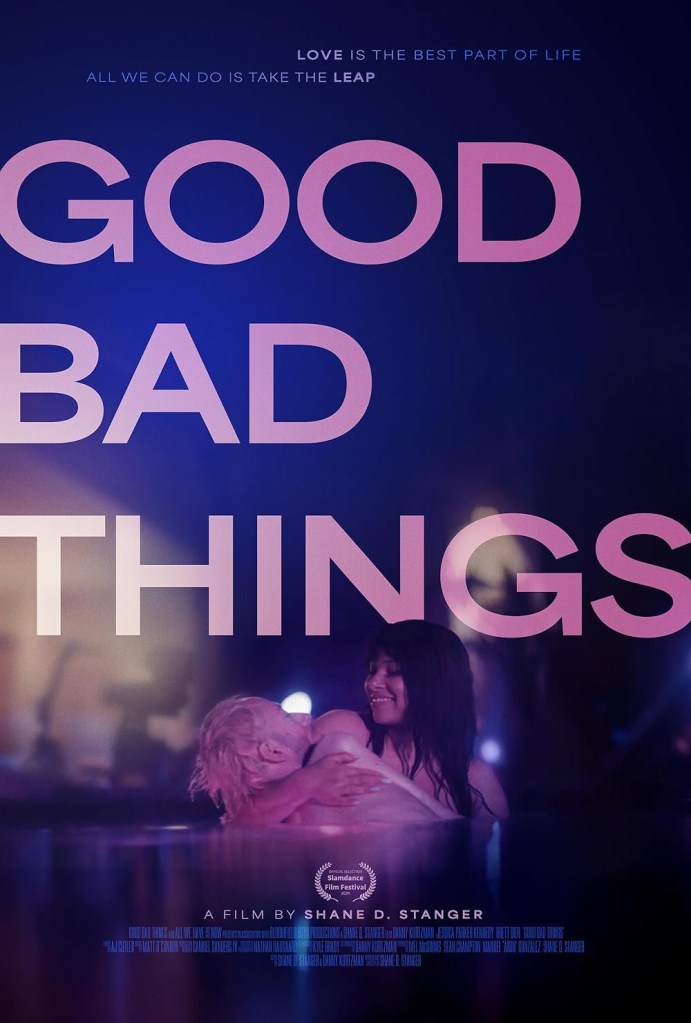
Good Bad Things Review


When it comes to being limited due to physical disability, Good Bad Things takes hold of limitations and turns them into portraits of a touching story. Directed by Shane D. Stranger, Good Bad Things navigates the challenges of a disability through the life someone who is physically impaired and an entrepreneur. The main character Danny (played by Danny Kurtzmann) is the co-writer of with Stranger. Danny’s path toself-discovery shares his individuality with the masses—it is all about the moving parts in his life which help him find positivity.

Good Bad Things keeps a steady pace that gives the audience a feeling of resilience in Kurtzmann’s performance. He spends his days running his routine to get a dating app called Rubi up and going. His friend, roommate, and colleague Jason (played by Brett Dier) encourages Danny to make a profile on his dating app. Hesitancy strikes Danny at first, but then when he gets his first match with someone named Madi (played by Jessica Parker Kennedy), a new world of amazement flows magically for Danny. The feelings of love and connection bring Danny along with the audience to a place where euphoric, surreal feelings abound. 

Reality and excitement via an app are unfamiliar to Danny and Madi is his dream come true. The writing and pacing loop in emotional tones which reflect what Danny is experiencing. His gut is sensing unforgettable connectivity. Despite his limitations, Madi may be his revelation. Good Bad Things is a poetic project of purpose. It provides hope that everyone can find love…no matter what their disability is.

Through the realizations throughout the film, Good Bad Things displays a trail of ups and downs presented truthfully. Danny’s life requires assistance, but his assistance may be found in the love of his life. Madi thrives with Danny. The film captures theart of human connection that is empathetic and endearing. How true is the love? Is it real or fate? 

With Danny navigating new beginnings, there is a two-sided component in Good Bad Things. Both sides seem combative yet destined for aspirational hope. The first is his livelihood as an entrepreneur, and the second is his relationship with Madi.  Will both have outcomes that benefit Danny? Good Bad Things keeps audiences going with questions about Danny, because his limitations are vivid as are the frustrations and sadness portrayed with grains of realism through his eyes. Good Bad Things is a film about finding the paths where chances exist. In Danny’s case, finding true love and professional success both have value displayed in an artistic form.

As Good Bad Things continues to pursue parallel values, curious thoughts emerge easily, especially about the relationship between Danny and Madi. Danny feels something new, and so does Madi. Both have distinctive differences, yet commonalities. Danny is artistic with a mind to create for business purposes, and Madi is brilliant with photography skills. They both have artistic talent that finds common ground through the lens of Good Bad Things. The film is irresistible, engrossing, and leaves the audience with empathy that feels essential. Three-and-a-half out of four stars.

Full Time Review


Full Time is a compelling and overwhelming movie about being a committed parent coping with continuous stress. The realistic story has empathy and meaning.  There is no easy way out of the hard moments in Full Time. The film takes place in France and the focus is on a mother, Julie Roy (played by Laure Calamy). Julie has two young children and works as a lead housekeeper at a five-star hotel in Paris. She is always on the go and working hard to keep a roof over their heads. She never seems to get a break due to overdue bills, overdrafts, and home maintenance issues. The national transit strikes in Paris only add to Julie’s problems.

In Full Time, the strikes cause Julie to hit her breaking point. The opening of the film starts with Julie’s heavy breathing as she wakes up to start her day. From that point on, the audience will learn why her breathing is so heavy. She is pushing her limits to work, make changes, but also dealing with the constant trial and error that surrounds her life. I was astounded by the poetic energy of the stressors that kept coming at Julie because they were so real and spellbinding.

As the strikes continue, the stress and frustrations mount. Her boss, Sylvie (played by Anne Suarez), starts to get annoyed and concerned with Julie’s behavior as she is at the end of her fuse. She is showing up late and is not on her A game. Julie exclaims, “They can’t fire me for being late during a strike!”  Julie struggles to keep her personal problems at home which results in bringing her problems to work due to her lack of sleep and little support with her children.

Julie has a chance for a better job. However, her underlying problems and the strikes impact her chances of being hired and even her ability to display professionalism. The strikes create exhausting episodes for Julie, but that does not stop her from giving every opportunity a shot. Julie is a go-getter on many levels. She is beyond Full Time given how much she continues the effort for her children and herself.

Full Time gives us hope that Julie has a chance to succeed. for Julie. The issues she faces are detrimental and vivid.  The film is in-depth and realistic in terms of portraying parenting responsibilities. It reminded me how people do what they do best in good times and bad for the ones they love.

Julie loves her children deeply. But can she find more support? Can she find a better job? Will the national transit strikes ever end? Full Time is a graphic portrait of what life can be like for a single parent. The movie makes it clear that it is no picnic for any parent.

Full Time is a nerve-wracking experience. Julie faces much frustration in her aggravating ride as a single mom. The consistency of the pressures in Full Time are mind-boggling. Julie finds herself at risk of losing her current job. She also has anxiety worrying if she will be hired elsewhere or not. Deep down Julie is a good mom and a wonderful person, but she keeps getting thrown curveballs. Full Time is a meaningful film that shows what someone can do when they strive for a better life. Four stars.