Tag Archives: Netflix

The Piano Lesson Review


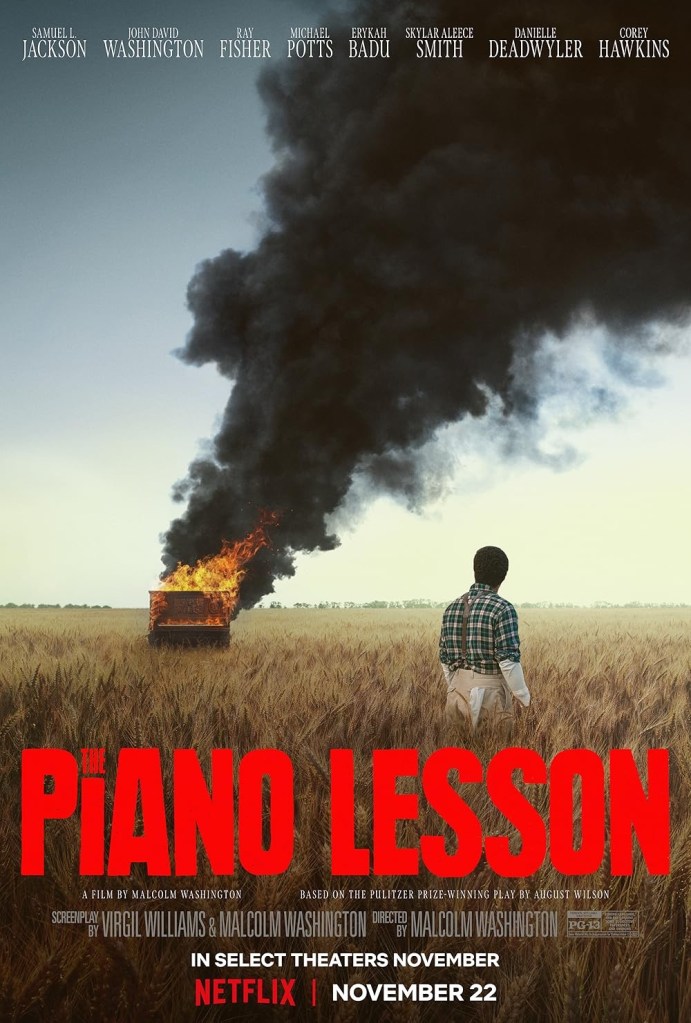
From my experience, I will say that the Washington family has the gift of pontification. They do it all so well in The Piano Lesson. Directed by Malcolm Washington, the son of Denzel Washington, who on his rise to fame. Along with John David Washington (Denzel’s other son), he continues to be an icon worthy of his father’s legacy in his movies. The Piano Lesson is a film where art and appreciation find their value to the deepest core. It is all centered on an heirloom piano and weaves emotions continuously in a cinematically enticing experience.

The film focuses on the Charles family.  The setting is a home owned by Doaker Charles (played by Samuel L. Jackson). In that home is an heirloom piano that is enriched with designs dating back to ancestors with its carvings. The story is based ona play adapted into a film. The conflict though, is between a brother and a sister, Boy Willie (played by John David Washington) and Berniece (played by Danielle Deadwyler). Boy Willie aspires to a brighter future, but only if he sells the piano.Berniece wants to keep the piano—it has much of her legacy engraved. Tensions boil over as the dynamic of family and the meaningfulness of the piano create one long boxing match that is relentless to find a sacred path for all involved with or without the piano.

The dynamics of a large family with many personalities ranging from Wining Boy (played by Michael Potts), Avery (played by Corey Hawkins), Boy Charles (played by Stephen James), and more, make for a lot to take in with The Piano Lesson. It is a fueled drama where the dramatics of seriousness and empathy tango for a passionate scenario—there may be some withdrawals without the piano. The engravings and their meanings are where the disagreements keep creating the flow of a family that falls apart, rejuvenates, and then cycles into the same pattern again,rapidly agreeing then disagreeing about the fate of the piano. 

The evolution of authenticity is surreal in The Piano Lesson. As more arguments and revelations unfold, eerie events begin to happen. In those moments the film fuels its audience to be curious too if there are spirits having expectations. There is the sensation of shifting to create a universe of unexpected tension rising for something unforgettable. The feelings for the piano are the beginning, but the deeper meaning of cultural tides may cause unforeseen consequences.

The direction is superb. The experience is relentless. This film is a theatrical journey—the setting of a time gone by loops in the importance of family at that time.  The presence of the piano is where the film stands tall for a fight to find the light of empathy. The Piano Lesson fuels characterizations and dynamics with a fulfilling atmosphere of serious considerations, of what happens when the feelings surrounding an object of purpose are not taken seriously. Where does the piano stand? Who is in the right? It will take many wrongs before finding the “right” one in The Piano Lesson. Three out of four stars.
Don’t Move Review


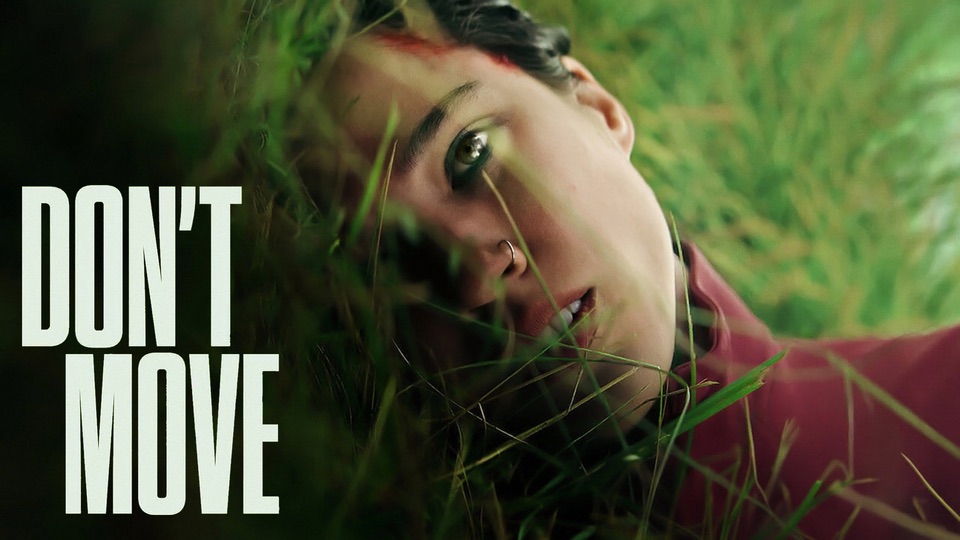
Don’t Move is a cat-and-mouse premise with a spiraling limit. Directed by Brian Netto and Adam Schindler, the testing of the waters gets vivid (rapidly) in Don’t Move. The writing is a killer with a motive. However, the “motive” does not go as planned. There is a setting with a forest and a mountain. And one hiking trip in peril with a tantalizing twist.

The film’s main character is Iris (played by Kelsey Asbille). The film begins with going on a hike to grieve the loss of her child. As she stands over the ledge on her hike, another hiker gets her attention, and he is Richard (played by Finn Wittrock). They start some small talk, but within minutes, she finds herself as Richard’s hostage. She tries many means to escape, but then she realizes that Richard has injected a relaxant into her bloodstream. Therefore, running and being in shock causes a shutdown of her motor skills. The film makes the clock tick. Can Iris escape the dangers of Richard (who is a killer)? Can Iris keep her body from shutting down? Don’t Move is like an odyssey of its audience worrying about running out of gas. However, it is in terms of human functions to survive.

Don’t Move is a film of adrenaline. It is also thought-provoking. As Iris finds herself fighting to keep her system from shutting down, Richard finds himself to be causing more disasters among himself. This is because when witnesses get in the way, he mustkeep destroying the evidence (as he is dealing with Iris). Therefore, the film creates more for its audience to think about while the chaos is already mayhem.

There is a saying in the film, “Wrong place, right time!” it is the “wrong place” for both characters because both are in harm’s way. Iris is doing everything (in her power) to run before giving Richard the chance to hurt her (even more). Richard tries to keep his act together and keep Iris in sight. Otherwise, his raging behavior sends off red signals. The suspense is all intuitive. However, it does not offer many surprises. It contains more shock value of its graphic violence.

The frequent thoughts of Iris and her body shutting down had my attention on Don’t Move. The focus of that halting effect made my head spin repeatedly. The natural setting adds to that pressure (for the audience). Limited cell service, a small town, and a race to survive.

Even though it is in tune to be shockingly disturbing, its cleverness is that its killer is not getting his way. The two-sided stressors of the hostage (Iris) and the Killer (Richard) bring in lots of damage to be considered (for its audience). The damage creates a two-to-tango dynamic intensively in Don’t Move. Overall, it is a typical continuity setup that grasps terror with misdirection. “Misdirection” with one at risk for motor skills shutting down (along with the risk of being murdered) and one running out of time to hide his uncharted territory. Two-and-a-half out of four stars for Don’t Move.

His Three Daughters Review


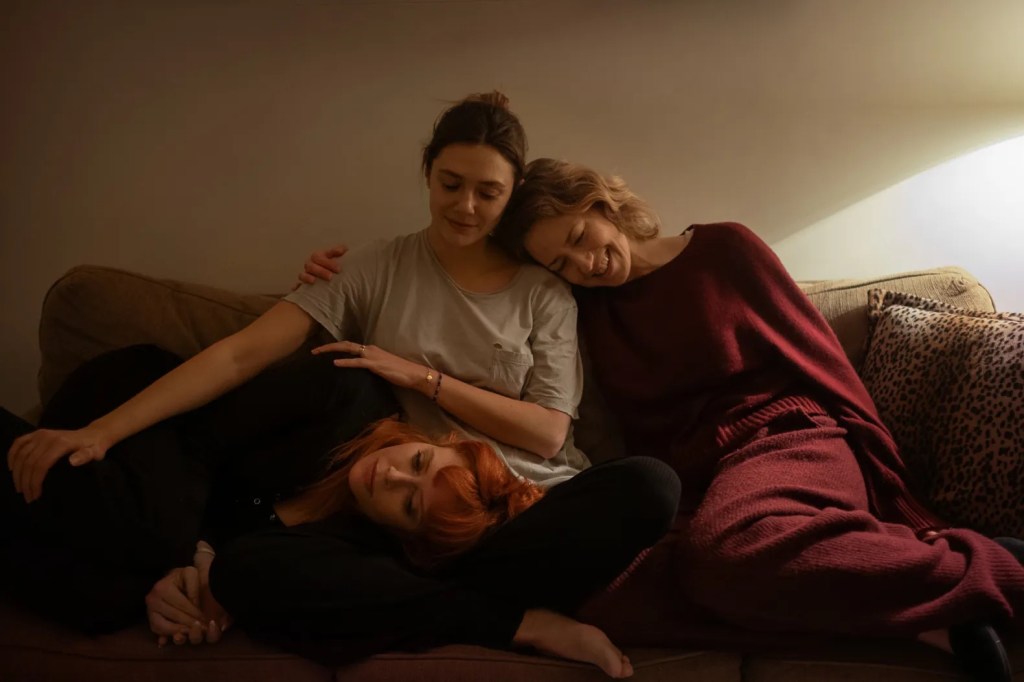
This film spotlights three sisters working to come together during a time of pain and grief– spiraling many emotions of regret, shame, jealousy, confusion as well as agreements, disagreements, and connections. His Three Daughters takes all those concepts and forms them into one life-changing and complex scenario. It does so with a flow of writing that is faithful to human feelings. His Three Daughters is a narrative that knows how to keep its focus—keeping the three sistersworking together despite their differences with the patterns shifting and spiraling authentically. Carrie Coon delivers many of the long speeches in the dramatic scenes. I have seen Coon in Steppenwolf Theatre productions in Chicago. Coon’s performance in His Three Daughters brings out her determined and theatrical presence to the finest level. Natasha Lyonne plays a role common to her quirkiness in The American Pie franchise. Lyonne though, shifts this one to have silly sides within her, while dealing with a serious situation. Then there is Elizabeth Olsen.  We are used to seeing her in Marvel films, but her breadth of roles has gotten more serious and fulfilling. After her performance in the HBO Miniseries, Love & Death, her monotone personality has shifted thought patterns in an exhilarating matter.

In His Three Daughters, Coon is Katie, Lyonne is Rachel, and Olsen is Christina. They are three sisters who are trying to be with their father at his home in New York to aid him until he passes. This is not an easy task, and one where tolerance and many moving parts are mentally taxing. Katie is the sister that is eager and setting all the blocks up to honor her father after his death. Rachel has always been in their father’s home and provided a lot for him before his health got worse. With Christina, she is just there to make each moment for their father comfortable. Their father is Vincent (played by Jay O’Sanders). The dynamics of the sisters take all kinds of paths. Rachel smokes weed and gambles continuously, Katie keeps being provoked by Rachel’s poor etiquette, and Christina is just trying to see things through properly. His Three Daughters is a revelation of how families can feel in the times where they are about to lose someone. Mindfulness flows through this film, with constant reminders of how the complexity of death lingers.

The sisters living in this limbo create the depth and perception of presence through the writing in His Three Daughters. The film rumbles like a dramatic stage production as the characters sit in unstable circumstances. The shaky feelings are a lot to take in mentally in the film and it’s seen in every conversation. This is where the writing blows its audience out of the water.  The truth is hard to hear—especially when it is around the subject of who has been more responsible or who is winning in the race of loyalty.

Audacious is the adjective that came to mind in the representation of His Three Daughters. It is  vivid in the way of being an open book. Writer and director Azazel Jacobs knows how to make dynamics of conflict have an intense sense of hurt and hatred. He also knows how to move it around and bring in acceptance.  Acceptance is not easy in His Three Daughters, but it does come around with connection in coming together. Three-and-a-half out of four stars.