
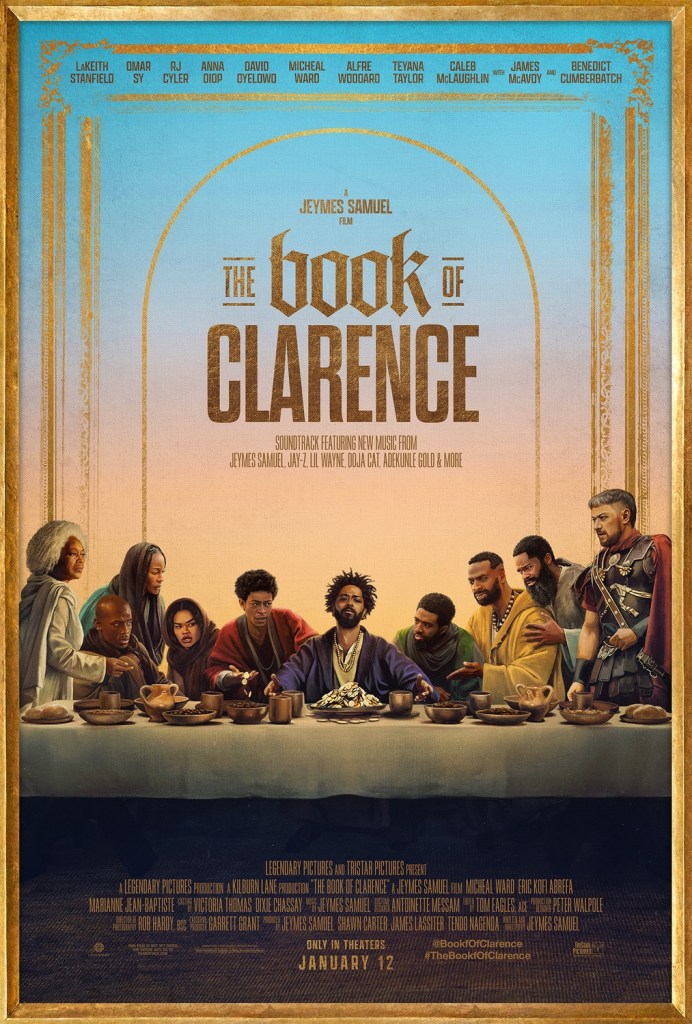
The Book of Clarence goes deep in an authentic exploration of religion and faith in becoming an apostle. The foundation is setin the era of Jesus Christ, yet in the context though of atheatrical and stage experience. There are countless moments of music and an over-achieving attitude with the film’s characters. The Book of Clarence starts out with being an exhilaration of a fantasy setup, but it falls flat. There is a continuity in the telling of the story of Jesus Christ, but with a different person taking the same steps. It feels like a faith story trying to add a form of diversity or an added layer of a connecting factor that does not do any justice to the narrative.
The film centers on Clarence (played by LaKeith Stanfield). He is an individual who has problems maintaining his debts in Jerusalem in A.D. 33. In the perspective of Clarence, he wants to top the hierarchy of Jesus Christ (played by Benedict Cumberbatch). The film follows Clarence in his new beginning as he lays claim to be a rising new Messiah. He feels that if he can accomplish the impossible, that he will not have debts, gain followers, and live for freedom from any hardship he has experienced in his life. He must prove he can grow though.
Clarence has to prove himself to others not only as a Messiah, but as a warrior. He gets in a death match with Barabbas (played by Omar Sy) to win the freedom of slaves. The film brings that dynamic of race and class in the A.D. era. In these moments the musical elements come through. They are attention-grabbing in the aspect of lending a feeling of exhilaration to the performances. Given the setting though, the factors of the film become misconstrued.
The order of events in Clarence’s upbringing does not do a clear justice how he grows to become a messiah. He gets baptized by John the Baptist (played by David Oyelowo) and makes a deal with Pontius Pilate (played by James McAvoy). Pontius believes that he can get Clarence close to Jesus himself. It is like the magical characters of a bigger story are just floating right to Clarence. The film tries too hard to use a magical approach in respect to the intense religious and spiritual themes. The vibe tries to be overly positive and it does not work well.
The Book of Clarence is centers on the experience of one man finding inspiration to do better. The audience is led to have faith in Clarence and those who are important to him. The most influential to him is Elijah (played by Ry Cyler). Elijah is a friend to Clarence and one that would sacrifice anything for him. Another character that is important to Clarence is his mother (played by Marianne Jean-Baptiste). The people and relationships around Clarence are the biggest factors in the dynamics of who benefits the rise of Clarence. The film though remains messy in its telling of this story.
This is an experience where I felt like I was watching a version of The Passion of the Christ, but one that wanted to have no graphic violence or extreme sadness. Instead, it wanted to go in a more heroic direction of power seeking with a dangerous attitude. It did not work for me. Faith and religion are important to many. The writers added layers of ego to portray a messiah with a rich dynamic to help fuel his growth in hopes that he will rule the world. If he was ruling any world, it is one that would struggle to find its faith and meaning in life. The music made my mind boggle with happiness and enjoyment…for about thirty minutes. The rest of the film was filled with too many characters, enemies, and rituals being thrown in that correlate to the history of the Bible. The connections came out poorly though, to a point where I felt I could not even figure out if I was enjoying the movie or not. I felt neutral about the experience of this unique take on a man becoming a messiah and I should have been enthralled. Two out of four stars for The Book of Clarence.
 Movies with Tarek