Tag Archives: Warner Bros

The Alto Knights Review


Director Barry Levinson has always captured the dynamics of fulfilling matters. The Alto Knights is a true story that keepsfalling stale. With a 20th century setting, the film builds on the fundamentals of cinematics to tell a story of politics, criminality and connection. Much of this movie relies on the performance of Robert De Niro who plays both Vito Genovese and Frank Costello.

The richness of The Alto Knights is in its approach using noir-type writing. Like many other mob flicks, the character development does not sync up with the foundation in The Alto Knights. The only lines that seem straight are in theperformances of De Niro’s characters going up against each other.  Over the years, De Niro has always displayed a loyal attitude with his serious words. Those elements are utilized again, but the continuity is flawed in The Alto Knights.

The plot focuses on both Vito and Frank and their background as crime family rivals. With their various connections and contacts, discrepancies brew below the surface in The Alto Knights. The wife of Frank Costello is Bobbie Costello (played by Debra Messing). Family integrity is presented as critical in a captivating way in The Alto Knights. There are many conflicts and disagreements between Vito and Frank, many related to the mob and previous events. Some issues end of in the courts where more secrets are revealed.

There is no clear line of resolution in The Alto Knights even though there is an attempt to paint a portrait of good and bad. Since both Vito and Frank are criminals, the apple does not fall far from the tree. The dynamics of the story weave frustrating emotions through the film’s central theme which tries hard to fly high. Levinson’s direction does what it can to aid understanding. The execution, however, is mediocre.

The uncharted territory surrounding the mob seems too vast to build an effective storyline. Vito and Frank both look like emperors of the mob. Deep down, the story is about relationships and trust becoming the bigger problem, yet the lines are unclear in The Alto Knights. Unfortunately, the theme of a family sticking together does not sell like it used to. Levinson’s direction this time around lacks to a massive level in The Alto Knights.

On a positive note, the biographical side of the story compelling, especially when related to the evolving era of mobsters and drug dealers. The deep examination of “who one knows” does not reveal any truth but simply adds to a stirring pot that keeps trying to find the pieces. De Niro’s performance is entertaining, yet not amazing because of the script.

Truly, this is one of the most disappointing films by Levinson. I rarely throw movies under the bus and instead try to find the best in all films. This is only the second time that Levinson has directed a mafia flick. His last one was Bugsy back in 1992 and now three decades later, the writing simply got stale when it came time for this film. Deep down, The Alto Knights has a stellar foundation of separating groups from gangs, affiliations, and operations. Frankly, building on this foundation is where all bets are off on any form of achievement this time around. The only real achievement in this movie is seen through the eyes of De Niro. One and a half out of four stars.
Mickey 17 Review


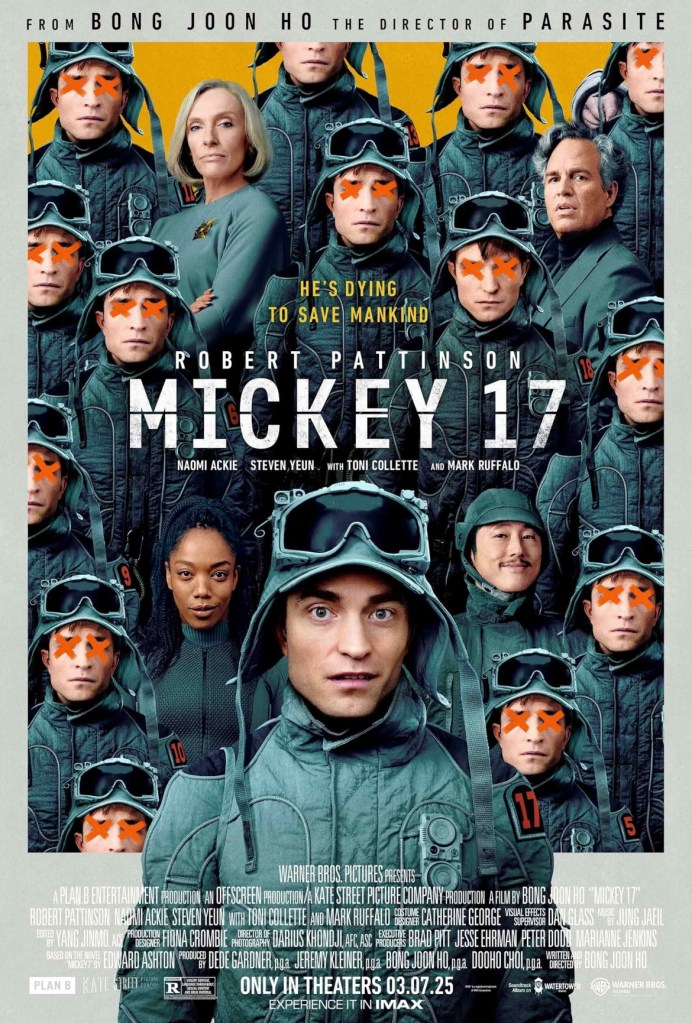
Bong Joon Ho has navigated territories that are hard to overcome as a filmmaker. He is from South Korea and has directed films that have blown audiences out of the water, especially with Parasite winning many awards in 2020. It was one of the first international films to win Best Picture at the Academy Awards that year. From that aspect, the success of his work is how he ties themes together to create a purpose. Mickey 17 has that direction and approaches being monumental. The surfaces though, have tangents. It is a film based on the novel Mickey 7, written by Edward Ashton. Ho wrote the screenplay of this film and for those who know the foundations of his previous films, they will see the fantasy world through his eyes with Mickey 17.

Ho’s directing trait is that of having diversity among genres. Mickey 17 blends that aspect with the use of space and fantasy settings mixed with dark comedy layers. The film’s main character is Mickey Barnes, played by Robert Pattinson. The year is 2054 on an isolated planet orbiting in space. Pattinson’s voice is the narration of Mickey 17. It feels two-sided because his character is in the pattern of living and dying multiple times. Going forward, Mickey is used as a tool for high-risk endeavorswhere his many odd deaths come into play, simply because he is reusable. Under a strange and egotistical commander named Kenneth Marshall (played by Mark Ruffalo) and his wife Yifa(played by Toni Collette), Mickey must try to reassess his memories before his usage is thrown in the wrong direction, as itfrequently is. With the help of a friend, Timo (played by Steven Yeun), Mickey has does have some hope of accomplishing this. The mission though, is one that is bound to have many repeats.

The direction of Ho is bound to find its humorous aspect the purest form in Mickey 17. It is not as mesmerizing, but it is a film that feels like a video game or a sitcom on acid. This is especially true in modes where Pattinson is repeatedly talking to another version of himself, as it makes audiences curious as to which version is the brighter one. The various levels of seeming “brighter” go down a rabbit hole of catastrophic adventures with the planet and the orbit being at risk. Pattinson’s voice fuels the film with the narration providing continuous dialogue. For Ho, it is clear that he wants the full-on characterization on Pattinson.  The shifting of gears with conflicts and the world around Mickey 17 is a foundation that is complex and not always easy to follow. However, it is still a stellar film with great entertainmentvalue based upon its moving parts and qualities that endure throughout.

With Ruffalo and Collette in the roles of superiors, and Pattinson as the protagonist, it is a world that navigates its tracks by hovering over the surface. Their performances are not serious, but they build a well-crafted foundation for expectancy of a joyful ride off course. Ho is known to create disasters for cinematic effect, but I felt this time he did not accomplish much of that on the levels of his previous films. Still, Mickey 17 is well done and rapidly paced. Pattinson as one who is repeatedly disposed of and revived is where the volume of humor and contempt hit the fan here.  Mickey 17 is a universal voyage with many joyful turns that are unforgettable. Three out of four stars for Mickey 17.

Companion Review


Why do humans rely on technology? They do for many reasons such as organization, boredom, and life essentials. But where is the line drawn? It is drawn at utilizing technology to enable human connections. Writer and director Drew Hancock pushes the boundaries of AI in Companion. It is a film that correlates with robot and human suspense for an entertaining result. The level of seriousness just right. Companion is about a matter that goes awry which leads to twists and secrets to be revealed.

The film focuses on a couple, Iris and Josh (played by Sophie Thatcher and Jack Quaid). They go on a weekend getaway at a lake house with friends. The other folks are a gay couple, Eli and Patrick (played by Harvey Guillen and Lukas Gage). There are also Sergey and Kat (played by Rupert Friend and Megan Suri). Iris is a robot and her emotions are mixed. Josh tells her, “Remember to smile and act happy!” For Iris, this is rather complicated. She displays feelings of tension which arecultivated by the narration from the very beginning of the film. The script delivers the key fact that Iris is not a normal human. Her sensitivity is the cornerstone of intriguing suspense in Companion.

The film’s genius is aided by the uncomfortable vibe in its lake house setting. Given Iris already has a boiling mind of vengeance, Companion loops in the feeling that many cans of worms are waiting to be released. Companion boils until the film’s point of destruction as so much goes wrong along the way. Iris commits homicide due to being unable to properly handle human emotions. After the homicide she walks into the living room holding a knife with spattered blood. Josh, Kat, Eli, and Patrick are stunned and horrified. Josh must figure out how to clean-up Iris’s mess which was prompted by a technical failure. Josh refers to Iris as a “companion robot” or “emotional robot.” He does this to try and cover his tracks before her functions worsen… which they certainly do. 

The film gets hysterical when it becomes a battle between an “emotional support robot” against real humans. On top of that,the scenes have an interactive component when the “emotional support robot” uses the functions on a tablet to help with functionality. This happens in moments of suspense. The storyline of covering up a murder and getting a crazy machine on the loose is results in a crazy ride that dangles shambles of wonderous audacity in Companion. AI takes a deadly turn of demise in Companion. Despite the quirky layout, what makes this film a gem is its ability to create an atmosphere where viewers must think. There is more here than what is expected and that gets the audience involved.

The vividness comes from the desperation in the performances of Thatcher and Quaid. Since Thatcher is a machine and Quaid is the consumer (of her). The error falls on both sides but there is no excuse for the cause. They both have the minds to fend for their lives. The film’s message is NEVER RELY ON TECHNOLOGY FOR HUMAN EMOTIONS! No good comes from that! The creativity behind the boisterous disasters results in a grandeur of comedy and suspense with technology going full throttle. Not entirely a masterpiece, but very close. Three out of four stars for Companion.