
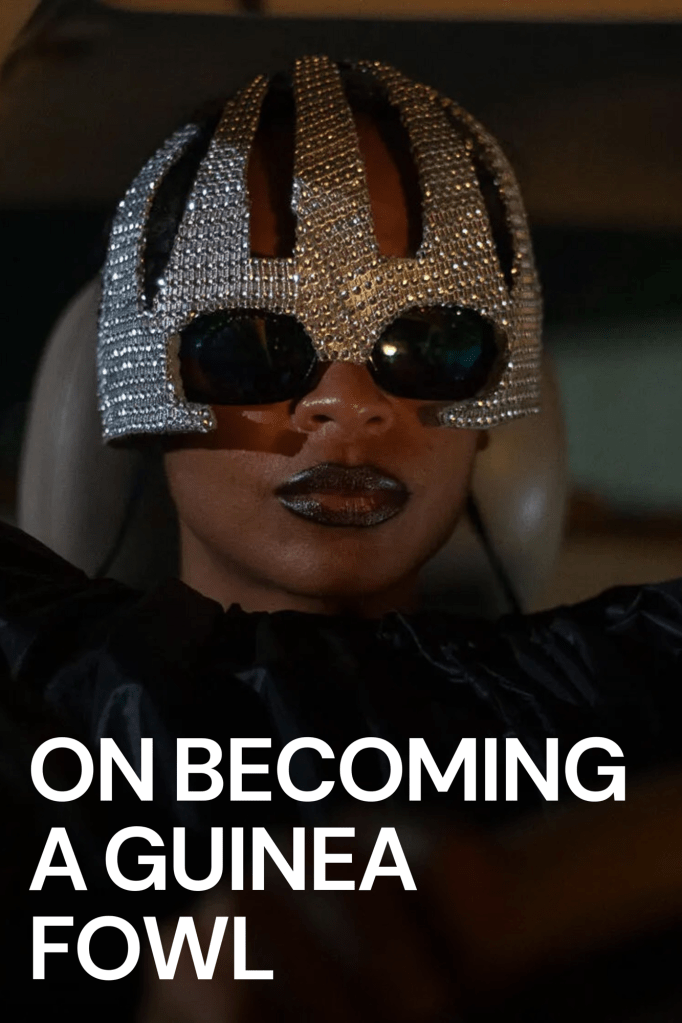
There is that notion of curiosity that lingers in a subtle matter. On Becoming a Guinea Fowl is a portrait of life and reality coming together to hear the harsh truths. Those “harsh truths” are in terms of one who is deceased. The devastating matter goes forward to creating an understanding of what to believe and what not to believe. Adjustments of honesty and facts are in forms of personalities—they are through those dealing with the complicated situation. Written and directed by Rungano Nyoni, On Becoming a Guinea Fowl is a landscape piecing together parts that are hard for a family to bare. It is cinematically enticing and deeply emotional. It will leave audiences to wonder what notions to buy.
The film surrounds Zimbabwe and a middle-class family. The character of the show is Shula (played by Susan Chardy). Shula is driving on an empty road and comes across her uncle lying dead on the street. Once this happens, word-of-mouth happens instantly, and funeral arrangements begin to come together. Her cousin Nsansa (played by Elizabeth Chisela) comes into the picture. Nsansa displays an obnoxious personality, and Shula is introverted (her characterization and facial expression have traits which prove she has a lot on her mind). With the family trying to cope and deal with the funeral arrangements, deeper and horrid revelations come around. Her uncle has done some things that are unforgivable, and with the family all together, the weaving emotions struggle to remain unseen.
The painted picture is suffrage at its finest in On Becoming a Guinea Fowl. There is no light on what is mentioned, but Shula is the one that keeps thriving for her family to find what is good in the dark after one is deceased. It is enticing with the family clashing, disagreeing, and not seeing eye-to-eye. A mesmerizing path of putting behind the bad does not come easy in On Becoming a Guinea Fowl. The apple does not fall from the tree in terms of the hatred that spirals like crazy.
The film loops in expressions of complications—no one knows how to view the scenario. The more family that arrives, the more suspicion. Nsansa is always looking at the offensive context of their uncle. “Offensive context” is painted fresh throughout all the vivacious negativity of the funeral process. It is one of those films where my mind kept making me wonder how the funeral can play out. Does one plan to make a scene? Does one plan to make a confession? Are there more unfortunate awakenings abounding? In the film there is the saying, “The good die to soon.” That saying means that clearly there is a major percentage of relief after the death of Shula and Nsansa’s uncle.
The writing of coping is cinematic. More hidden truths become increasingly disturbing—enough to make there be grievances and hostilities. However, “grievances” and “hostilities” are the building blocks that Shula continually works to downplay. On Becoming a Guinea Fowl is a masterpiece that measures how family absorbs a loss—in a precise approach—the thoughts of the individual family members create a pattern of distress that will hit it audiences emotionally and vividly. The drastic sense of trust is about the norms of those in attendance at the funeral. Three-and-a-half out of four stars.
 Movies with Tarek