
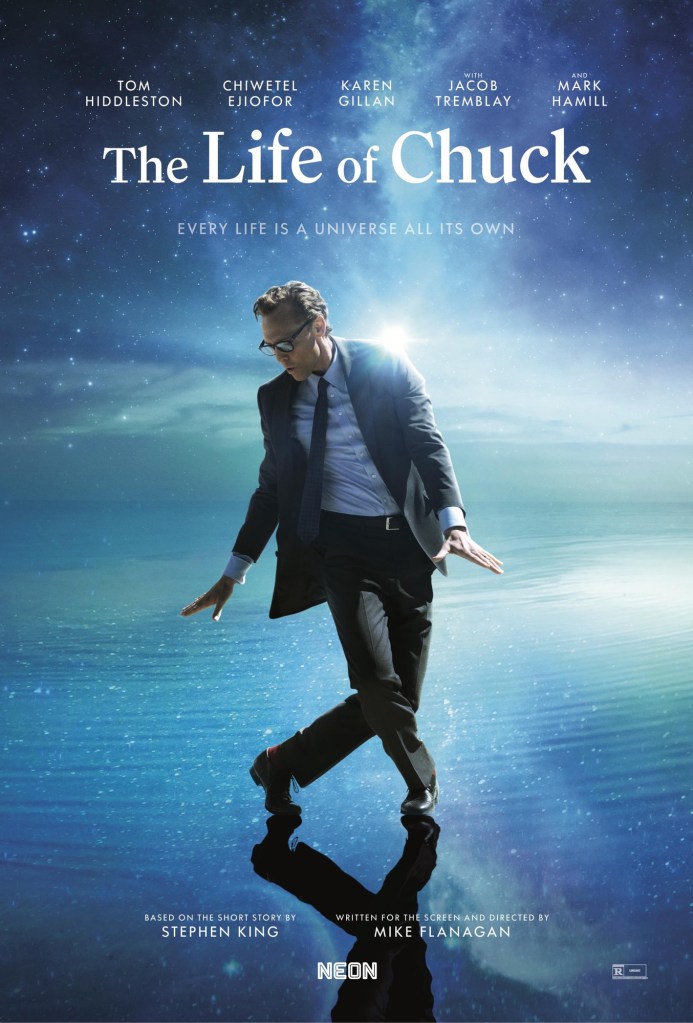
This is a film in three acts—they all go in reverse. Each event carries a multitude of what seems to be on track to be mesmerizing or revolutionary. The tracks of inspiration feel on par, although they come slowly and out of context. The Life of Chuck tries to look at life in different fragments. Directed by Mike Flanagan, it is based off of the novel written by Stephen King. Its introduction brings its audience into a place where it all seems lost, but then it transitions to a form of individuality. Once it gets to that component, it becomes sole focused on one man…Charles ‘Chuck’ Krantz. Thomas Hiddleston plays the older version, Jacob Tremblay plays the middle version, Benjamin Palak plays the younger version, and Cody Flanagan plays the very young version. The universe setting of the film all revolves around Chuck, but where does its meaning truly lie?
The film begins with Marty Anderson (Chiwetel Ejiofor), as he is navigating the many weird disasters surrounding California. This brings him to think of his ex-wife Felicia Gordon (Karen Gillan). In uncharted times of global warming disasters, the imagery of Chuck comes up as a symbol of some meaning. Marty finds himself searching for peace within and a means to reconnect with his life. This all comes from the concept of Chuck being the figure around him, because in every moment of stress, Chuck is the spotlight. Older Chuck comes in, and he has a lot of background as a successful accountant. He is the presence that sparks the attention to finding the meaning of life. However, all of this dismisses the global warming factor in a heartbeat.
The switch over is in Chuck’s life. One of which brings him back to moments of his childhood living with his grandfather Albie Krantz (Mark Hamill). In presenting a childhood of despair the momentum is created for Chuck to be a prodigy of some kind. I appreciate the flowing aspect of seeing one having his ups and downs, especially when it comes to being a pro at doing tap dancing or having a talent for mathematics. At the same time though, I ask myself where is the film going? More just because the opening is a separate event compared to what the film leads into.
There is the saying in the film that goes, “Math can be art, but it can’t life.” That saying spoke to the meaning of the film to me the most, because it made me realize that I had to turn my mind to focus entirely on Chuck’s continuity. The ups, downs, the turmoil, the success, and the childhood—there is a revelation looking for an explanation. The lines though, do not fulfill the context in its entirety. It tends to be a lot because of the cliffhangers that fall in between the reverse storyline approach; however, there is a narration which keeps the film afloat. It is a film that guides the audience to be mesmerized by Chuck. It just does not link to the beginning very well. An artistic approach that has a hard time connecting the importance of a multitude of events in reverse order. Two-and-a-half out of four stars.
 Movies with Tarek