All posts by Tarek Fayoumi…The Paterson of his Craft!

I am someone who strives to become a professional critic. I watch and review many movies. I view the eyes of movies as something as an art form. I have followed many critics over the years, but once I was thirteen I knew writing film reviews was going to be my passion. I learned from watching multiple episodes of Ebert And Roeper in my teen years, and then in middle school I began writing film reviews for a newspaper club. I am also an avid fan of the arts of Chicago including Theatre, Comedy, and music. Films, however, are my primary focus.

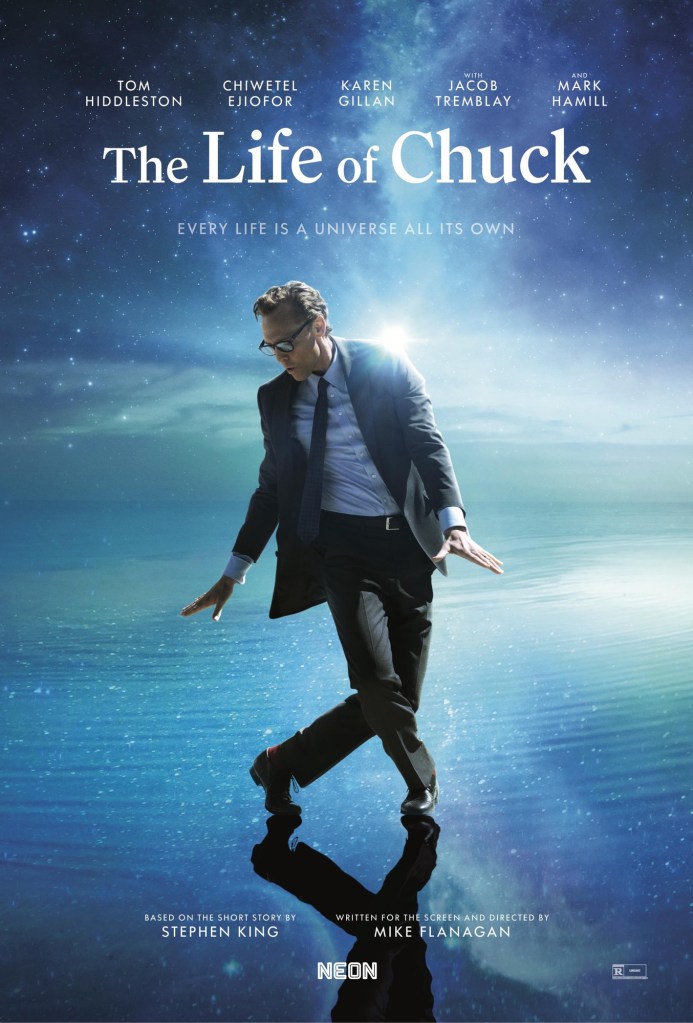
The Life of Chuck Review


This is a film in three acts—they all go in reverse. Each event carries a multitude of what seems to be on track to be mesmerizing or revolutionary. The tracks of inspiration feel on par, although they come slowly and out of context. The Life of Chuck tries to look at life in different fragments. Directed by Mike Flanagan, it is based off of the novel written by Stephen King. Its introduction brings its audience into a place where it all seems lost, but then it transitions to a form of individuality. Once it gets to that component, it becomes sole focused on one man…Charles ‘Chuck’ Krantz. Thomas Hiddleston plays the older version, Jacob Tremblay plays the middle version, Benjamin Palak plays the younger version, and Cody Flanagan plays the very young version. The universe setting of the film all revolves around Chuck, but where does its meaning truly lie?

The film begins with Marty Anderson (Chiwetel Ejiofor), as he is navigating the many weird disasters surrounding California. This brings him to think of his ex-wife Felicia Gordon (Karen Gillan). In uncharted times of global warming disasters, the imagery of Chuck comes up as a symbol of some meaning. Marty finds himself searching for peace within and a means to reconnect with his life. This all comes from the concept of Chuck being the figure around him, because in every moment of stress, Chuck is the spotlight. Older Chuck comes in, and he has a lot of background as a successful accountant. He is the presence that sparks the attention to finding the meaning of life. However, all of this dismisses the global warming factor in a heartbeat.

The switch over is in Chuck’s life. One of which brings him back to moments of his childhood living with his grandfather Albie Krantz (Mark Hamill). In presenting a childhood of despair the momentum is created for Chuck to be a prodigy of some kind. I appreciate the flowing aspect of seeing one having his ups and downs, especially when it comes to being a pro at doing tap dancing or having a talent for mathematics. At the same time though, I ask myself where is the film going? More just because the opening is a separate event compared to what the film leads into.

There is the saying in the film that goes, “Math can be art, but it can’t life.” That saying spoke to the meaning of the film to me the most, because it made me realize that I had to turn my mind to focus entirely on Chuck’s continuity. The ups, downs, the turmoil, the success, and the childhood—there is a revelation looking for an explanation. The lines though, do not fulfill the context in its entirety. It tends to be a lot because of the cliffhangers that fall in between the reverse storyline approach; however, there is a narration which keeps the film afloat. It is a film that guides the audience to be mesmerized by Chuck. It just does not link to the beginning very well. An artistic approach that has a hard time connecting the importance of a multitude of events  in reverse order. Two-and-a-half out of four stars.
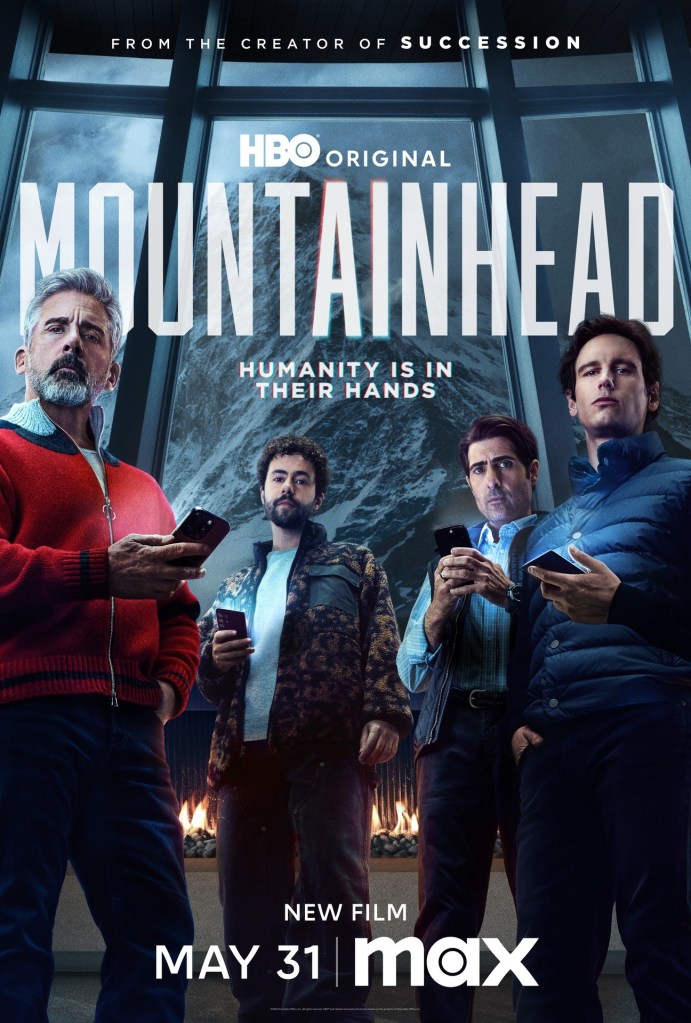
 

MountainHead Review


Written and directed by Jesse Armstrong who mesmerized viewers around the world with the HBO series Succession. Succession ran for four seasons and took home many nominations and awards. Armstrong’s powerhouse capability is to showcase his characters’ motives in business which often involve greed and morals. These issues are also featured in his newest film MountainHead. The setting is a weekend getaway for CEOs and corporate executive where there is much at stake to gain or lose. MountainHead made me feel like an avalanche of success or betrayal was going to be triggered at any moment.

The many wonders of MountainHead spiral amongst four friends: Randall (Steve Carell), Souper/Hugo Van Yalk (Jason Schwartzman), Venis (Corey Michael Smith), and Jeff (Ramy Youssef). These distinguished gentlemen decide to have a getaway at a high-end mansion in the snowy mountains of Park City, Utah. The millionaire’s dream home is outfitted with fancy fireplaces, a bowling alley, and a screening room. However, do these gentlemen want to have a weekend to party?

The stressors of the film start almost instantly. There are bad vibes due to AI technologies in Venis’ business, many of which take place overseas. Bad information spirals which has the potential to lead to all kinds of powerful impacts. The film’s writing is dazzling in MountainHead due to the characterizations of the friends’ relationships. For example, when it becomes clear that there is a potential financial gain for Jeff, Randall, Souper, or all, a line of betrayal and misinformation often follows. The envy and power at play boils down to one critical question…who has more to lose?

The film’s dynamic is bold since these individuals are successful and able to find loopholes in the system. I expected this pattern from Armstrong, because it is similar to Succession. CEOs take risks and executives deceptively go behind each other’s backs. Each move has positive and negative consequences. The legality of the choices will determine the outcome in MountainHead. Who will play the cards right? Will Venis find a way out of his corruption? Will Jeff use Venis as a means for gain? Will Randall blindside anyone? Finally, how does Souper feel about the whole host of issues? The news spirals throughout their getaway and MountainHead leaves its audience wondering if the men are friends or foes.

The film has a creative foundation that is amplified by the conflicts among databases and AI usage. The traffic leads tointense debates and theories among the four friends. Souper uses the filthiest verbiage, and Jeff leans on accuracy from the present outlooks. Randall and Venis view themselves as extremely intelligent. The competitive powerhouses weave together a landscape of knowledge that is irresistible. Media branding and individuality is at the center of the story in MountainHead. 

The fears, theories and anxiety as they await an outcome are all critical. As seen through the performances of Carell, Schwartzman, Smith, and Youssef, there is no clear equation to calculate what profits can be achieved or salvaged for these business moguls. The movie is like Succession on a weekend getaway adventure. When electrical output slips through the cracks, the media begins to rise which reveals weaknesses and sends cinematic jolts in MountainHead. The film is invigorating because it successfully mixes mental stressors and risks. Four out of four stars for MountainHead.


Karate Kid: Legends Review


It was good to see Ralph Macchio back in the franchise, especially in his role helping someone fulfill a destiny. Karate Kid: Legends is a continuation that should have happened years ago. Directed by Jonathan Entwistle, he brings the dynamic of what shapes a team and provides mentorship to a new level in Karate Kid: Legends. After the success of Cobra Kai, the franchise focused on teamwork in a more realistic way this time around.

The most essential remaining aspect from The Karate Kid(1984) is consistency as taught by Mr. Miyagi. I fondly remember the late Pat Morita’s famous lines, “Wax on, right hand. Wax off, left hand. Wax on, wax off. Breath in through nose, out of the mouth.”  Sadly, he passed away in 2011. The legacy of patience as a virtue stands the test of time in Karate Kid: Legends. Daniel LaRusso (Macchio) is one of the individuals promoting success now along with Mr. Han (Jackie Chan). Karate Kid: Legends is a new universe with potential.

The new young warrior is Li Fong (Ben Wang). He moves from China to New York. His mom, Dr. Fong (Ming-Na Wen), hopes Li can dismiss his fighting as they adapt to their new lives in the USA, but the combat finds Li. Some positives do happen for Lias he forms a friendship with Mia (Sadie Stanley) who works at a pizza parlor with her father Victor (Joshua Jackson). As Li navigates new routes in New York, he realizes the chance to fight is just around the corner. His mentor is Mr. Han and that is who he learns most of his motives from. Karate Kid: Legends is filled with interpersonal dynamics that lead to a bond that is stronger than I expected.

Before continuing into details about the dynamics, I want to touch upon the fact that the film’s writing may feel like it is trying to be a blockbuster. Unfortunately, I found it somewhat lacking especially when it came to the pacing of the franchise’sbiggest alumni…Daniel LaRusso. Macchio is the gem of the franchise. He is a mentor, learner, and someone reevaluating his own combat. Kung-fu and karate have separate terminology, but they find common ground in their juxtaposition. When Li is about to enter a competition, he plans to go up against a bully/jock by the name of Conor (Aramis Knight). With much uncertainty given the various relationships, Li finds himself in the middle—trying to settle the conflict by competition. I believe this is where Karate Kid: Legends highlights the mastery of martial arts and persistence in a dazzling way.

There is no easy way out for Li. The world of New York is his playground, and he uses the streets and subways as his training ground for becoming a winner. The encouragement of champions is presented in a captivating way. Karate Kid: Legends is not mesmerizing, but the message it sends to never give up is a knockout. Three out of four stars for Karate Kid: Legends.