All posts by Tarek Fayoumi…The Paterson of his Craft!

I am someone who strives to become a professional critic. I watch and review many movies. I view the eyes of movies as something as an art form. I have followed many critics over the years, but once I was thirteen I knew writing film reviews was going to be my passion. I learned from watching multiple episodes of Ebert And Roeper in my teen years, and then in middle school I began writing film reviews for a newspaper club. I am also an avid fan of the arts of Chicago including Theatre, Comedy, and music. Films, however, are my primary focus.

Heretic Review


When it comes to religion and theology, there are always layers of context regarding the various theories that are questioned. These layers thrive with an in-depth sense of sinisterism in Heretic. Written and directed by Scott Beck and Bryan Woods, they present a demonic tone that stays clearly present throughout Heretic. I found the format and setup to be realistic and almost like a puzzle. The terror, however, is what makes the film twisted. Just when you think one thing is happening, connections and dangerous methods are thrown into this mix which leads to a hole that is detrimental to crawl out of. 

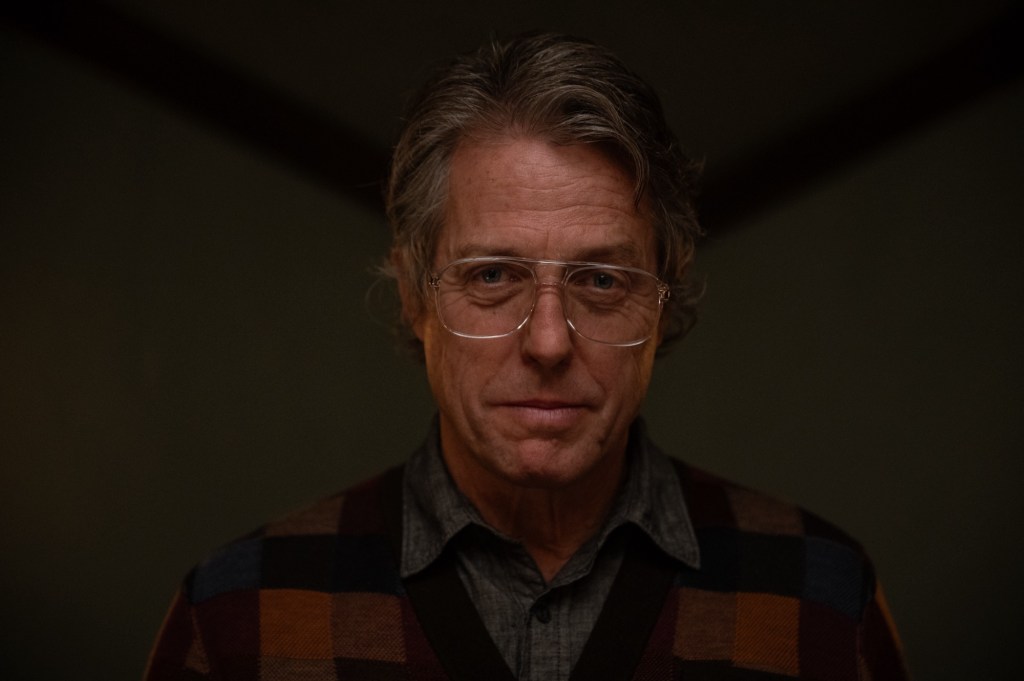
The film is centered on two young religious girls. They are Sister Barnes (played by Sophie Thatcher) and Sister Paxton (played by Chloe East). They are both missionaries who practice Mormon religion. They are doing rounds knocking on doors promoting what their religious beliefs and practices. When they knock on the door of an older gentlemen, Mr. Reed (played by Hugh Grant), he initially delivers a welcoming, friendly attitude. Then, as their conversation continues, his tone as well as his home start to present strange things. He delves into religious topics and suggests that faith has two elements, “belief” and “disbelief.” Given his weird personality, the girls find themselves scared and realize he has trapped them in his home. Soon they are in a deadly game of survival with Mr. Reed. If they cannot prove their theories effectively with him, they may end up never leaving his home.

Grant’s performance in the role of an old, tender yet deceitful man is the fuel to the fire in Heretic. Mr. Reed’s ability to cause the girls to fear for their lives as they navigate his theories creates a complicated landscape. Trying to determine what is known, true, false, or should be rightly questioned in religion and theology are all explored. Heretic delivers a sense of psychological uncharted territory in a dark manner that continues to evolve in an unpleasant way during this cinematic experience.

The focus is solely on Sister Barnes, Sister Paxton, and Mr. Reed—it is like a dueling trivia match where death is likely if wrong. The writing and directing of Beck and Woods keep viewers thinking about religious theories and their accuracy. Do they all eventually agree for the victims to live? The story highlights the lengths to which curiosity can go and leads to a sensational one-of-a-kind death match that is relentless. Heretic leaves the audience repeatedly thinking “WOW” in the back of their minds. The element of surprise is more than what audience expects in Heretic. This film is a genius gem filled with moving parts which portray how someone sinister can find a new maker.

Is there a chance that the girls can escape this evil home? Are the theological and religious theories factual? How well do Sister Barnes and Sister Paxton know their faith? Ultimately, their faith will allow them to find a door to make it out alive. Three-and-a-half out of four stars for Heretic.
The Rule of Jenny Pen Review


The portrayal of derangement in old age is at its finest as the core of  The Rule of Jenny Pen. Written and directed by James Ashcroft he offers a new blend of terror where the lines of laughter find their angles. The Rule of Jenny Pen finds a tone of quirkiness that keeps its genius track. It is a film where the elderly seek revenge. With the performances of Geoffrey Rush (as Stefan Mortensen) and John Lithgow (as Dave Crealy), they both deliver a sinister mode of acting style where they may be nice at heart, but deep down there is a misdirection that is surreal.

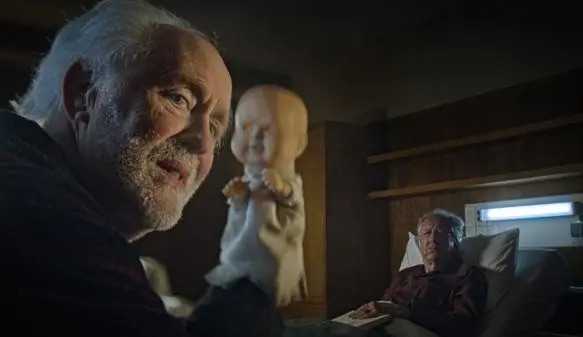
Stefan Mortensen is the main character of the film. He is a judge who finds himself to be in an aging crisis. His health issues cause him to move into a nursing home, where boggled and irritated by having his life transition, he must learn to share with other elderly individuals. One of these folks is Dave Crealy, a demented man of cruelty who is quite terrorizing. He continually pushes to Stefan to play a game called “The Rule of Jenny Pen” which involves a doll with personification to be a tool of rudeness. Once this happens, the film is a gradual ride of laughter and terror (at the minimal level). Repulsive in some fragments, The Rule of Jenny Pen is one of those experiences where tolerance may be a necessity.

The cruelty of the film is where it most captures the attention ofits audience. The Rule of Jenny Pen is a spellbinding and creative journey where a strange form of creativity keeps building a balance between two elderly men in one never-ending boxing match of an anxiety-provoking behavior. It is psychologically crazy, while also killer funny. The Rule of Jenny Pen has a form of writing that blends into humor that is witty—the scenarios may seem disturbing, but they grasp what can also be hysterical. 

With the film’s terror coming from the use of a doll, it delivers the impression that the doll may have powers, which it in fact does in a way. These powers though are discrete. The cleverness though, is how it fuels the persona of the doll as being the source of the blame. Any form of conflict between Stefan and Dave is linked back to the doll. It is a never-ending ride of the blame game, frustrations in the nursing home, and a question of its audience asking who will have a heart attack first.

As the bonkers of agitations go above and beyond (from the performances of Rush and Lithgow), it delivers a classiness of characterization of the quirks of an elderly age. The only add-on is a puppet that becomes the source of the blame and the of the butting heads. The Rule of Jenny Pen does at times lack seriousness and authenticity, but it does right to remain in its lane to be psychologically crazy and fun. Three out of four stars for The Rule of Jenny Pen.

The Piano Lesson Review


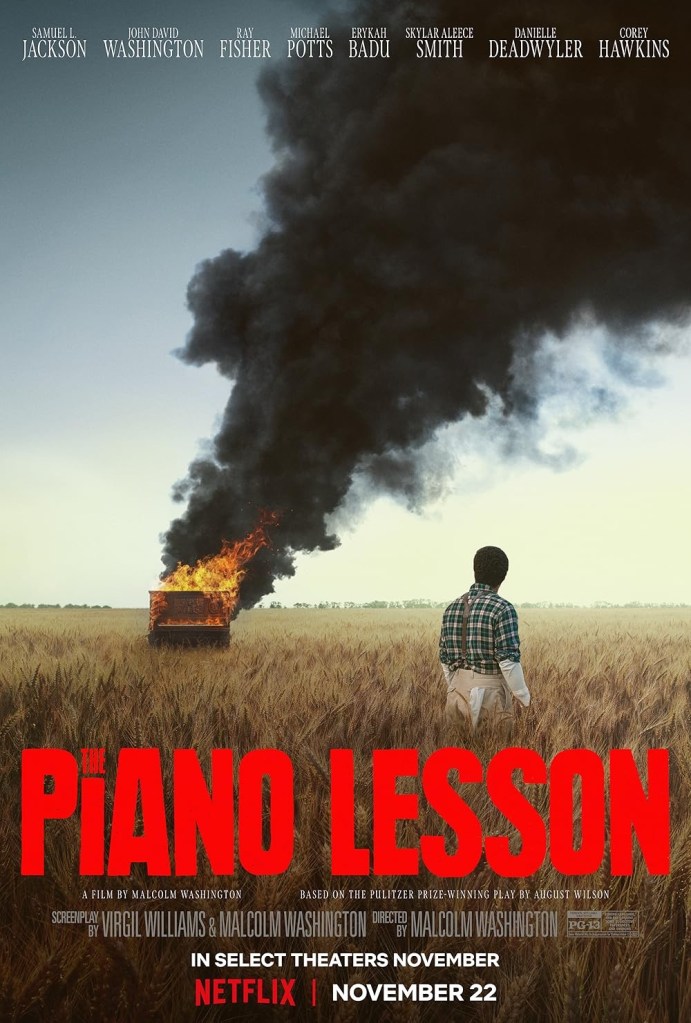
From my experience, I will say that the Washington family has the gift of pontification. They do it all so well in The Piano Lesson. Directed by Malcolm Washington, the son of Denzel Washington, who on his rise to fame. Along with John David Washington (Denzel’s other son), he continues to be an icon worthy of his father’s legacy in his movies. The Piano Lesson is a film where art and appreciation find their value to the deepest core. It is all centered on an heirloom piano and weaves emotions continuously in a cinematically enticing experience.

The film focuses on the Charles family.  The setting is a home owned by Doaker Charles (played by Samuel L. Jackson). In that home is an heirloom piano that is enriched with designs dating back to ancestors with its carvings. The story is based ona play adapted into a film. The conflict though, is between a brother and a sister, Boy Willie (played by John David Washington) and Berniece (played by Danielle Deadwyler). Boy Willie aspires to a brighter future, but only if he sells the piano.Berniece wants to keep the piano—it has much of her legacy engraved. Tensions boil over as the dynamic of family and the meaningfulness of the piano create one long boxing match that is relentless to find a sacred path for all involved with or without the piano.

The dynamics of a large family with many personalities ranging from Wining Boy (played by Michael Potts), Avery (played by Corey Hawkins), Boy Charles (played by Stephen James), and more, make for a lot to take in with The Piano Lesson. It is a fueled drama where the dramatics of seriousness and empathy tango for a passionate scenario—there may be some withdrawals without the piano. The engravings and their meanings are where the disagreements keep creating the flow of a family that falls apart, rejuvenates, and then cycles into the same pattern again,rapidly agreeing then disagreeing about the fate of the piano. 

The evolution of authenticity is surreal in The Piano Lesson. As more arguments and revelations unfold, eerie events begin to happen. In those moments the film fuels its audience to be curious too if there are spirits having expectations. There is the sensation of shifting to create a universe of unexpected tension rising for something unforgettable. The feelings for the piano are the beginning, but the deeper meaning of cultural tides may cause unforeseen consequences.

The direction is superb. The experience is relentless. This film is a theatrical journey—the setting of a time gone by loops in the importance of family at that time.  The presence of the piano is where the film stands tall for a fight to find the light of empathy. The Piano Lesson fuels characterizations and dynamics with a fulfilling atmosphere of serious considerations, of what happens when the feelings surrounding an object of purpose are not taken seriously. Where does the piano stand? Who is in the right? It will take many wrongs before finding the “right” one in The Piano Lesson. Three out of four stars.