Category Archives: Film reviews

From the world of John Wick: Ballerina Review


I love all the John Wick films and I truly adored From the World of John Wick: Ballerina. I enjoyed it from the structure in thebeginning to the pattern of revenge which evolved throughout the film. Directed by Len Wiseman, the aspect that fuels thisfilm is the background correlating to the John Wick franchise. As it moves forward it contains the same momentum that results in non-stop mayhem until a price is paid. It is a rollercoaster that is unstoppable and a force of power that is not to be messed with. From the World of John Wick: Ballerina weaves a mode of continuity that makes audiences come to worship Ana de Armas.

Ana de Armas plays Eve in the film. She saw her father get killed right in front of her at a young age. Her childhood wasrough, but she always has a plan for revenge. She is introduced to Winston (Ian McShane). For those familiar with the John Wick films, Winston is an inspiration for some unsettling and throttling events. Eve begins her training to find the man who killed her father. The dangerous target is The Chancellor (Gabriel Byrne). Over the course of the film, Eve gets her training and finds herself on the run while hunting down The Chancellor. The correlation to John Wick is the presence of his character, played by Keanu Reeves. Wick is not a massive presence, but the correlating lines of vengeance expand rapidly. 

It is a two-hour ride where Armas is brutally and insanely good. The riveting components of revenge leads to in-depth motions that are loud and fearless. Gasp as grenades go spiraling, watch fighting on roller skates, and do not mess with Armas. From the World of John Wick: Ballerina paints a portrait of one “ballerina” that is not be reckoned with. The many intriguing aspects of this franchise’s universe are bound to have more to offer. Three-and-a-half out of four stars for From the World of John Wick: Ballerina.

The Phoenician Scheme Review


As someone who has been fascinated by the artistic mind of Wes Anderson, I found The Phoenician Scheme to be a mix of politics combined with jealousy and egos. I adore Anderson’s craft because his setups and the background of his characters are always created for the audience to feel in tune. He also brings inbig names to his projects, and this film has many.

Before diving into the many cinematic adventures of The Phoenician Scheme. I am going to introduce the main characters. There is Zsa-Zsa Korda (Benicio Del Toro), Liesl (Mia Threapleton), Bjorn (Michael Cera), Prince Farouk (Riz Ahmed), Leland (Tom Hanks), Reagan (Bryan Cranston), Marseille Bob (Mathieu Amalric), Sergio (Richard Ayoade), Marty (Jeffrey Wright), Cousin Hilda (Scarlett Johansson), Uncle Nubar (Benedict Cumberbatch), Excalibur (Rupert Friend), and Mother Superior (Hope Davis). All of them are of major importance to The Phoenician Scheme. Some play roles in the classic XYZ pattern of deceit which is something Anderson has mastered in the most colorful and auteur way.

The arthouse vibe may be alive in this film, but the pacing is off. The film is set to focus on Zsa-Zsa Korda, who has done many bad deeds which have put his life in peril with many trying to assassinate him. The 1950s setting and the era of newspapers and old-school characterizations fuels the wealthy class of criminality in The Phoenician Scheme. Bjorn is the tutor and Liesl his daughter. Soon they find themselves at the end of Zsa-Zsa and his plans to run away or set up backups if people come after him. The writing and dynamics are plausible, but Wes tries too hard to add unexpected components for dramatic takes. For example, one moment there will be danger, and then in the next there will be someone imagining their life after they die. It is not done with a serious tone, but Wes utilizes his brain so much that the result is not as fulfilling as his fans might expect.

As usual, the film continues to focus on the quirkiness and cleverness of its characters, including the politicians and acquaintances of Zsa-Zsa namely Marty, Prince Farouk, Reagan, and Leland.  In most cases, Zsa-Zsa has somehow betrayed them in the past. In fact, Zsa-Zsa’s hiding is the central conflict of the film. The story moves forward with him trying to navigate these conflicts with the help of Bjorn and Liesl. Their presence is somewhat eerie, and the storyline ends up doing a bit of a tango. It is not so easy to put together the various pieces or clearly understand the background. 

This is not my favorite film, but it still carries Anderson’s signature craftsmanship as a director in many scenes. Much of the story is seen through the eyes of Toro and Cera who are key to the film’s humor in matters that would normally be perceived as serious. In the end, this film is the result of Wes being in his own world. While joyful in some parts, the surface overall keeps degrading. Two-and-a-half out of four stars for The Phoenician Scheme.


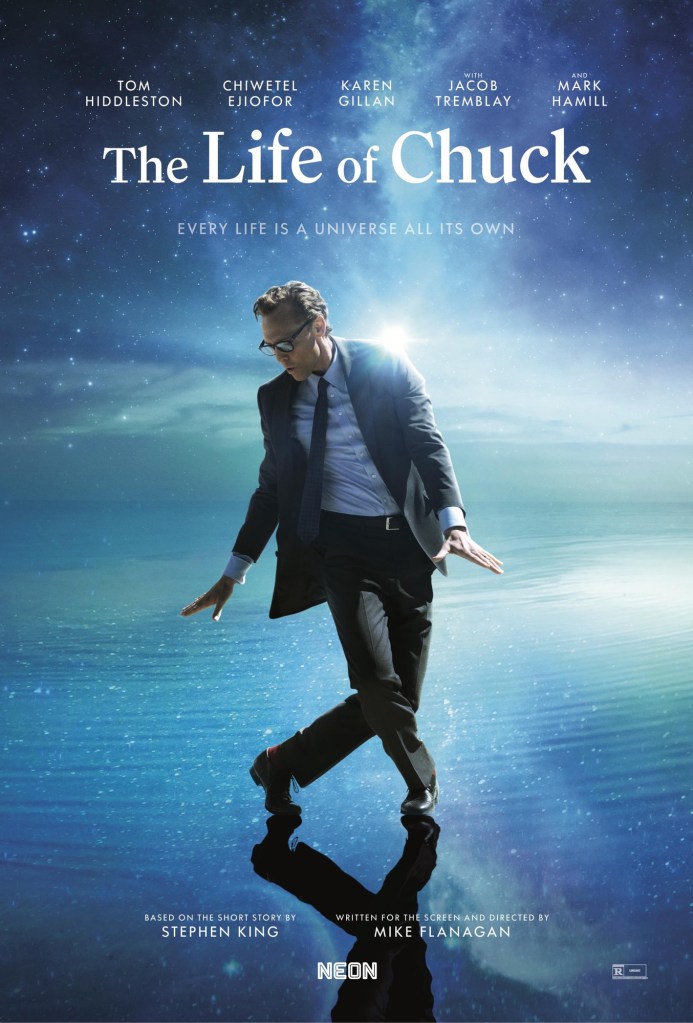
The Life of Chuck Review


This is a film in three acts—they all go in reverse. Each event carries a multitude of what seems to be on track to be mesmerizing or revolutionary. The tracks of inspiration feel on par, although they come slowly and out of context. The Life of Chuck tries to look at life in different fragments. Directed by Mike Flanagan, it is based off of the novel written by Stephen King. Its introduction brings its audience into a place where it all seems lost, but then it transitions to a form of individuality. Once it gets to that component, it becomes sole focused on one man…Charles ‘Chuck’ Krantz. Thomas Hiddleston plays the older version, Jacob Tremblay plays the middle version, Benjamin Palak plays the younger version, and Cody Flanagan plays the very young version. The universe setting of the film all revolves around Chuck, but where does its meaning truly lie?

The film begins with Marty Anderson (Chiwetel Ejiofor), as he is navigating the many weird disasters surrounding California. This brings him to think of his ex-wife Felicia Gordon (Karen Gillan). In uncharted times of global warming disasters, the imagery of Chuck comes up as a symbol of some meaning. Marty finds himself searching for peace within and a means to reconnect with his life. This all comes from the concept of Chuck being the figure around him, because in every moment of stress, Chuck is the spotlight. Older Chuck comes in, and he has a lot of background as a successful accountant. He is the presence that sparks the attention to finding the meaning of life. However, all of this dismisses the global warming factor in a heartbeat.

The switch over is in Chuck’s life. One of which brings him back to moments of his childhood living with his grandfather Albie Krantz (Mark Hamill). In presenting a childhood of despair the momentum is created for Chuck to be a prodigy of some kind. I appreciate the flowing aspect of seeing one having his ups and downs, especially when it comes to being a pro at doing tap dancing or having a talent for mathematics. At the same time though, I ask myself where is the film going? More just because the opening is a separate event compared to what the film leads into.

There is the saying in the film that goes, “Math can be art, but it can’t life.” That saying spoke to the meaning of the film to me the most, because it made me realize that I had to turn my mind to focus entirely on Chuck’s continuity. The ups, downs, the turmoil, the success, and the childhood—there is a revelation looking for an explanation. The lines though, do not fulfill the context in its entirety. It tends to be a lot because of the cliffhangers that fall in between the reverse storyline approach; however, there is a narration which keeps the film afloat. It is a film that guides the audience to be mesmerized by Chuck. It just does not link to the beginning very well. An artistic approach that has a hard time connecting the importance of a multitude of events  in reverse order. Two-and-a-half out of four stars.