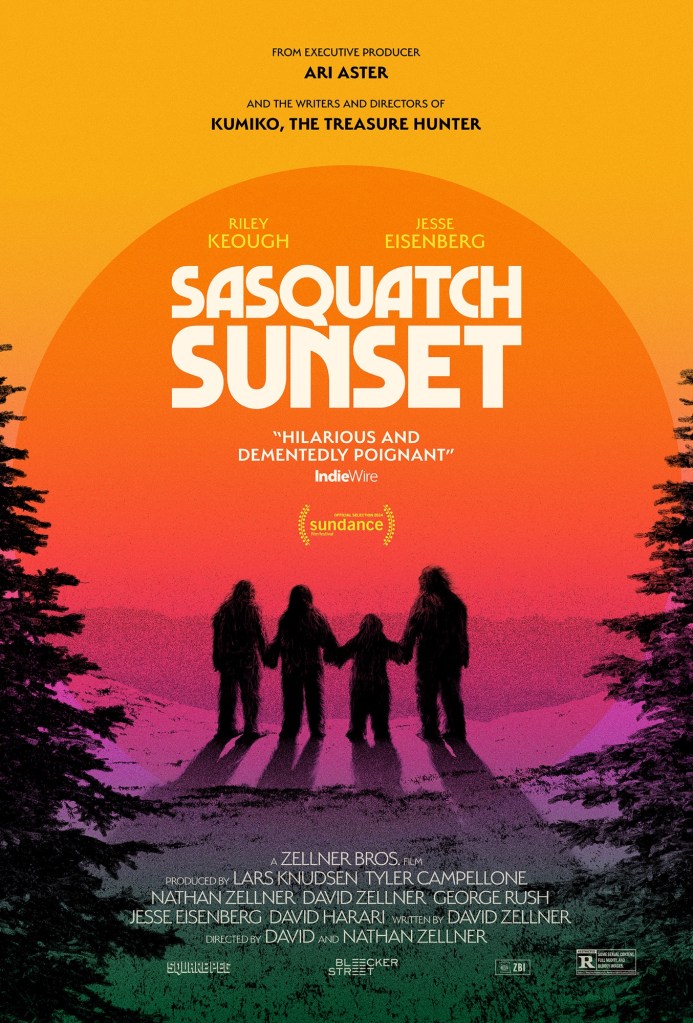
Sasquatch Sunset Review


This film opens with vast mountain scenery that represents a form of surreal solitude—the presentation looks and feels peaceful and rejuvenating. Then the film jumps to a family that is obscure—a family of sasquatch creatures. The creativity of Sasquatch Sunset is unique and fearless—the film itself feels like uncharted territory. However, I felt sold on it for the first thirty minutes, and then later I felt there were multiple blurred lines in the continuation of the film itself. Directed by David and Nathan Zellner, their attempt to create a strong form of portraying a unique environment is almost accomplished, but the line of continuity just continues to be halting.

The film is about a family of sasquatches, and they have no names. The celebrities as the sasquatches are Jesse Eisenberg, Riley Keough, Chrisotpher Zajac-Denek, and Nathan Zellner. The focus is on the life of this sasquatch family in the forest over the many different seasons. Nature takes its course to a heavy extent. There is no dialogue though, only repeated grunts, gibbers, and all kinds of animal sound effects. All of which give a pretty clear understanding though, as one of the beginning moments is where two of the sasquatch creatures engage in having a sensual moment. That scene gives off the feeling that Sasquatch Sunset could be decent, neutral, or mediocre.

With all the nature vibing, the life of the sasquatch family in Sasquatch Sunset has no clear point to give the film continuity. I felt that it was like a lighthearted version of a Planet of the Apesflick…there are just no humans or spoken language whatsoever. Its scoring and use of music is what creates the euphoric and somewhat inspiring atmosphere. The sasquatch family gets hyperactive and enthusiastic with the resources of their forest—turtles, plants, and drenches are where their positivity thrives. They may not be able to speak, but their facial expressions are their key to understanding their forms of communication for the film’s audience. How does this bizarre family of creatures find their connection? What are its writers trying to accomplish? Is their home in the forest their center of massive conflict?

My mind kept swerving back and forth with Sasquatch Sunsetcreating a blur. I thought to myself that the territory is clearly one that is taken and making the sasquatch family feel violated. If that was the case, why does the film resort to so much grunting and crazy buffoonery. “Buffoonery” in terms of how they act when they are not pleased. A lot of which I do not intend to describe, as it is on the side of grotesque. However, if the audience likes what is twisted, then they will get their money’s worth of “gross” in Sasquatch Sunset. I will say that the many behaviors made me have a clear understanding of the reasons why this film had people walking out at the Sundance Film Festival this year. It is clear this was not everyone’s cup of tea. It may be for some, but not so much for me. I will say though, I give this one credit for its different idea even though it did not find the right path of execution.

There is a moment where the sasquatch family comes across a tree and that sets off curiosity—a major layer of “curiosity” because the sasquatch family just starts eating from the tree. Then there is another tree found, and one of the sasquatches despises the taste of that second tree—animal instincts are clear and descriptive of what the underlying turmoil can be in Sasquatch Sunset. After they eat from a bad tree, there is a bizarre eagerness, how an animal would react if they were overly-excited. They do not speak, but they grunt and cheer on a bonkers level.

This is a ninety-minute nature escape with suspense in the craziest matter and repulsive to the extreme. Its writing makes its viewers think of nature along with the creatures (who roam like animals). From this setup, I felt like there would be more surreal tones of connection and a unique-type feeling. I thought of films like Where the Wild Things Are, March of the Penguins, and Jumanji—films of creatures, animals, or humans finding a course of action in an unknown territory. There is that setup of trying to find peace for the odd sasquatch family in Sasquatch Sunset, yet its presentation is just scattered and quirky.

This habitat that is natural for the sasquatch family is not so much for the rest of its audience. The big question…where is nature going? Especially with a moment of the sasquatches coming across a boom box and going into a mental state of craziness. I was rattling my head thinking maybe it was haunted. The forms of the forest seem to be haunted by layers of normalcy…the building blocks of nature are not part of the clever process of the film’s continuity…it makes for a below average portrayal in Sasquatch Sunset. Is there a point? Is there a layer of importance I was missing? Where is the narrative or poetic vibe in this film? I had a hard time seeing it. I do credit the film for its heavy direction in unforgettable scenery though. Two out of four stars for Sasquatch Sunset.

EbertFest 2024…Star 80, Conducting Life, & The Light of Truth: Richard Hunt’s Monument to Ida B. Wells


The opening night of the 25th Annual Roger Ebert’s Film Festival began with Bob Fosse’s Star 80. In this this film, boundaries were challenged due to the behaviors in a pressure-filled relationship. Award-winning actor Eric Roberts attended the festival and engaged in a discussion after the film. Hearing Roberts talk about his days working on the film added much emphasis to the experience. The sense of realism in the diverse viewpoints about Star 80 still captivates with evolving revelations. Roberts talked about how Fosse was a director who had some strange behavior patterns himself, in part related to drug use. Roberts has continued to persevere as an actor and to this day Star 80 remains one of his most well-known films.

This film is a true story of a monumental talent. It is brilliant, spellbinding, and only half an hour long. Conducting Life follows the life story of a man who worked through his way upto make it as a conductor. That man is Roderick Cox and this movie about his passion, trials, and errors is under the direction of filmmaker Diane Moore. The exploration of talent and what it takes to truly grow as a conductor is inspirational in Conducting Life. Cox is now on the road working as a conductor in many places around the world. Seeing his story moved me and resonated with the audience. Persistence is where Conducting Life shines with an encouraging message to never give up.

Directed by Rana Segal, this is an honest, artistic documentary about the struggle for culture and rights. The story is real and is supported by layers of empathy. The Light of Truth: Richard Hunt’s Monument to Ida B. Wells paints a portrait of how racism and history have important roles to play in art. It follows an artist, Richard Hunt (who has sadly passed), who builds meaningful sculptures involving his backstory and his ethnicity. His art is also a way of showing appreciation for how times are different than the past. Hunt’s legacy involves honoring the work that African American journalist and activist Ida B. Wells did fighting for racial and gender equality. This film is an insightful portrait of courage and positive empowerment.

La Chimera Review


The film opens with faded lighting and as it progresses is captured like an artistic archive.  La Chimera glows with glimpses into a world of aspirational wonders. The Italian director Alice Rohrwacher’s film is both an empathetic and vibrant experience. Its set in Italy in the 1980s with beautiful landscapes serving as part of the film’s foundation. La Chimera takes a wholistic approach with its narrative involving an extensive search for artifacts through uncharted territory.

The film focuses on Arthur, played by Josh O’Connor, a tomb raider, referred to as the Tombarol. Arthur’s job is digging and searching for archeological artifacts that are in tombs in various places in Italy. His old friend Flora, played by Isabella Rosellini,is elderly and suffers with some health issues. Flora’s assistant is Italia, played by Carol Duarte, who is learning to sing and but is tone deaf. Arthur has a friend Pirro played by Vincenzo Nemolato who is his partner-in-crime in their search for artifacts that they’re hoping will be profitable. Arthus, however, is frustrated that his earnings aren’t what he anticipates given his time and devotion to his job. He reports his finding to Spartaco, played by Alba Rohwacher, who handles the public relations, and determines the value of what Arthur and his team find.

The film’s direction is poetic in portraying Arthur’s point of view. He takes his artifacts seriously and has skills and knowledge to figure out where to search. Arthur is also suffering from a loss, and the artifacts keep him occupied. Unfortunately, Arthur is under-appreciated, and many see his research as a gimmick or a waste of time. His friends Flora, Italia, and Pirro help inspire him to continue his search.

La Chimera is a journey where interesting dynamics lead to something more life changing. The forests and landscapes fuel the invigoration in La Chimera. Arthur is trying to find artifacts, Italia is dealing with being a servant, and Flora is struggling with health issues. Whatever is found in the depths of Arthur’s research could change the lives of those around him. Hatred flows through the community of the people that despise Arthur’s work. Arthur is not a bad person, but he is viewed by some as a con artist. Arthur’s persistence in La Chimera makes the movie lively for its audience.

The writing and lighting combine to send a message—the bigger the artifacts, the greater the chances of a promising livelihood. There are many pleasing discoveries in the story and the revelations go deep in La Chimera. There is a hidden irony in the revelation that the hard work will not benefit everyone. While there is a notion in the film that the tasks at hand are detrimental, in the end persistence leads to finding somethingmore rewarding. Three-and-a-half out of four stars for La Chimera.

Treating cinema in many forms of art!