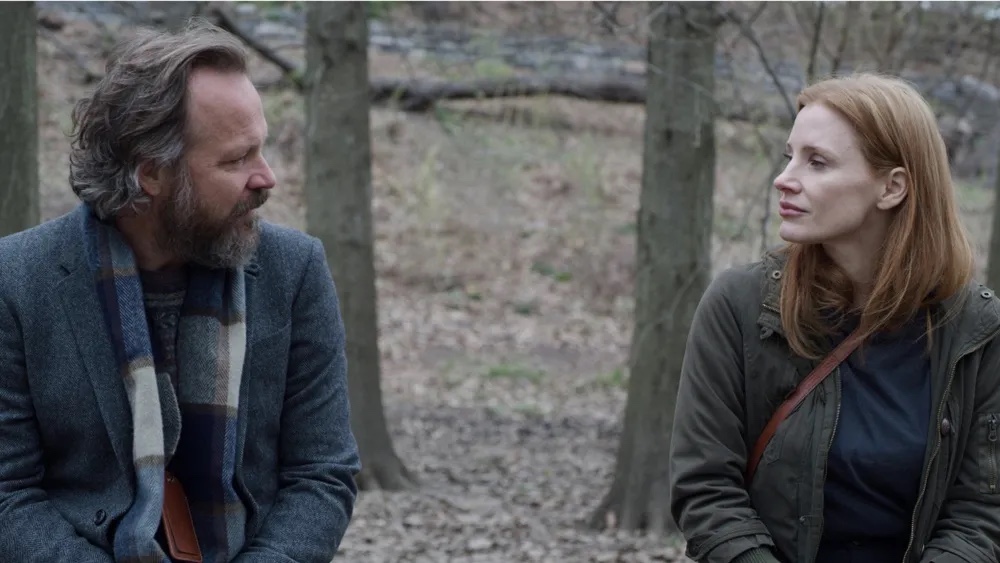
Memory Review


Memory is a film that deals with past problems that remain and the life going forward that is yet to navigate. It shows that moments of the past can raise their heads to bring out the worst in people’s lives. It also explores the different sides from various angles centered around a conflict. Memory is a film about channeling anger. Director Michel Franco brings his audience into a world where choices led to consequences and how they have evolved as time went on. Memory is true to its story and its direction as details come into play. It displays that there is still good that can be done regardless of what was done in the past.

The film is centered on a woman named Sylvia, played by Jessica Chastain. She is dealing with past issues of substance abuse and a whole range of other problems. She has a daughter named Anna, played by Brooke Timber. Sylvia is a social worker in a daycare for adults with learning disabilities. She helps people who are incapable every day. She is also trying to reconcile a difficult relationship with her Anna as well as tryingto grow closer to her sister Olivia. Olivia is played by Merritt Wever. Sylvia is introverted due to her emotions. She decides to come out of her shell and attend her high school reunion. As she walks back from her reunion, an odd gentleman follows her back home. This gentleman, Saul, is played by Peter Saarsgard. At first, Sylvia is confused by Saul’s presence. She gets in touch with his brother Isaac, played by Josh Charles, and learns that Saul has dementia. From Sylvia’s realization, she sees that Saul is also having trouble adapting to life due to past problems and mental health issues.

The writing and dialogue feel a bit generic at the start of the film. The melancholy vibe if the directorial style seems appropriate for Memory. There is the concept that after dealing with hard times its main characters do not have much to say. What they do have to do though, is to deal with the reality of the present. Franco’s directing is faithful in this portrait of a drama that is one-of-a-kind.

The correlation of conflicts that lies beneath the surface for both Sylvia and Saul creates connections of empathy in Memory. The melancholy feeling of Memory is a landscape of human emotions. Despite both Sylvia and Saul dealing with their detrimental scenarios, they learn to reassess their lives. That is because of their shared past. They went to the same high school and have had underlying problems that they have carried with them forever. Despite their rough history and troubling conflicts, Sylvia looks after Saul on a regular basis. They spend time together and build a relationship, but is their growing relationship because of their vulnerability?

There is also that side of Sylvia showing deeper concerns for her daughter. Her daughter has that attitude of being hateful and vindictive, because of how much her mother shelters her. As Sylvia navigates her errors with her daughter, she sees more growth with helping Saul. As Sylvia gains clarity, she begins to care seriously about her daughter’s secretive behavior. Anna is distraught at how her mother has rules and how she feels her life is in turmoil. The dynamics of Memory are vast with problems going from one individual to the other. It is hard for Sylvia, Anna, and Saul to keep their heads high, but all they can do is try. It is a more difficult struggle for Saul than it is for Sylvia. Sylvia can support herself financially, but Saul cannot. The past and mental health problems impact him the most.

It is an experience where any human can feel rough emotions from the past at any time in their life. Anna finds herself distraught with her mother’s silence—it is belittling and condescending with layers of detrimental conflicts. The lighting in the film is neutral—that is in juxtaposition to the dynamic between Sylvia and Saul in Memory. The truth of Sylvia’s problems is a harrowing past that is unforgivable. Sylvia and Saul are fall in love simply because they feel there is no one else to care for them. Those who are in their lives only remind them of their failures.

Memory is not an experience of happiness. There is a neutral quality throughout the film meant to enhance its sense of reality. The eerie and quiet feeling displays the emotion of a loving heart. The performances of Chastain and Saarsgard is a revelation of humanistic nature, and it is a ride of mixed feelings that keeps its audience thinking about the human condition thoroughly. Three and a half out of four stars for Memory.


The Teachers’ Lounge Review


The profession of teaching must follow codes of conduct and a set of instructions in order to protect both teachers and their students. Likewise, there are also rules that students are expected to abide by, and they do not always understand given their young developing minds. In The Teachers’ Lounge rules and confidentiality hit the fan drastically. This makes for a movie experience that is both mentally draining and captivating. The choice of a particular teacher spirals the audience into the examination and inquiries involved. In The Teachers’ Lounge the question remains, “Is this proof, or an assumption?” The answer unfolds in the realm of a hectic and low-paid profession and quickly moves in an audacious direction in The Teachers’ Lounge.

I was raised in a family of teachers and professors and The Teachers’ Lounge spoke to me truthfully. The level of tolerance and patience needed each day is the key to understanding the film’s depths in portraying a hard scenario in a school setting. Especially when the rights of teachers, rights of parents, and rights of students are involved. The film shows that being a teacher is a career where a cautious mind is essential to solving many problems…no matter how big or small.

The Teachers’ Lounge takes place in Hamburg, Germany. The main character is Carla Nowak (played by Leonie Benesch). Carla is a schoolteacher of young students and her school routine is a consistent part of her daily life. That is until there is a theft, as Carla reports an individual that she suspects has stolen from her. That individual is a faculty member, Friederike Kuhn (played by Eva Lobau). Going forward, when disciplinary actions are taken, the matter does not remain quiet. The other factor to this problem is that Friederike’s son Oskar (played by Leonard Stettnisch) is also Carla’s student. With Friederike facing serious charges, Carla’s career begins to spiral downhill. Oskar starts to act out badly in her class as rumors go around about what has happened, and Carla struggles to keep her confidentiality intact as a teacher. Oskar becomes stuck in the middle of this intense and confusing matter with his mother and as a student. The question becomes one of who is most at risk in this confusing and frustrating scenario.

The writing in the film dives deep into a portrait of how rules and school systems begin to be at risk when serious questions develop. The parents of other students become infuriated, and Carla’s students act out more. The picture is thorough in pointing out that scenarios are not as private as some may think…even for teachers. Despite how true Carla’s case might be, there are still consequences. With rebellious students, the ugly dynamic is hard to tolerate, and Carla has no choice but to put up with it to keep her integrity.

This is one of the most chilling, exhilarating and mammoth experiences I have had with an international feature. It is a film in which going by the rules is questioned, along with the pressure of grueling rumors that carry through the film and enhance its psychological tension. The Teachers’ Lounge is unforgettable and the direction is on par with its inner conflict of underlying issues. It eagerly puts together the moving parts of the dynamic for a resolution. What will come of all this turmoil of a theft scenario? Who will suffer? How does it impact the faculty and the students? Find out in The Teachers’ Lounge. Three-and-a-half out of four stars.

Mean Girls Review


This is a repeat of the 2004 Mean Girls film, but with a combination of different actors, some returning actors, and musical numbers. Mean Girls is a new revisited experience. In this version, adolescence goes into the modern age of technology. The old version was during the era of flip phones and before social media. In today’s version, social media takes a turn for the worst. Mean Girls is still about favoritism, class divisions and being cool. Mean Girls takes the original high school story up a few notches as it explores a concerning development. The movie is catchy throughout its adolescent-focused direction.

In Mean Girls, the new Cady Heron is played by Angourie Rice. She moves to the United States with her mom Ms. Heron (played by Jenna Fischer). Angourie struggles to fit into the classroom setting in a diverse high school full of dim-wit nerds and jocks. Cady is a brainiac and becomes friends with Janis and Damien. Janis is played by Auli’l Cravalho and Damien is played by Jaquiel Spivey. They are Cady’s mentors in this new world of high school. Cady then becomes friends with the evil Regina George (played by Renee Rapp). Regina’s group also includes Gretchen (played by Bebe Wood) and Karen (played by Avantika). Regina feels she is the queen and able to help Cady learn the rules of being cool and part of her clan, “The Plastics.” Being “plastic” may have its perks for Cady…until it creates a dynamic which impacts her relationship with the boy of her dreams, Aaron (played by Christopher Brinley). The film is entirely the same setup and premise as the 2004 version, but with musical numbers in between the conflicts.

The shift in Cady’s life is where there are realizations of truth. However, the context and the characters do not always seem to fit. For example, Cady’s personality is much shyer this time around. When she does gutsy stuff to boost her popularity, the believability lacks. Audiences watching the new Mean Girls will constantly be thinking back to the 2004 version. Tim Meadows is back as Principal Duvall and Tina Fey is back as Ms. Norbury. Reuniting these two characters will cause audiences to get their hopes up. However, they are in this film for much less time. Their reunion also has little to do with this musical adaptation of the film. Fortunately, focusing on today’s society and its impact on Cady’s character is what increased my appreciation for this version of Mean Girls.

The tensions are high as backstabbing goes back and forth. The “Burn Book” returns and with it the haunting premise of betrayal among adolescents brings realism to Mean Girls. The whole concept of labeling people to assert power over others to be popular is focused on again in this story. The tensions and hormones go awry with added musical moments in this new version of Mean Girls. It is a slick film that searches for answers to the challenges adolescents face today. Three out of four stars for Mean Girls.

Treating cinema in many forms of art!