Origin Review


Origin is a deep film which is faithful to a true story. The film is about a meaningful journey in society with moving elements as well as an inspiring purpose. The cinematography in Origin delivers seriousness and the technical environment creates tension. Origin is about the writer Isabel Wilkerson played by Aunjanue Ellis-Taylor. Wilkerson is the author of the 2020 novel Caste: The Origins of our Discontents, a book that was published during the beginning of the Black Lives Matter movement. Origin is the story of Wilkerson’s approach to her novel and various issues surrounding her research.

The film has a sense of tough love experienced while trying to find the right places. Origin begins with Isabel and her husband Brett (played by Jon Bernthal) and then transitions to Isabel being asked to write a piece about the Trayvon Martin case. Isabel is focused on doing research and writing the story. Herwords are her art and her voice. Many things happen in her life which cause her to feel depressed. Her husband and her mother die, and her sister Marion (played by Niecy Nash) is all she has left. The story that comes to her mind based on her research is how race and caste systems have evolved in society.

The film jumps to a narration of human divisions from prior eras when there were serious restrictions based on race. Origin is a portrait of how dynamics in society have changed over time. The inspiration for Isabel is the in-depth focus of her research and her prolific writing. Her mind boils with emotions as her goal is to write a thesis based upon her research on minorities, racism, and caste systems. Origin is a portrait of how reality has stressors that can be hard to tango with.

As Isabel begins to dive deep into her story, rising empathy grows throughout Origin. A moment of grief inspires change. A moment of loss causes a sad climax. Origin is an experience which demonstrates that life has meaning. The film’s writing and direction develop characters trying to fulfill what provides light in their lives. Isabel believes instead of soul-searching with one specific focus, she can expand her horizons. Isabel strives to connect the dots of racism and loss into a story that can inspire the world.

The mission of the film is to offer a refresher on past eras and how they have evolved. Origin reminds its audience that even though rules and systems for minorities have shifted, they still exist today. The presentation of Isabel and her research offers athought-provoking experience. The film’s honesty and sense of sadness flow throughout the story.

Racism in politics, countries, systems, and theories— all connect for a riveting story of truth in Origin. As part of her research, Isabel visits other countries, including Germany and India, to understand their political systems and their evolution over time. She finds herself in turmoil when she faces disagreement with her beliefs in other countries. Although there are “structural similarities,” each country has developed their own society in their own way which has led to different outcomes. Origin is a revelation of empathy and hope as it provides context which aids understanding. The film and Isabel’s story will touch many hearts. Three-and-a-half out of four stars for Origin.
The Boy and the Heron Review


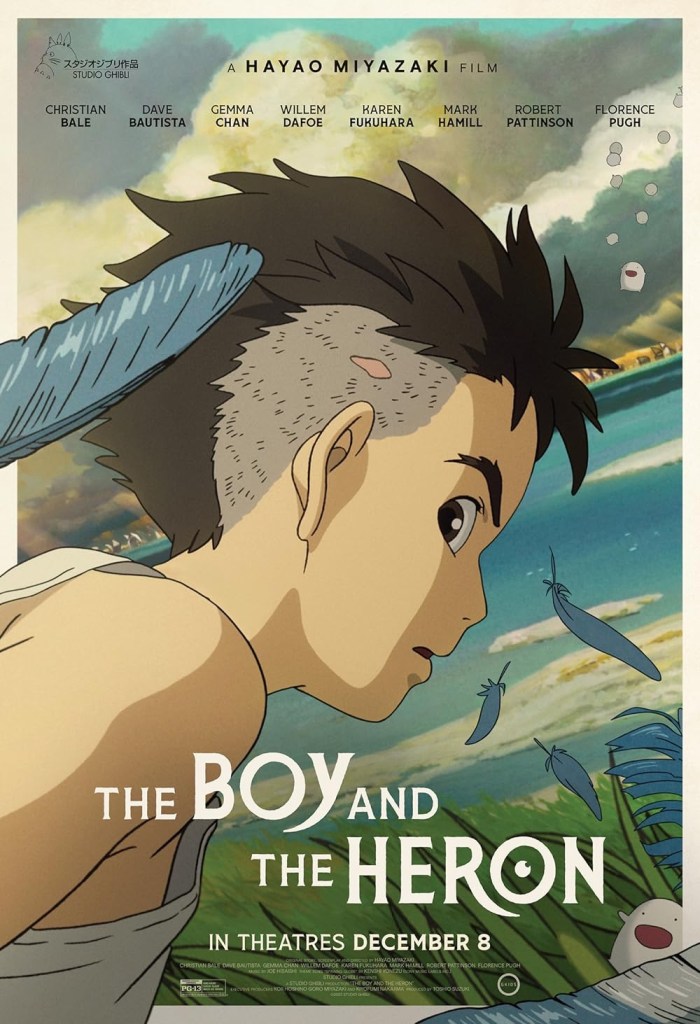
The mind of director and writer Hayao Miyazaki gives his movies verisimilitude. He brings his audience into a world of wonders with strong bonds to a fascinating reality. The Boy and the Heron is a new world of wonders that left me breathless. A tale where something is lost but has a chance to be regained by taking a chance and adventuring into the unknown. With Miyazaki skillfully adding depth and emphasis to his animations, The Boy and The Heron soars with faith and ambition. The magical imagery in The Boy and the Heron is an experience that is hard to forget.

The film is set in a fantasy post-war era. The story focuses on the character Mahito (voiced by Luca Padovan). Mahito’s mother has died, and he moves to his family’s estate with his father Shoichi (voiced by Christian Bale) and his stepmother Natsuko (voiced by Emma Chan). Mahito struggles with the grief of losing his mother. Repeatedly, in his head he hears his mother calling him for help. Mahito is visited by a Grey Heron that always shows up unexpectedly and he takes this as a sign. This leads Mahito to follow the bird (voiced by Robert Pattinson). After he is told that his mother may still be alive, Mahito is in for an adventure that he will never forget. It takes him into a world of the living and the dead. Death is an end, yet there is a new start from where life leaves off. Mahito and the Grey Heron embark on an adventure where Mahito may be able to find the missing aspect in his life…his mother.

The Boy and the Heron is a journey into the unknown with an added layer of faithful significance—Mahito’s name means sincere one. Mahito is the meaning of everything that happens around him as he embarks on his adventure with the Grey Heron. A sense of disconnect surrounds Mahito as a more revealing and empathetic atmosphere gradually increases throughout the film. His experience opens up a world of possibilities. The writing of the film fulfills that aspect of despair finding hope. It does so in its fantasy elements as Mahito goes deeper in his journey.

To an extent, this is one of the most authentic animations I have seen in ages. Its presentation flows like a classic novel through vast narrations in key moments of the film. A new door is unlocked around every corner of The Boy and the Heron.

Will Mahito find his mother? Will Mahito find a new direction in life through his adventures with the Grey Heron? There are a few moments in this film that may not make sense at first, however they are where the empathy builds. It is an experience where humanistic aspects will truly touch audiences in afantastic display through the mind of Miyazaki. Three-and-a-half out of four stars for The Boy and the Heron.

Monster Review


In Monster, the audience will feel a sense of concern due to thetension that boils from the beginning of the film. An outburst evolves into surreal aspects in Director Kore-eda Hirokazu’s Monster. The movie offers an experience in which a portrait of behavior leads the audience into unknown directions on a worried search for answers. The film’s opening scene of a building on fire and children running is an illusion of what the film’s actual problem is. Hirokazu’s direction is based on his audience putting together pieces of the puzzle.

With a vast landscape offered in the surprising introduction, the plot starts with a smooth approach. The film takes place in Japan and introduces us to a mother Saori (played by Sakura Ando) and her son Minato (played by Soya Kurokawa). Minato starts acting in bizarre ways. He cuts his hair shorter, has outbursts at home and at school which causes a concerning and detrimental journey for Saori as a mother. It comes to her attention that his teacher, Mr. Hori (played by Eita Nagayama) may have assaulted him. Saori goes to school and talks with the hierarchy which is not of much use due to strict rules and confidentiality. Slowly, however, the turmoil of Saori, Minato, and Hori begins to go awry.

The film is well paced. It jumps to the conflicts that have occurred and then reverses. It is an experience where it is not easy to put together the pieces of an unfortunate event, but solving the puzzle causes a continued fight for boundaries. Mr. Hori consistently fails to respect people’s wishes and tends to act out. Based upon Saori’s concerns, Mr. Hori’s career starts to be problematic due to his erratic behavior. Minato’s behavior is also a problem. The clashing of personalities in Monster gets to point where hardship is inevitable.

Honesty lies in the depths of Monster. The writing of the film provides context for the set of rules which the teacher follows. Mr. Hori’s personality is impatient and bizarre, and he displays an abusive tone. With frustrations rising for Mr. Hori, the writing continues to be vivid regarding the realistic consequences given the matters which are non-negotiable. Monster offers an unforgettable portrait of the reality of matters that are irreparable.

The film is a poetic experience involving the sensitivities in life. Saori has conflicts with Minato, and Mr. Hori is in a bind due to his behavior The portrait of Minato and what is happening in his mind is visually captivating. With his changing behaviors, the audience is left to worry about everyone associated. There is evidence to explain what is happening, but is it true? Did Mr. Hori hurt Minato? Is Minato dealing with grief after the passing of his father? With the events happening and then reversing, there is a deeper context which is a “monster” in all the characters in the film. The spellbinding writing in Monster creates a monumental maze of questions, realizations, meaning, symbolism, friendship, and disconnect. Three out of four stars.

Treating cinema in many forms of art!