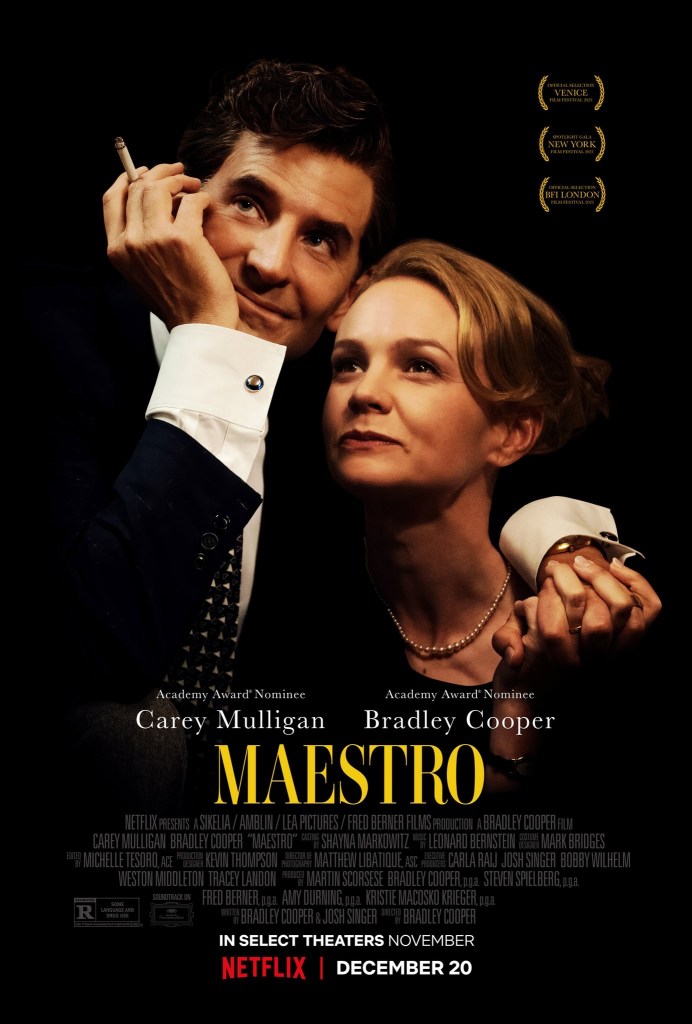
Maestro Review


The musical direction is strong, the artistic direction is unique and relevant, and Maestro is simply one of the most audacious and vigorous experiences from the mind of director, writer, producer, and lead actor Bradley Cooper.

Maestro will take viewers deep into thought as the film captures many captivating moments in the life of conductor-composer Leonard Bernstein (Cooper) and his relationship with his wife, Felica Montealegre Cohn Bernstein (played by Carrey Mulligan). Bernstein had a lot to live for, but it came with many struggles as well. Maestro is simply majestic in its stellar experience of grandeur and musical galore. It is also a story about emotional distress that eventually finds light.

As Leonard gains success with his music and composing, the stress of fame and his devotion to his craft begins to take a toll on his relationship with Felicia. The film weaves musical moments with many interesting dynamics between Leonard and Felicia. The film finds its sinking points of saturated black and white cinematography in the beginning, and then lights up as it progresses. Cooper’s use of this technological form enhances the richness of the film while emphasizing the darkness and turmoil that was hidden within Leonard.

The authenticity of Maestro shines within the eyes of Leonard and Felicia. Felicia is not fond of Leonard’s behavior or the reputation he is gaining, and she lets it be known. He is a brilliant conductor-composer, but he isn’t always the husband or father that he would like to be. Their children begin to have problems and, ultimately, Leonard must find what is right. In interviews during that time period Leonard talks about not seeing much positivity as a composer, and he makes it clear he is depressed. But can he turn despair into hope? Does he want to build a positive reputation and be an icon who inspires? Time will tell.

The film’s development of the relationship between Leonard and Felicia in Maestro is daring, brutal, and emotional. Cooper and Mulligan are a revelation together, and they both deliver Oscar-worthy performances. My only issues with the film centers around the very dramatic, almost disturbing at times, portrayal of Leonard’s mental struggles. The plus side though, is that the realism is almost poetic. It just felt very eerie at times.

Overall, though, Maestro is an unforgettable and alive experience with great cinematography, great acting, and a strong storyline. The story of Leonard Bernstein lives with purpose and beauty in the film. It reminds us of why life is important and what a person can accomplish when they have talent and passion, and they find their joy in their craft. Leonard certainly had those traits, and Bradley Cooper has them as well in his portrayal of Leonard. Maestro will leave its audience with feelings of glory and sensitivity. Three out of four stars for Maestro.
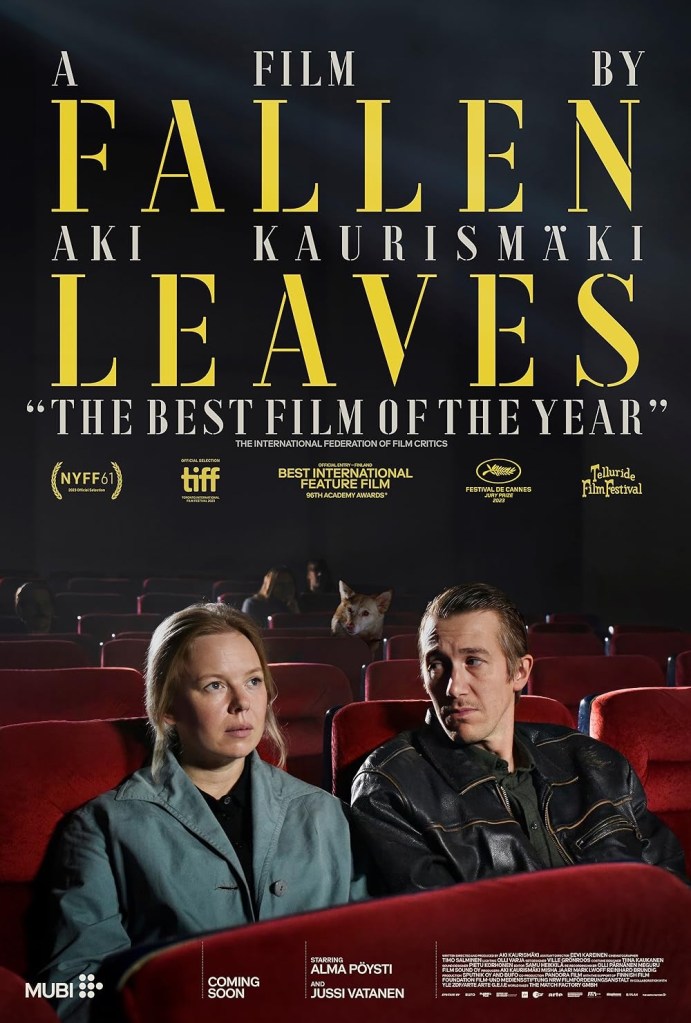
Fallen Leaves Review


This experience will leave audiences asking, “What does it mean to improve and to thrive? and “What does it take to establish a connection?” Fallen Leaves is all about connection coming about in unlikely places. Director and Writer Aki Kaurismaki’spoetic film is set in Helsinki, Finland. He uses lighting to reflect frustration and shame in the beginning. As the film progresses, it reveals more aspects of the reality of the period in which it takes place. Fallen Leaves is a film where personality melds with frustration—because it links two individuals. Both characters will bring the world of fascination and realization into a new and unforgettable light in Fallen Leaves.

The film’s opening focuses on a lady named Ansa (played by Alma Poysti). She is dealing with some financial mistakes as well as struggling to hold down a job. The film begins with her job in a supermarket that falls apart. Then the film jumps to Raunio (played by Martti Suosalo). He is a construction worker who has alcohol abuse issues and deficits at his own job. While consistently falling behind at work, and not having his act together, more tension comes into Raunio’s life. Ansa goes to a karaoke bar, and Raunio goes to that same bar. The film turns into a journey of Ansa and Raunio building a friendship out of nowhere. Their relationship is portrayed with a sense of believability and a humanistic nature. Their eyes for each other are one-of-a-kind.

The film’s writing highlights the errors of Ansa and Raunio, but also on building their self-esteem. The tone of frustrated human beings is pervasive through the dramatic directing in Fallen Leaves. The bonding between Ansa and Raunio is somewhat sporadic. There is a moment where Ansa finds Raunio passed out by a bus station and from there the friendship deepens in the most empathetic way.

Ansa and Raunio go to a cinema and see the movie The Dead Don’t Die which is a film directed by Jim Jarmusch (one of my favorite directors for his artistic talents and creative vision). This part of the film spoke to me because of the way Jarmusch uses cinematography in his projects that is quite like the cinematography used in Fallen Leaves. There is that unique connection in the cinema, the place where movies can create memories and bring people closer together. Fallen Leaves is a gem of fine cinema with unforgettable depth.

The bond between Ansa and Raunio is one that is tested—their own errors test the boundaries of their evolving friendship (which might become a relationship). It is enthralling in the sense of two individuals doing the best they can at a time when they are dealing with several obstacles. Together, there is a spirit of encouragement to change their routines for a better life. The lighting helps to capture the essence of vulnerability in the authentic direction of Fallen Leaves.

Fallen Leaves is a faithful portrait of what it means to take on life’s unexpected challenges. I love the fascinating connection between Ansa and Raunio who are inseparable despite their flaws. Fallen Leaves is one of the most artistically triumphant films I have seen in a long time. Fallen Leaves proves that change can make a positive impact on someone’s life. For example, if Raunio were to stop drinking, Ansa would have more faith in him as a kind soul and he would have more faith in himself. The film is an empathetic look at going through turmoilto find what is right. Four out of four stars for Fallen Leaves.

The Royal Hotel Review


The title The Royal Hotel is not the meaning its audience thinks. It is an experience where it finds its uncomfortable elements. The premise is promising, the acting is stellar, but the writing falls short in its lack of continuity. The result is a messy blur of a story. Written and directed by Kitten Green, The Royal Hotelis about a vacation going awry. The film is not lacking in narrative, but it continues on a path of redundancy. It does not stir any feelings whatsoever after experiencing it and leaves the viewer flat.

The film takes place in Australia and revolves around the relationship of two best friends, Hanna (played by Julia Garner) and Liv (played by Jessica Henwick). They are backpacking around the country and enjoying their adventure. All of this changes when they find themselves in a financial debacle. This puts them in a situation where they must find temporary jobs in order to have enough money to continue on their travels. They are assigned to work at a pub behind “The Royal Hotel.” As soon as they show up, they realize the place is questionable with a negative energy. The pub is in gross disrepair with broken showers and rude patrons indulge in drunkenness daily. The two managers are Billy (played by Hugo Weaving) and Carol (played by Ursula Yovich). They deliver poor training to Hannah and Liv, but the two young women learn to deal with it initially, until things begin to change.

With their touring being on hold for Hanna and Liv, working at the pub becomes their new existence for the time being. However, the continued drunkenness of the bar’s customers is hard for them to bear. The rudest of these folks are Matty (played by Toby Wallace), Teeth (played by James Frecheville) and Dolly (played by Daniel Henshall). Dolly is the worst of them all. Their pervasive flirting and disgusting behavior become intolerable for Liv and Hanna. Liv is a risk-taker and can handle it all much better than Hanna who is more sensitive. The uncomfortable setting of the hotel and the pub has turned their dream vacation into a nightmare.

The film may be set up with good guys and bad guys, but it quickly becomes repetitive. It relies heavily on the bad behaviors of Dolly, Matty, and Teeth to make the storyline more unnerving. This dark tale has a hard time finding its purpose and quickly becomes a bore. The disasters at the bar and the crazy customers never stop. The dynamic of characters in a deserted setting where dangerous and innocent minds clash creates an unpredictable experience that really does not work.

Problems keep rising and the pub finds itself in financialturmoil. It is in an odd place, the people are always negative, and Hanna and Liv are treated poorly—all of this indicates that getting out of “The Royal Hotel” will be a treacherous path. It is not long before Hanna and Live are pressured to make choices with irreparable consequences. The longer they stay, the more vulnerable they are. They find themselves in a boxing match with the increasingly bad behavior of the drunken bar patrons.Their rage is fueled by putting up with constant abuse. But where does it find its resolution? There is too little backstory on the girls to feel for them or care about their situation. The film’s foundations are set up poorly and it jumps right to the suspensein a weak attempt to offer substance. A horrid vacation experience that does not deliver any element of the thriller it strives to be. Two out of four stars for The Royal Hotel.

Treating cinema in many forms of art!