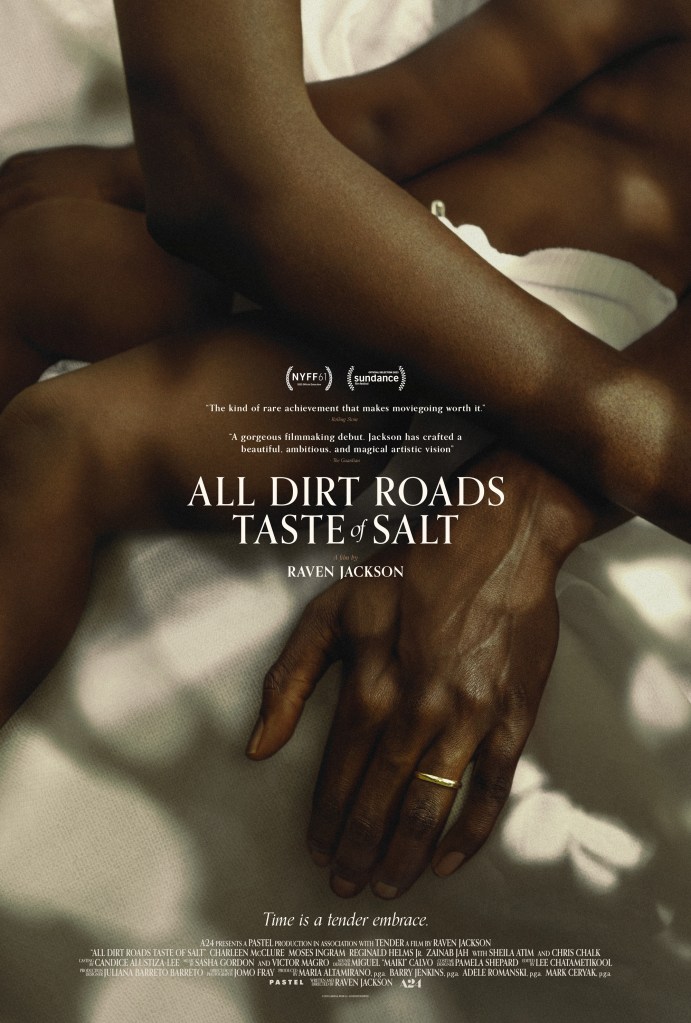
All Dirt Roads Taste of Salt Review


The film opens with a scene of someone being taught how to fish. In that moment the instruction is strict yet encouraging. However, it is a moment of much deeper meaning that spans many decades and many lives. There is a pervasive feeling of loss and disconnect. There is sadness, frustration, cultural differences and confusion—that is All Dirt Roads Taste of Salt.

The Mississippi setting of the film is one where poverty and daily routines are a challenge. The film makes observations of life from the past and present. It portrays moments of light and darkness in the good times and the bad. Strong writing correlates well with the cinematography in creating a sense of dramatic irony. There is drama with purpose in All Dirt Roads Taste of Salt, however, the film leaves a trail of questions. What is the meaning behind the film’s focus on catching and preparing fish? What part of the drama serves the biggest purpose? The trail of hopelessness is in the form of a scavenger hunt for the good times for an individual in All Dirt Roads Taste of Salt.

The Mississippi setting of the film is one where poverty and daily routines are a challenge. The film makes observations of life from the past and present. It portrays moments of light and darkness in the good times and the bad. Strong writing correlates well with the cinematography in creating a sense of dramatic irony. There is drama with purpose in All Dirt Roads Taste of Salt, however, the film leaves a trail of questions. What is the meaning behind the film’s focus on catching and preparing fish? What part of the drama serves the biggest purpose? The trail of hopelessness is in the form of a scavenger hunt for the good times for an individual in All Dirt Roads Taste of Salt.

The director and writer Raven Jackson is poetic in her direction with All Dirt Roads Taste of Salt. The pacing may seem to blur in moments, but it makes sense in order to create a certain feeling for its audience. It helps the viewer feel the dramatics of All Dirt Roads Taste of Salt. Many times, the film flashes back to the lake where the fishing moment takes place. Most of the film feels like a blur of an artistic project trying too hard, but then the realization comes that the lake setting holds together everything in the film. The setting of the lake is thepersonification of Mack’s life. The location of the lakesymbolizes the themes of the film. It rains by the lake, it shines by the lake, the water is clear, yet deep. The lake is where the meaning of Mack’s life has a form and a life that is destined to be inspiring. It is spellbinding.

All Dirt Roads Taste of Salt is an experience of dramatics that may try too hard in moments. I did not entirely love the experience; I appreciated its art form. It is a film which requires a certain mindset to watch in that takes on more of a literary approach to its storytelling over that of a typical big screen movie. The experience of the film felt like a literature class because of its use of the lake in the film like literary device paralleling the dramatic portions of the film itself. Three out of four stars for All Dirt Roads Taste of Salt.

Poor Things Review


Director Yorgos Lanthimos is known for his brilliant use of bizarre and downright weird imagery; however, he knows how to blend these elements with success and brilliance. He builds resilience by pushing the envelope of his strange ideas as a director. He did so with The Lobster (2015), The Killing of a Sacred Deer (2017 and my top favorite of his), and The Favourite (2018). In Poor Things he turns up the volume on the grotesque factor combining humor, daring, and genius. It is definitely one of his most sexualized films, but also one where the context is intended for those who want to experience a film that is different and not one’s normal romantic or sci-fi adventure. The plot line is filled with twists and scientific anomalies which lead to hysterical and invigorating outcomes.

Poor Things takes place in a historic setting introducing Dr. Godwin Baxter (played by Willem Dafoe), a professional of unorthodox practices. His studies focus on bringing people andvarious creatures back to life. The film quickly moves into eerie and daring territory. His assistant is Max McCandless (played by Ramy Youssef), and he oversees moderating the experiments of the doctor. Baxter’s most ambitious project is Bella Baxter (played by Emma Stone). Bella has been brought back to life with a brain that is very undeveloped and out of tune. This has left Bella in a state where she is always anxious to experience new things, yet has no filter or social awareness. Her brain and thought processes are so muddled that she keeps pursuing activities that would be considered acts of public indecency. Although she is eager to feel out her new life, she does not know how to hold it together. Being under the care of Baxter and McCandless, Bella finds herself angry that her existence seems uneventful. Suddenly, Bella meets a lawyer, Duncan Wedderburn (played by Mark Ruffalo). Bella falls instantly in love, and she runs away with him. Her undeveloped brain and state of mind are out of whack, but something inside of her is determined to feel connected to the world and find a sense of fairness. Bella’s struggle is that her brain is so sexualized thather behaviors remain highly inappropriate.

Stone’s performance is gutsy in her portrayal of a woman with such eager sexuality. Under the direction of Lanthimos, she depicts a creature whose sense of desired connection has become confused with satisfaction. It is a film where there areno limits. Also, Dafoe’s performance is fierce as Baxter, whoseego and fanaticism blind him to the reality that his procedures have failed. He is unrelenting in his efforts to get Bella back. Dafoe is a master of his craft despite the strange calling of his character. As for Ruffalo, he is playing an attorney who is taking a risk. One with a girl whose brain is undeveloped. The characterizations surrounding Poor Things are like those of Young Frankenstein on steroids.

Lanthimos often plays with the theme of matters getting out of control, and the consequences having to be dealt with. In this story, it is a situation of finding the right direction for Bella.With the film being two hours and twenty-one minutes long, heincorporates all kinds of scenarios to take her on a journey that explores what happens when desires are allowed to manifest themselves without restriction. The film begins in moments of black and white and then transitions to color. The direction of Lanthimos takes a serious approach like a dark novel, but then transitions to brilliant cinematography with an undertone of darkness. The performance of Stone craves for sex, love, experiences, and seeing the real-world. It is one wanting connection, but in the context of behaviors that are immoral. It does go intentionally overboard in some moments, forcing the viewer to question one’s own desires and constraints. That element is the genius of this film. Three-and-a-half out of four stars for Poor Things.

Priscilla Review


The realism in Priscilla, from director Sofia Coppola, is powerful and passionate throughout the film. It will evoke strong feelings from its audiences, especially those who were fans of Elvis Presley.

Priscilla is a true story based on the 1985 novel Elvis and Me written by Priscilla Presley (formerly Beaulieu). Priscilla takes its audience through a vast landscape of happiness, sadness and confusion through the eyes of Priscilla as she endures her relationship with Elvis Presley. Cailee Spaeny plays Priscilla, Jacob Elordi is Elvis, and both of their performances are superb portrayals of the heights of young love and the lows of dealing with the insanity that becomes their life. Although she certainly loved Elvis, the burning question is whether Priscilla was ever actually happy when she was with him.

Priscilla is the one who falls in love at first sight, despite the big age gap between the two. Priscilla had a frustrating life when she met Elvis at just 14 years old at a party on a military base in Germany where Elvis and her father were both stationed. When they reunite a few years later in the US, Elvis and Priscilla seem to be madly in love as Elvis’s fame grows. But Priscilla has problems being in the public eye, and being in a relationship with Elvis, who is constantly flocked by women fans, is hooked on pills, and is full of half-truths, is hard to bear. Will the power of love be enough, or is it too late for them to be happy?

With Priscilla’s expectations shifting and Elvis’s honesty being tested, Priscilla is a portrait of a women descending into surreal realizations of their crazy life. Elvis assumes that Priscilla will learn to accept their life, that she can’t leave because he gives her everything she could possibly want. But can money and fame buy Priscilla or Elvis happiness?

Coppola’s ability to portray shifting emotions in Priscilla is her strength. The love between Priscilla and Elvis begins to vanish, and reality surrounds them. But its not a positive reality for Priscilla, and she has just bad or worse options. The eyes of fame blind the eyes of love, and their hearts can’t overcome the turmoil in their relationship.

With the situation worsening and more reality coming, Priscilla needs to focus not on their relationship, but on her own happiness. She is the one who sacrifices everything to be with Elvis. She didn’t ask for the fame; she went with her heart. She wanted love in uncharted territory. But is it true love from Elvis? How long can Priscilla endure Elvis’s toxic behavior? There are so many questions and Priscilla needs to find the answers.

A ride of drama and surrealism, Priscilla will have audiences asking themselves what the meaning of love really is, and just how much even true love can endure. Sofia Coppola’s directing of Priscilla, the amazing cinematography, and the writing of this captivating yet devastating true story will absolutely enthrall audiences. Four out of four stars for Priscilla.

Treating cinema in many forms of art!