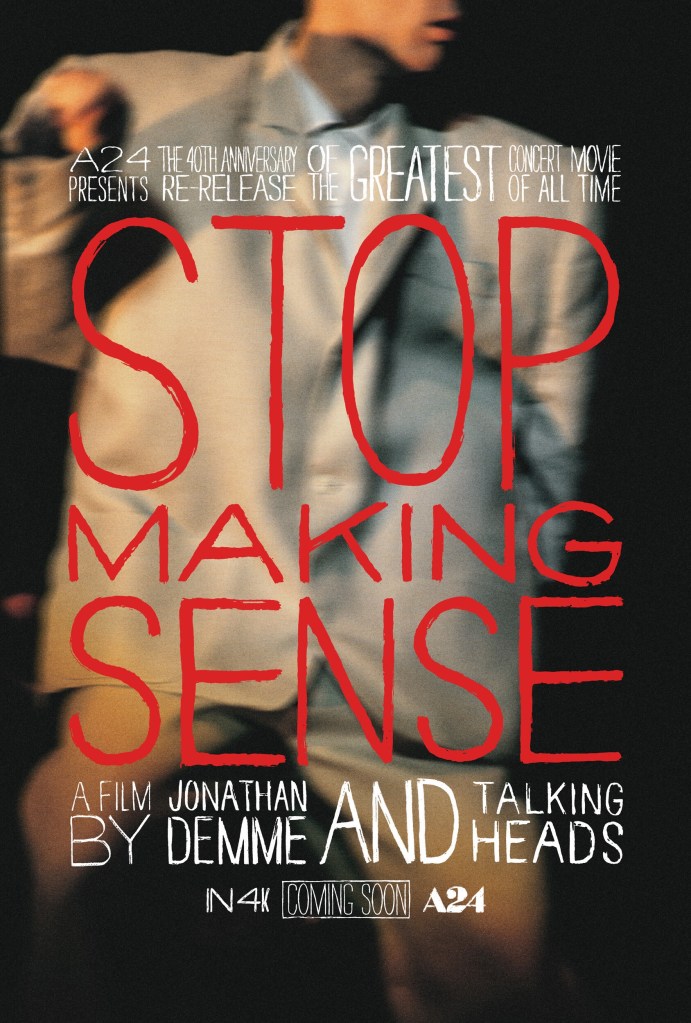
Stop Making Sense (2023 Re-release) Review


Stop Making Sense, a concert film directed by Jonathan Demme in 1984, is unequivocally the best concert movie of all time. Filmed at Hollywood’s Pantages Theater over three days in December, this cinematic masterpiece features Talking Heads, with David Byrne at the helm, as well as Tina Weymouth, Chris Frantz, Jerry Harrison, Bernie Worrell, Alex Weir, Steve Scales, Lynn Mabry, and Edna Holt. This incredible film is an immersive and unforgettable experience that showcases many of The Talking Heads’ greatest hits. It’s no wonder audiences around the world were completely blown away by this exceptional concert film.

I saw David Byrne live in concert in 2018 at the Auditorium Theatre in downtown Chicago. My Mom was fortunate to see Talking Heads perform in 1982 at the Civic Center in Des Moines, Iowa, and it remains one of her all-time favorite concerts. Seeing Stop Making Sensemade me feel like I was revisiting the concert experience my mom had back in the 1980s. Seeing this film in the IMAX experience felt like a journey back in time. This group has a reputation for magical music and their songs are still magical today thanks to the artistic genius of David Byrne and his band.

As soon as the film started, the song “Psycho Killer” captured my attention. David Byrne always knows how to set the tone for his music and concerts. He has the moves, voice, and style that make his performances grand. Throughout Stop Making Sense, there are many uplifting moments that make you want to dance. These segments exude positive vibes and are extremely enjoyable.

The re-release of this concert feels authentic and immersive. The film, as well as the concert itself, are captivating and mesmerizing, showcasing Byrne’s imaginative world of wonders. The songs are infused with cultural significance and are brilliant in their direction. Stop Making Sense is a treasure trove of a concert experience that will awaken nostalgic memories for many and create a special experience for those who are witnessing it for the first time. The concert features many of Talking Heads’ great hits, including “Slippery People,” “Once in a Lifetime,” “Heaven,” and many more.

One song that always lifts my mood and restores my positivity is “This Must Be the Place”. It’s a song about acceptance, finding the positive aspects of life, and facing reality head-on. The performance of this song in Stop Making Sense is truly remarkable due to the incredible energy flowing from the artists, the audience, and those watching the film. “This Must Be the Place” has been an uplifting anthem for fans worldwide for many years, including myself.

The grandeur of Byrne’s artistry is demonstrated by his giant, oversized suit which evokes a feeling of enchantment. Once Byrne puts that suit on, the world of Stop Making Sense takes on its own amazing dimension where Byrne is the master of culture. His empowering lyrics round out the incredible concert experience of Stop Making Sense.

Fans of David Byrne and Talking Heads simply cannot afford to miss this incredible opportunity to see this film on the big screen. Even if you’ve had the pleasure of witnessing it before, it is worth revisiting, now that A24 has obtained the rights. So, go ahead and grab your oversized suits and get ready to dance to the music, because Stop Making Sense is a definite four-star experience.

You Can’t Stay Here Review: A Psychologically Haunting Ride with The Chicago Underground Film Festival


With the conclusion of The Chicago Underground Film Festival, I felt many of the film experiences required a lot of tolerance tohandle. The invigorating part of this phenomenon is that filmmakers are putting their art to the test. I felt that many of the films went in-depth into worlds that are unknown. Specifically, I mean there were films that explore addiction, politics, and various challenging subject matter. The film that haunted me the most is You Can’t Stay Here, a film in which a mistake made in the wrong setting takes a turn for the worse.

You Can’t Stay Here is directed by Todd Verow. The film’s opening delivers that noir feeling which sends shivers down its audience spine. It is a film that takes place in the 1990s around New York City. The vibe during that time period on the east coast provides a setting of realistic suspense that only grows more haunting. You Can’t Stay Here feels eerie based on the perception of how the mind feels when anxiety is provoked. It is also a film in which safety is questioned sporadically throughout due to experimental filmmaking and writing.

The plot of the film is geared on a photographer, Rick (played by Guillermo Diaz). He strolls through New York’s Central Park focused on his photography. Rick’s whole world is turned upside down when he is the witness of a homicide situation. The murderer is Adam (played by Justin Ivan Brown) and he puts Rick into a life-threatening scenario. Adam has feelings for Rick and Rick has feelings for Adam. With their eerie bond, Rick’s situation can threaten his life if he reveals evidence to the authorities about Adam. Because Rick tends to be a man of solitude already, there is a feeling of intense loneliness that only causes his desire to grow throughout You Can’t Stay Here.

The film is an experience of anxiety which is built upon the audience’s increasing concerns about Rick. His thoughts and Adam’s presence continuously haunts him. Adam also shows up into Rick’s dreams. It is a bizarre experience and has dazzling sensations. The realism of the dangers impacting Rick’s life arewhat causes ongoing anxiety and suspense during You Can’t Stay Here.

There is a line in the film that goes, “Lose yourself in my eyes.” Rick is in a place where he is completely beside himself. Adam is always in his head and on his mind. The horrific event where Rick chose not to do anything only opens the door to his reality being altered. The state of mind throughout You Can’t Stay Hereis a continuous blur of emotions. It is a ride which starts with aneerie event that simply does not leave Rick or the film’s audience. You Can’t Stay Here is an experience that is unforgettable, but hard to revisit. You Can’t Stay Here is a film that requires an open mind. Three stars for You Can’t Stay Here.

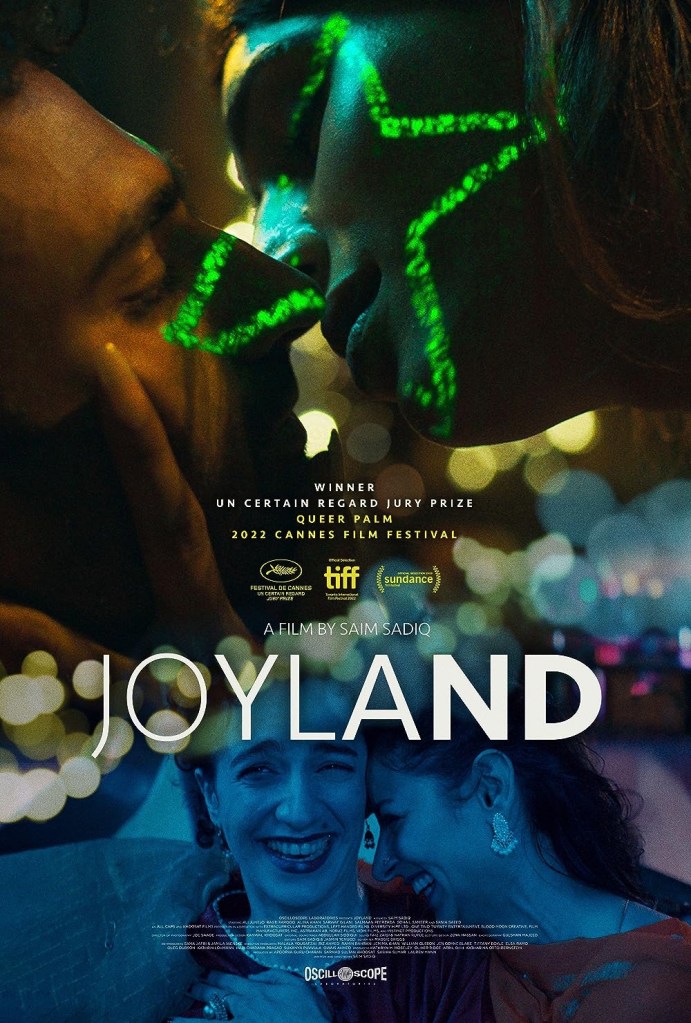
Joyland Review


This movie experience made me think about life’s questions, including those on pursuing connections and feeling connected. Joyland is a spellbinding film because of the deep and humanistic approach used by writer and director Saim Sadiq. His international achievement is successful because he knows how to portray characters with cultures and family values. Watching Joyland was invigorating due to its passionate story of finding realization in uncharted territory.

The story of Joyland takes place in Pakistan. The main character is Haider (played by Ali Junejo), one of the youngest siblings inhis family. Haider struggles with employment. Due to this, he takes a job with a Bollywood-style burlesque show as a backup dancer. He realizes that there is a lady, Biba (played by Alina Khan), who grabs his attention. Haider and Biba begin to connect and build a strong bond. The problem is that Biba is trans, but nevertheless the love between Haider and Biba grows. It is clear they have deep feelings for each other. However, due to cultural expectations and family values, Haider feels he will be hated due to his attraction for Biba. Fundamentally, hisfamily believes that men should fall in love with women and have children. While their love may be strong, how can Haider and Biba move forward?

As the tension rises with a renaissance of disturbing cinematography, it is clear that love is real for Haider and Biba. Their love for each other grows out of disconnect because both feel emptiness in their lives. When they find each other, they feel accepted.

With the role and norms of a traditional family taking a center role in the film, viewers learn this is also where the secrets of Haider and Biba lie. Haider is in a relationship with his significant other, Mumtaz (played by Rasti Farooq), and questions why his life is at a standstill. He also wonders if he is happy with Mumtaz. The tensions caused by dishonesty is where the film gets shaky with increased with increased turmoil.

Deep down, Joyland is a poetic ride that consists of frustration, disconnect, and confusion. The film’s writing is strong throughout. I felt sadness and aggravation as Haider and Biba find themselves at a loss about their situation. The feelingswhich come from love’s desire keeps the narrative direction flowing. I appreciated how the bond of love keeps growing with an emphasis on mindfulness and sensitivity. Biba is sensitive about being trans, and Haider is sensitive about loving someone who is trans. This fact does not change who they are as humans. What changes is how others perceive them. Regardless, both have a right to be happy.

Joyland is artistic in the way it shows the way love can come in unexpected moments, and with unexpected people. The film is also set in an interesting territory of different political and religious tides. Joyland soars with engrossing performances and filmmaking. This is one of the most touching and emotional films I have seen in a while. The chances of love surviving deliver hopefulness in Joyland. Four out of four stars.

Treating cinema in many forms of art!