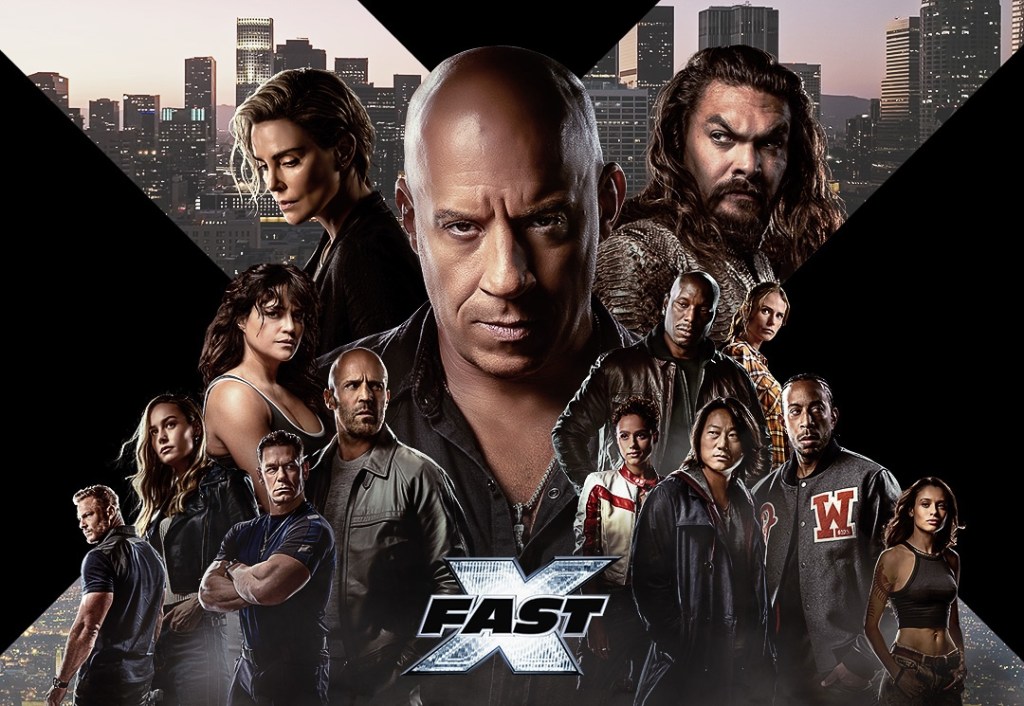
Fast X Review


There was a time when the cult following for the Fast franchise was strong and invigorating, especially when Paul Walker was alive and playing Brian O’Conner. Walker was a big component of that franchise, but his role ended with Furious 7 in 2015, when he died in an auto crash as that film was wrapping up its production. Fans of the franchise have seemed to remain loyal up to this most recent film, Fast X. That loyalty may not survive this film.

Vin Diesel is still in this Fast film as Dominic Toretto. There are some new characters, but there are enough of the old ones to still have continuity with the franchise. The main characters are Mia Toretto (played by Jordan Brewster), Roman (played by Tyrese Gibson), Letty Ortiz (played by Michelle Rodriguez), Tej (played by Ludacris), Cipher (played by Charlize Theron), Deckard Shaw (played by Jason Statham), Queenie (played by Helen Mirren), and Jakob (played by John Cena). The enemy in Fast X is Dante, played by Jason Momoa, and that is where the film starts to plateau with misdirection and out-of-focus writing. The film seems to degrade into basically just bad guys and car destruction.

In Fast X, Dominic finds himself in danger once again. This time he has been targeted by Dante, the son of a drug cartel leader who delivers all kinds of dangerous technology so powerful that it can destroy cities and even continents, and do all kinds of extreme damage at the click of the button. Dominic must rely on the people in his life including Mia, Roman, Letty, Tej and Jakob to help get through the life threatening danger Dante poses. But there is no escape from the reality of the situation that Dominic finds himself in.

Fast X does have some hidden gems to give its viewers an idea of where the Fast franchise will likely head going forward. But to me, at this point it seems that it’s about making money rather than trying to create a stronger story. The bottom line is that it’s a challenge to carry on this franchise without Walker. The role of Diesel is what is keeping the franchise going. But Fast X has gone from street racing and gangs, to cars in space and cars destroying cities with tons of mass damage that is over the top and doesn’t always seem to have a purpose.

In my view Fast X shows that this franchise is running out of ideas—in storyline, plot development, and in keeping its characterizations intact. There is a rather long line of boredom in Fast X, with over-the-top car explosives repeated continuously. As I said before, it seems to just be about profit.

Fast X also seems to me to be a lot like a film by Michael Bay, but with cars doing the damage instead of robots. Its stunts are more and more like the styles of Bay, which does not create a strong direction for this franchise. Instead, it’s becoming confusing and frustrating. Two stars for Fast X.

Blue Jean Review


The beginning of Blue Jean rolls with a contemporary tempo. The year is 1988, and the subject matter involves an individual whose sexuality is closeted. The film moves forward with the foundation of the main character just wanting to maintain her normal everyday life. Set in the United Kingdom, Blue Jean is an artistic portrayal of the value of one’s privacy, but also of one’s choices. Blue Jean is fascinating both in its poetic achievements and its empathetic journey towards the conflict that arises.

Blue Jean focuses on Jean who is played by Rosy McEwen. She is a gym teacher with a secret. She is a lesbian with a normal and uneventful life. It takes place in the year when Margaret Thatcher’s conservative government is going to pass a law which stigmatizes gays and lesbians. Jean is in a situation where she must be careful because of her sexuality. She visits LGBT night clubs and maintains a relationship with another woman. The situation comes to a challenging place when a student of Jean begins visiting the same nightclub. This student is Lois who is played by Lucy Halliday. Lois is a troubled student who is also closeted during a time when being attracted to the same gender is not accepted everywhere. The tensions rise for Jean because Lois makes choices that become alarming and even continues to be persistent with Jean outside of school. Jean does what she can to establish boundaries, but Lois is the type who will act out of spite. Blue Jean is a tale of emotion and sadness in an era when it’s hard to feel accepted for what the heart desires.

With the LGBT romance vibe being interrupted for Jean, Blue Jean possesses engrossing tensions that will shock audiences to the core with emotions. It is a film that involves an array of questions that weren’t unusual for the late 1980s. Why does Jean feel at a loss with herself? Why is Lois obsessed Jean? Is Jean disconnected? Is Lois disconnected? Is it even about feeling connected? Blue Jean is a realistic portrait of how it hurts to not feel accepted. The film’s artistic captivations are triumphant and fascinating. The power of wanting to feel loved and accepted is a universal feeling that audiences will experience in the eyes of Jean and Lois.

Blue Jean may start out slow, but this pacing gives audiences the idea of how a life of solitude may have seemed for those who were closeted back in the day. Jean is not a bad person; she just wants to live her life without impact. Lois on the other hand wants attention, but she cannot get it from acting out of frustration. As Jean has her escape in the nightclubs and her drives through the evening, audiences will sense how her solitude hurts sometimes. The movie is gut-wrenching, but it is also a poetic achievement in terms of how the director taps into factors of sexuality and people’s feelings of attraction. Four stars for Blue Jean.

Sanctuary Review


I had a hard time deciding what I thought of Sanctuary. A film from independent film company Neon is usually artistically brilliant, with twisted scenarios. Sanctuary, though, seems to be more predictability over artistry. It does have a twisted outlook, but the film is more like a play with a lot of dramatic irony, rather than the dark comedy that it is billed as.

Sanctuary’s two characters are Hal and Rebecca. Hal is played by Christopher Abbott and Margaret Qualley is Rebecca. It is a dominatrix scenario, with Hal being an extremely wealthy client who arranges the meets with Rebecca. He believes that aside from his relationship with Rebecca his life is a joke and not exciting. His bizarre, sexual escapades with Rebecca is to help him escape his mundane life. However, when Hal decides that he wants to end Rebecca’s services, the film takes an ominous turn. Rebecca makes Hal believe that she will ruin his life by blackmailing or exposing his many dark secrets. All this turmoil Rebecca creates is where Sanctuary goes downhill for Hal, but creates excitement for Rebecca.

The sexual escapade of Sanctuary is where it becomes predictable. Hal may be getting his desires fulfilled, but is there more to why he has these desires? Rebecca’s sexual escapades with Hal is to her advantage, but is it really benefiting her? The performances of Abbott and Qualley just seem to lack the characterizations for a believable trap. Rebecca really doesn’t sell her claim to own Hal by her threats to destroy his whole life based on his choices and experiences with her.

The title of the film Sanctuary comes from the safe word that Hal and Rebecca develop to let the other one know that the escapade is going too far. Ironically, though, no one is “safe” in Sanctuary. Hal and Rebecca have built a relationship that causes both of them to have all kinds of weird and obsessive thinking.

It seemed to me that the tensions between Hal and Rebecca was more about a clash of egos rather sex. There are no romantic ties or connection between Hal and Rebecca in Sanctuary. There is just an array of personal flaws, bizarre settings, and scandalous realizations. The focus of Sanctuary seems to be on the gaslighting between Hal and Rebecca. Rebecca’s way of gaslighting is one that remains quiet, yet effective. Hal on the other hand cries with fear and anxiety to manipulate Rebecca.

In my view Sanctuary is a very poorly written dark comedy. Is “sanctuary” truly a word to ensure safety in this film? Hardly. The misrepresentations of this film takes it in an ambiguous direction. The film lacks ambition or any form of artistic direction. The artistry certainly can’t be found in the the gaudy red lighting that surrounds the apartment of Hal. Sanctuary was just not a very satisfying experience. Two and a half stars for Sanctuary.

Treating cinema in many forms of art!