
First Cow Review


FIRST COW Heads Home Now, May Return to Cinemas Later


Audiences may perceive that First Cow is going to be a quiet and dull experience based on how mellow it is in the beginning. However, it is a brilliant film due to the screenplay and cinematography, and that is why First Cow deeply captivated me.  The director, Kelly Reichardt, had an interest in photography since childhood, and her fascination was fueled by having a father who did photography for crime scenes. Reichardt’s experience in photography has led her to make films with vast scenery, and First Cow’s scenery is magnificent. The photography in the forests and the mountains left me visually dazzled.

The plot of First Cow takes place in the 1820s in a forested territory in Oregon. The film introduces us to Cookie (played by John Magaro) who is a loner and a cook. He is seeking to find someone to start a business with involving food and cooking in a timeframe of no technological advancement. As he navigates his travels, he joins fur trappers. The fur trappers do not express much interest in his cooking or creating food for business. That is until he meets a Chinese Immigrant, King-Lu (played by Orion Lee). Cookie’s wishes come true when he finds assistance in King-Lu who has an affiliated past as an entrepreneur. With King-Lu’s strong sense of the hard work needed to establish a successful business, the two team up to build a business milking cows.  Together they find business connections in the uncharted territory of Portland, Oregon, and First Cow turns into an astounding and inviting journey that will touch many.

The film’s focus on milking cows looks so accurate in terms of how the process of making foods would have been back in the day. The cinematography that is used the film is realistic, where viewers will feel taken back to a time when there weren’t any forms of technological advancement for business.  No phones, no computers, no networking tools, and everything had to be done on foot and through in-person networking. The film’s sense of urgency to succeed in business is amplified through dialogue demonstrating trial and error which will make viewers appreciate the past. The main characters do not get distracted, but are always on foot trying to find what is right, and they can only do that via face-to-face interactions.

The business side of this movie spoke to me. I felt that the roaming of uncharted territories showed how being a landowner and having the option to share or not, was what truly made businessmen or landowners have power. Cookie and King-Lu have some power, but they are not confrontational or egotistical. They are restrained and patient, because given that they have limited resources, confrontation is the last problem they want to have. I found that is what also drove the film to be inspiring, because although they are striving for success, they do not want to hit plateaus. First Cow is about two men trying to develop a new idea for everyone, but with spiritual meaning.

Based on the spiritual value, deep connections, and cinematography, I give First Cow four stars. To watch this film during the hard time the world is going through now, made me appreciate life more. It made me realize that I need to be more thankful for the resources the planet gives us to create and rejuvenate. Today, we continue to use so many products from milking cows, and it is still a growing business. First Cow is a faithful film to how that era started.

Beats Review


Watch a trailer for Scottish coming-of-age rave film, Beats


Beats is a ride of mischievous behavior combined with friendship. Directed by Brian Welsh, and executive producing done by Steven Soderbergh, Beats includes many risky scenarios that are intriguing, haunting, and inviting. The time period is set in the early 1990s and the film is blended with black and white cinematography. The setting and the cinematography add to the entertainment. The question is, “Could the two main characters have wild fun without serious consequences?”

The film gears on two best friends in Scotland. They are Johnno (played by Cristian Ortega) and Spanner (played by Lorn Macdonald). Both have issues at home that they feel they cannot overcome making their lives miserable. Johnno lives with his abusive and criminal brother, and Spanner is about to move to a new town with his family and his mom’s significant other (who he does not feel close to). Due to the sorrow caused by the fact that Johnno and Spanner are going to be separated from each other, they make a risky decision to party one last time together. They choose to go to an illegal rave part where they run into a mix of destruction, freedom, and legalities that they will always remember.

Given the outcomes of their decisions and associated consequences, their friendship, Johnno and Spanner does not change. What grasped my attention was that the two friends keep making risky decisions, but they view those decisions as a way of making positive memories of their friendship as opposed to focusing on the irreparable consequences. When they make one bad decision, they just make another one, and they find it entertaining. These risky behaviors made Beats engrossing, because I found myself curious wondering who was going to suffer the worst consequences. The outcomes provide much anticipation and interest for viewers.

The film’s timeframe added to the risky decisions, since the main technology they had for fun in the 1990s was radios and TV.  There was no streaming or fancy smart phone technologies which people now use daily for life, work and fun. Beats shows how boredom could have stirred up dangerous times for enjoyment in the 1990s.  Many events like parties and raves were much more exclusive due to limited ways of promoting them. That is why the illegal party becomes a special opportunity for Johnno and Spanner. From their vantage point, it was a chance to have the time of their lives and put their problems behind them for a change.

This was a film that was a different experience on many levels. It was like a young version of Danny Boyle’s Trainspotting (1996) blended with black and white. I felt like I was watching a younger generation of two European misfits trying to boost their confidence and live life to the fullest. Beats is a summer fun ride and I give it four stars.


The Rental Review


The Rental Ending Explained: What That Final Twist Reveal Means ...


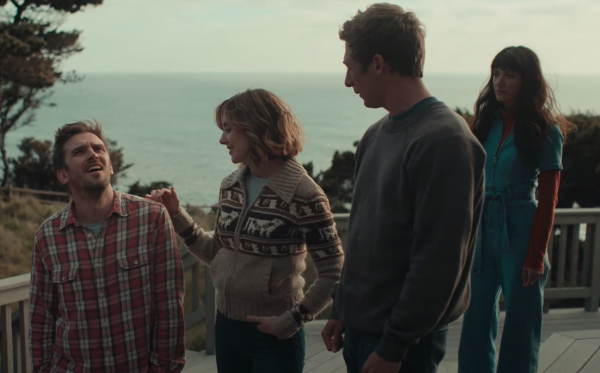
With limited cinemas being open due to the COVID-19 pandemic, I have been questioning whether to venture out to see the films in the theatre depending on the titles. With Dave Franco’s The Rental, I was glad I ventured out to see this one on the big screen. In Franco’s directorial debut, The Rental is a chilling and suspenseful vacation film that leads a deadly trail of deception, dishonesty, and danger among its four main characters as they take a vacation in an Air BNB in the mountains of Oregon. One tactic leads to another which had me aching in curiosity of what the outcomes would be for Charlie (played by Dan Stevens), Michelle (played by Alison Brie who is also the director’s wife), Mina (played by Sheila Vand), and Josh (played by Jeremy Allen White).

The plot of the film is that the two brothers (Charlie and Josh) decide to take their girlfriends (Michelle and Mina) on a weekend getaway to celebrate work success. At first, some seem skeptical, but figure it is in a house with privacy and that it cannot be that bad (unfortunately it is the opposite). Once they all settle in on the first day, all of them get into hard drugs, drinking and partying. Some decide to call it a night early and go to sleep, but others keep the party going and start engaging in mischievous activities believing they will not get caught. However, they are already in the spotlight due to hidden cameras around the house. Two of the guests start to realize their risqué behavior was probably recorded and worry that they could face all kinds of life-threatening conflicts if the video is out there. The key is that the man behind the cameras can see everything. Soon the house becomes more dangerous, as he sees everything and creates tension via the technology that he uses to challenge the behaviors of his guests.

The tension in the film was intense as were the emotions of the characters as they try to maintain their safety and fight for their lives, but also somehow find the footage of the lewd behavior that was recorded of them. The film reminded me of Vacancy (2007). I felt the premise was similar, but this was a film that has a setting which is much less predictable. Both films ask the same question, i.e. how can the protagonists fight for their lives when the antagonist can see all they do technologically? The Rental takes those tense elements many levels up, given the cameras are wireless and hidden in many places that people would not think about.

The Rental may well have been one of the best movies I have experienced with shock and horror during these hard times. I love films with jump scares as well as people chasing and trying to fight others. The Rental spoke to me throughout its ninety minutes. It had me on edge, and while it was somewhat predictable in some moments, in others twists of shock are thrown in. Franco has done an excellent job with the shock value in his directorial debut. Three and a half stars.


Treating cinema in many forms of art!