“The Living” Review


the living

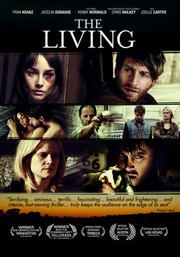
Recently, I was thinking of a movie to watch. What came to my mind right away among that topic was a suspense movie. Therefore, I came across “The Living.” This is an independent thriller that is captivating, has good character structure, a great screenplay, and a twisted plot with a rather odd climax. However, the film is not that brilliant. Given the conflict in the movie is kind of silly and gets blown completely out of proportion. However, the surprising part is that the fact that the gruesome violence comes across a teenager.

The film stars many unknown actors and it takes place in Auburn, Pennsylvania. The film begins with bringing viewers to a damaged room with clues that domestic violence occurred before hand. The married couple is Teddy and Molly (Fran Kranz and Jocelin Donahue) and they are having serious problems. Teddy abuses Molly badly where her face is bruised up. This makes Molly’s brother Gordon (Kenny Wormald) resent Teddy entirely. Gordon has a big grudge on Teddy and wants to protect his sister. Teddy’s behavior makes Gordon want to end Teddy.

For a guy like Gordon, he does not have the guts. He is just a nerd who works in a grocery store and does not really have faith in his own self to be protective. For Wormald, his shyness he portrays does not do it for me. Just he carries his shyness to an extent where his pride to being the big guy in a scary situation does not seem to add up to the film’s suspense. Suspense is built though with this nerd actor as the film progresses on. I will elaborate more on the premise of what makes the film suspenseful. Then you will have an idea of what I mean on terms of the characterization of Gordon.

With Gordon being defenseless, he hires an ex-con to kill Teddy. He arranges to meet with the guy in person before the events happen. However, he has no idea of what he is getting himself into. The ex-con’s name is Howard (Chris Mulkey). As soon as Gordon and Howard meet, Gordon realizes he put himself in a major, yet terrifying mess upon him. Howard wants the money before he kills Teddy. Wait that is not all. He also wants Gordon to be in his site at all times before the killing even takes place. This makes Howard ride with Gordon all night long to the location of where Teddy lives.

There are times on the car ride where Howard is disturbing. He kills a few people along the way, seriously questions Gordon uncomfortably, and even threatens to hurt him if he attempts to run. This is a major disaster to the point where viewers will wonder why Gordon did not just talk to Teddy instead of putting himself into this array of violence, regret, and possibly death.

Writer and director Jack Bryan is interesting with how he has the movie setup. I like the scenery of Pennsylvania, the very few characters elements, and one twisted plot. I will say this is like an independent version of The Hitcher, however, with no car chases, less, but strong violence, and an extremely gruesome conclusion (that is something you will have to find out if you watch the movie). Overall, I will say three solid stars.
“The End of The Tour” Review


end_of_the_tourjason segel and meJason Segel and Me!

maxresdefault

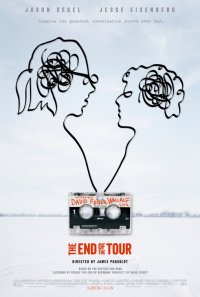
Even though “The End of the Tour” is receiving positive buzz right now, I was lucky to get to see it back in April at the Roger Ebert Film Festival in Champaign, Illinois. I also met the lead Jason Segel. As I walked into this movie not knowing very much about it, I ended up being enthralled by the film’s meaning, acting, and its story. Director James Ponsoldt creates a true story that is destined to be a cult classic. In the discussion after the movie at the festival, I was moved by the discussion between Ponsoldt and Segel. However, I am now going to explain the movie a bit and why it stands out as a masterpiece.

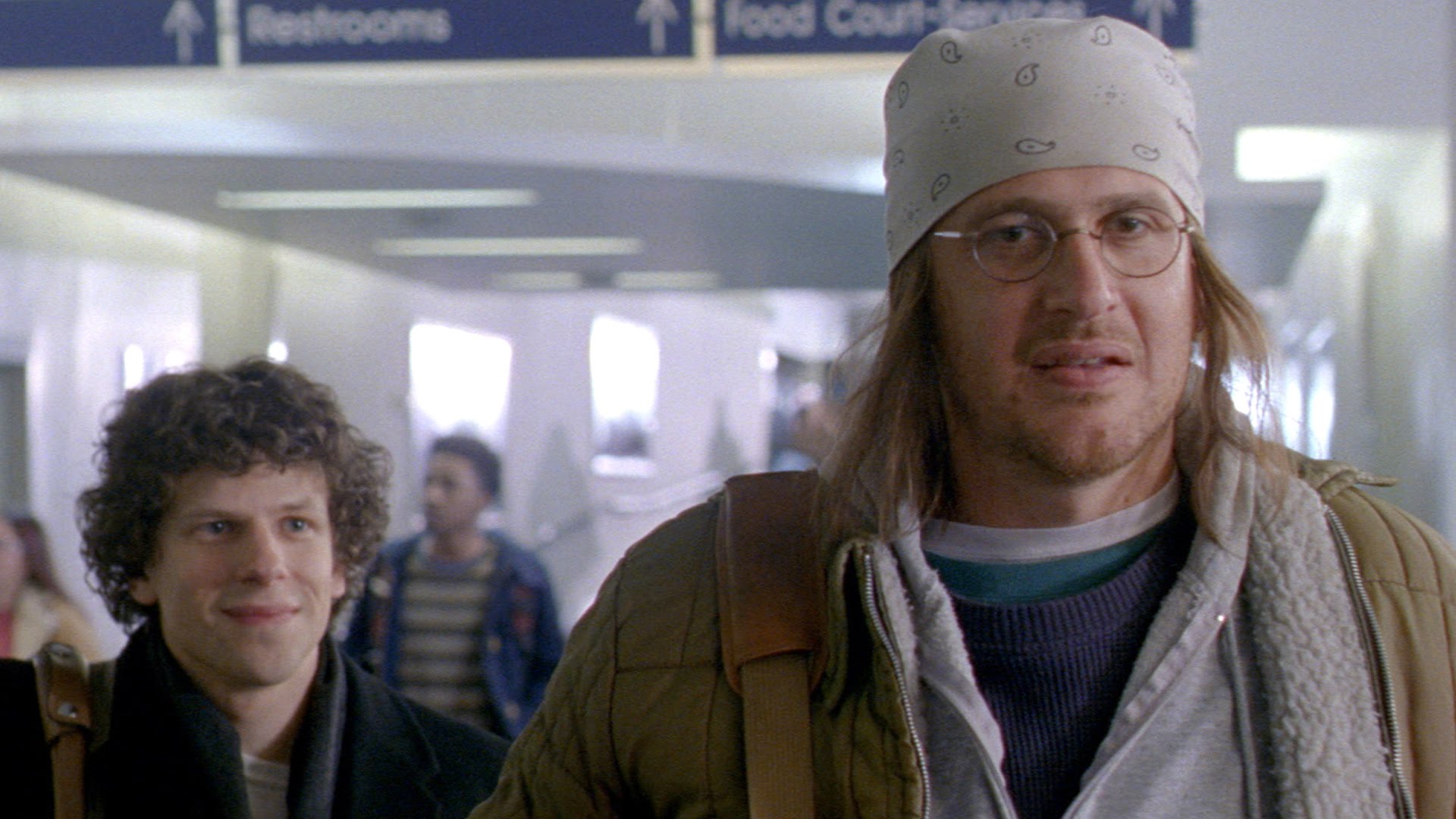
A Journalist named David Lipsky (Jesse Eisenberg) is set to do a five-day interview with David Foster Wallace (Segel). The goal for Lipsky is to get an idea of Wallace’s background, his hobbies, and what he does in his daily life. This is all right after Wallace’s 1996 publication of his novel Infinite Jest. However, as the days go by, Lipsky and Wallace become quite close as Lipsky conducts a series of interview questions. They have their awkward, yet fun moments, they are connecting, and for Lipsky, he feels that Wallace is like a brother to him. The relationship between the two is touching where viewers will feel enlightened at the end of the movie.

There are times of frustration between the two. Some of the information that Wallace shares with Lipsky is quite open about his life. I will not give details of what that sacred information is. That is something that you will have to find out if you watch “The End of the Tour.” Overall though, it is about coming out of your shell. That is something that Wallace and Lipsky find themselves doing at times of conversations with each other. When they do that, they feel they are creating a bond that will change their lives forever. The different tones of their frustrations can be something that makes better in the end.

“The End of The Tour” is essentially about friendship. Lipsky may just be a journalist that wants to write a story to build his ego, but he has a lot of heart. He demonstrates having a heavy heart in the scenes where he proves to Wallace that he is a reasonable and honest guy. Wallace may be a hippy, lazy, but auteur writer, but has a very creative mind and has a lot of positive personality for Lipsky to absorb.

Lipsky will have a brilliant story on spending his time with Wallace. His story will be successful. However, to find out how successful it is, that is something for you to find out. “The End of the Tour” simply cannot be missed. I think it is one of Ponsoldt’s best. The best since his previous film “The Spectacular Now” (2013).

“The Stanford Prison Experiment” Review


stanford

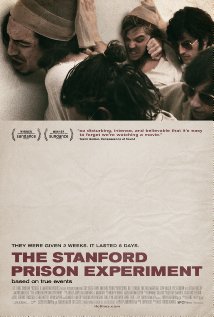
The real story of “The Stanford Prison Experiment” is about how Doctor Philip Zimbardo wanted to see the psychological aspects of a prison re enactment of Stanford University. The experiment was suppose to last for two weeks, and it only lasted six days due to how the violent behavior of the students (who portrayed guards and prisoners) were impacted. The experiment led to students wanting psychological treatment and had nightmares for long periods of time. Zimbardo insisted on letting suspenseful situations get more out of control as a way to lead to results of his experiment. As Zimbardo saw the negative behavior through his own eyes, he decided to end the scenario early. The goal of the movie, however, was to capture the harshness of the scenario, rather than the psychological result of it.

Zimbardo turned a hallway of Stanford University into a prison. He got bunks, designed places for the guards, and assigned policies in regards to how guards can treat the prisoners. The guards push the prisoners to the limit though. They are quite horrid, intense, and vulgar towards the prisoners where it messes with the prisoners minds. Therefore, the movie has good acting, good plot structure, but there is no result of the psychological purpose of what Zimbardo is trying to find with what he has created for just volunteer students. Things go ballistic.

Doctor Philip Zombardo (Billy Crudup) assigns guards and prisoners based on their interview questions. The main guards are Christopher Archer (Michael Angarano), Anthony Carroll (Moises Arias), and Karl Vandy (Nicholas Braun). They are guards that are a recipe for disaster. The main prisoners are Daniel Culp (Ezra Miller), Peter Mitchell (Tye Sheridan), and Jeff Hansen (Johnny Simmons). These prisoners are heavily impacted by the guard’s behaviors. The prisoners and guards both have a generous amount of time to think about their behavior for the next two weeks. However, both of the parties decide to abuse the privilege. The guards start first with verbally abusing the prisoners consistently. This makes the prisoners become rebellious. Zimbardo does not think of ways to calm down the conflicts between the two parties, he wants to let the intense situations get out hand to be able to find a result for his psychological study.

Zimbardo has many options to calm down his victims he has chosen. Instead he ponders with agitation, discomfort, and hope. He does this because he wants something big out of it. He would then feel like the experiment was all for nothing. I will not give any more information away regarding the judgment of the characters. That is something for viewers to see (if they choose to view this brutally intense thriller).

The guard moments are heavy with language, brutality, and being outspoken. This is all ran by Archer. He is the guard that wants to be a guard just to have the authority and to feel like he is the Big Kahuna.

Despite the film’s violence, “The Stanford Prison Experiment” is vast with cinematography, acting, and plot development, but there is not a good solution to the movie. Since “The Stanford Prison Experiment” is a true story I would have liked to view the film for its psychological purpose, rather than just violence after violence. Overall, I will say two and a half stars.

Treating cinema in many forms of art!