Companion Review


Why do humans rely on technology? They do for many reasons such as organization, boredom, and life essentials. But where is the line drawn? It is drawn at utilizing technology to enable human connections. Writer and director Drew Hancock pushes the boundaries of AI in Companion. It is a film that correlates with robot and human suspense for an entertaining result. The level of seriousness just right. Companion is about a matter that goes awry which leads to twists and secrets to be revealed.

The film focuses on a couple, Iris and Josh (played by Sophie Thatcher and Jack Quaid). They go on a weekend getaway at a lake house with friends. The other folks are a gay couple, Eli and Patrick (played by Harvey Guillen and Lukas Gage). There are also Sergey and Kat (played by Rupert Friend and Megan Suri). Iris is a robot and her emotions are mixed. Josh tells her, “Remember to smile and act happy!” For Iris, this is rather complicated. She displays feelings of tension which arecultivated by the narration from the very beginning of the film. The script delivers the key fact that Iris is not a normal human. Her sensitivity is the cornerstone of intriguing suspense in Companion.

The film’s genius is aided by the uncomfortable vibe in its lake house setting. Given Iris already has a boiling mind of vengeance, Companion loops in the feeling that many cans of worms are waiting to be released. Companion boils until the film’s point of destruction as so much goes wrong along the way. Iris commits homicide due to being unable to properly handle human emotions. After the homicide she walks into the living room holding a knife with spattered blood. Josh, Kat, Eli, and Patrick are stunned and horrified. Josh must figure out how to clean-up Iris’s mess which was prompted by a technical failure. Josh refers to Iris as a “companion robot” or “emotional robot.” He does this to try and cover his tracks before her functions worsen… which they certainly do. 

The film gets hysterical when it becomes a battle between an “emotional support robot” against real humans. On top of that,the scenes have an interactive component when the “emotional support robot” uses the functions on a tablet to help with functionality. This happens in moments of suspense. The storyline of covering up a murder and getting a crazy machine on the loose is results in a crazy ride that dangles shambles of wonderous audacity in Companion. AI takes a deadly turn of demise in Companion. Despite the quirky layout, what makes this film a gem is its ability to create an atmosphere where viewers must think. There is more here than what is expected and that gets the audience involved.

The vividness comes from the desperation in the performances of Thatcher and Quaid. Since Thatcher is a machine and Quaid is the consumer (of her). The error falls on both sides but there is no excuse for the cause. They both have the minds to fend for their lives. The film’s message is NEVER RELY ON TECHNOLOGY FOR HUMAN EMOTIONS! No good comes from that! The creativity behind the boisterous disasters results in a grandeur of comedy and suspense with technology going full throttle. Not entirely a masterpiece, but very close. Three out of four stars for Companion.
Flight Risk Review


Mel Gibson directed Flight Risk, but it does not fly high. It is a thriller set in one setting that is rushed with mediocrity. My senses told me it would be a hit-or-miss experience, especially with a slated release date of October (2024) and then forwarded to now. The delay in its release stands corrected. Flight Risk is a mess of suspense with poor writing, characterizations, and a horrid foundation.

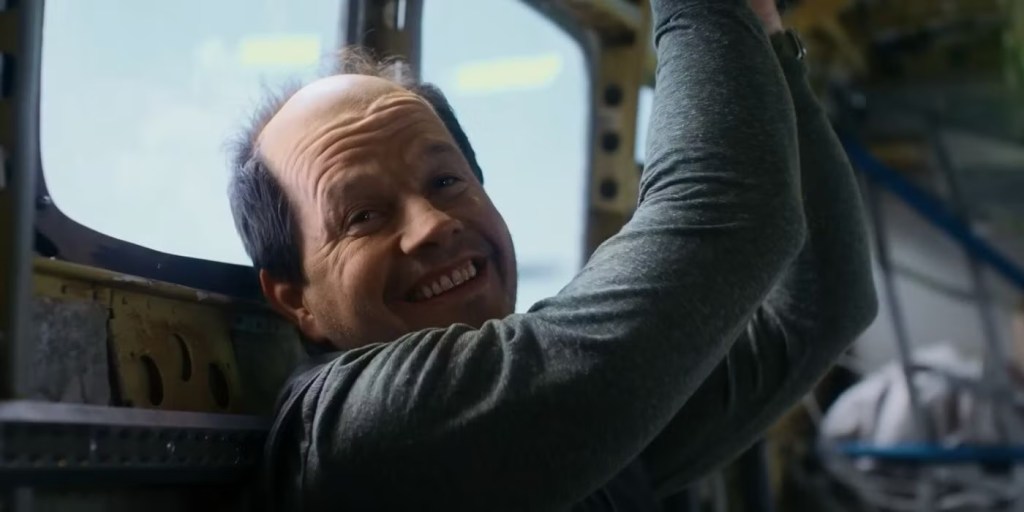
The film gears on a fugitive, Winston (played by Topher Grace). He is to go on trial, and his air marshal is Madolyn (played by Michelle Dockery). Their pilot is Daryl (played by Mark Wahlberg). Their flight is going over the wilderness of Alaska. Once they are in the sky, red flags begin to arise. Winston and Madolyn see signs of a questioning personality with Daryl. Also, he becomes abusive. Therefore, Winston and Madolyn must figure out how to keep themselves from crashing with the aircraft or battling with Daryl. Also, with Winston (as one who is a criminal), the level of trust lies in the balance of the film’s suspense.

The title and the cast are the appeal of Flight Risk. The conflict is what is the blur. The criminality part has little explanation, and the problems in the plane are boring. There are a few moments that have audiences jump. Its quality is like it belongs to a reality show in a TV movie. It is challenging to take seriously.

With Wahlberg (as the bad guy), he is the one who brings in the vindictive vengeance danger to the aircraft. With Grace and Dockery (as the protagonists), it is like Three Stooges meets Con-AirFlight Risk lacks authenticity and big means of awry.  Flight Risk continues down its path of a disaster setup.

The film leaves many questions. What is the crime of Winston? How many charges are there? How did all the legalities begin? Why is Daryl the pilot to question? There is not much means of a foundation. Its audiences do not have much background to the upbringing of the conflict in and of itself.

The plane flies in hurdles. It is not shot vividly to create enticing entertainment. There are some moments of sharp turns, but other than that, all the conflicts are inside the plane. There is no place to escape, and only inside the plane is the boredom of time wasted in Flight Risk.

What came to my mind was the other films directed by Gibson. He is one that is known to push the envelope of violence. I wonder if this one was lighter because of going into production with his next project The Passion of the Christ. It is like he decided to direct a thriller in the sky before the intense process of his next biggest project. Regardless, Flight Risk did not display realism or in-depth moments like his other fascinating projects. I would rather revisit Braveheart or Hacksaw Ridge to feel “the envelope of violence” again. I rate Flight Riskone-in-a-half out of four stars.

Presence Review


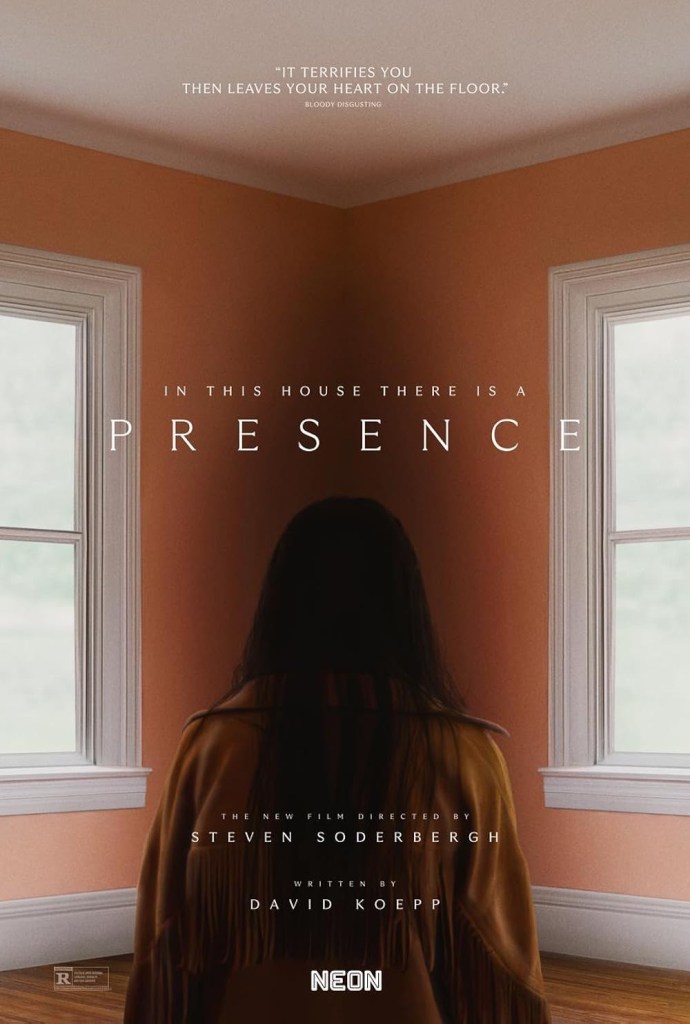
Director Steven Soderbergh makes the audience feel like they are the main character in Presence. Written by David Koepp, the story of a moving ghost and making the family the center of attention capture surreal value throughout the entire film. For clarification, the cameras and the whole frame are at the center of the film because every angle of the film moves during each moment of conflict or importance. While it is a bit shaky in some instances, the result is steady and perfect. Nothing even close to the shaky experience in The Blair Witch Project (1999). However, the film’s continuity and movement are clear and concise. I thought a lot about how Koepp’s writing feels like you’re following a story, and in this case it is through the moving angles of a hidden ghost.

The film is focused on a family that moves into a new home. The mom and dad are Rebekah (played by Lucy Liu) and John (played by Chris Sullivan). Their children are Chloe (played by Callina Liang and Tyler (played by Eddy Maday). Once the film begins, the dynamics of this family are captured effectively. Their disagreements weave back and forth through the motions of the camera (and the ghost is the camera.) However, they have a notion that their home is not normal, especially given frequent instances when the house is rumbling, and the lights are flickering. The audience is made to feel like they are the ones in control because of the way close-ups are used every time there are suspenseful moments. Soderbergh’s use of characterizations and realism are melded in a way that creates real stress and shocker moments for the audience given his careful direction of Presence.

As the camera/ghost weaves through rooms, the monumental lighting creates an atmosphere that highlights the characters. This produces anxiety in scenes when Chloe is with her boyfriend Ryan (played by West Mullholland). When they are together doing activities, the audience gets the sense that Ryan may be a bad influence. However, since the house can rumble, it feels as if the ghost is the protagonist preventing the antagonistic events in Presence. When Ryan has an evil plan, a rumble erupts. When there is a matter of concern, the camera pans closely on one of the characters. At the same time, the concern regarding what is making the house experience strange episodes is the central concern in Presence. The moving parts from the minds of Soderbergh and Koepp create a intriguing environment where outcomes are unpredictable, and tension spirals.

There are hidden events which may be the reason why there is a spirit lurking around the house.  There are hints in the story about someone who was important but lost. However, it leaves the audience hoping the invisible actions create more good than bad. The realistic human feelings are seen through the eyes of the invisible actions. This film takes a bold and new approach by Soderbergh which is genius and compelling. Three-out of four stars for Presence.

Treating cinema in many forms of art!