Tag Archives: A24

Heretic Review


When it comes to religion and theology, there are always layers of context regarding the various theories that are questioned. These layers thrive with an in-depth sense of sinisterism in Heretic. Written and directed by Scott Beck and Bryan Woods, they present a demonic tone that stays clearly present throughout Heretic. I found the format and setup to be realistic and almost like a puzzle. The terror, however, is what makes the film twisted. Just when you think one thing is happening, connections and dangerous methods are thrown into this mix which leads to a hole that is detrimental to crawl out of. 

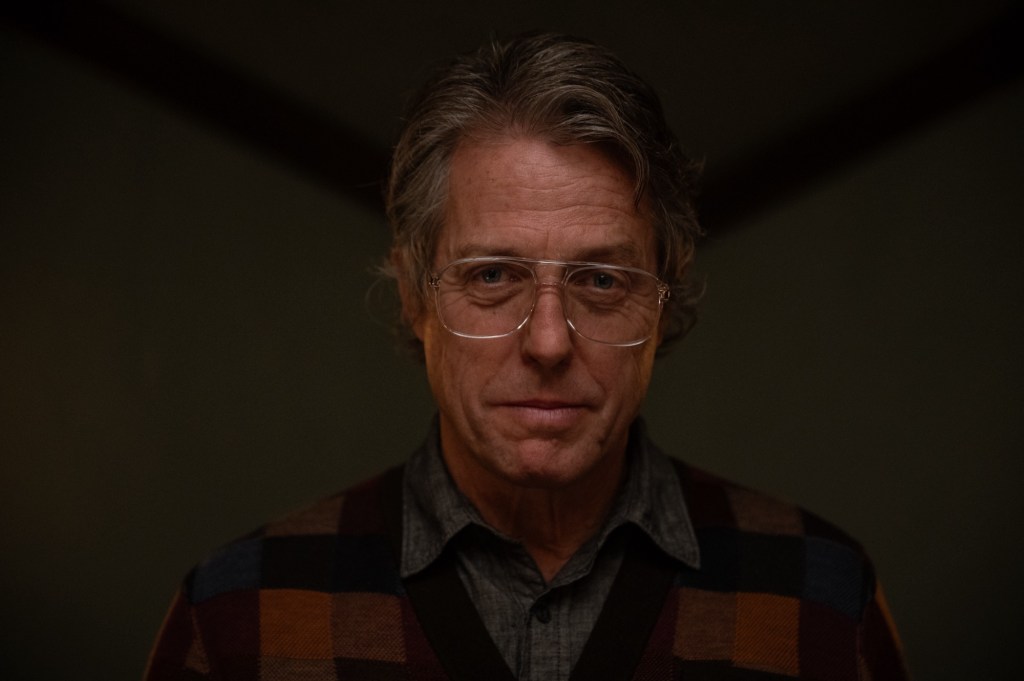
The film is centered on two young religious girls. They are Sister Barnes (played by Sophie Thatcher) and Sister Paxton (played by Chloe East). They are both missionaries who practice Mormon religion. They are doing rounds knocking on doors promoting what their religious beliefs and practices. When they knock on the door of an older gentlemen, Mr. Reed (played by Hugh Grant), he initially delivers a welcoming, friendly attitude. Then, as their conversation continues, his tone as well as his home start to present strange things. He delves into religious topics and suggests that faith has two elements, “belief” and “disbelief.” Given his weird personality, the girls find themselves scared and realize he has trapped them in his home. Soon they are in a deadly game of survival with Mr. Reed. If they cannot prove their theories effectively with him, they may end up never leaving his home.

Grant’s performance in the role of an old, tender yet deceitful man is the fuel to the fire in Heretic. Mr. Reed’s ability to cause the girls to fear for their lives as they navigate his theories creates a complicated landscape. Trying to determine what is known, true, false, or should be rightly questioned in religion and theology are all explored. Heretic delivers a sense of psychological uncharted territory in a dark manner that continues to evolve in an unpleasant way during this cinematic experience.

The focus is solely on Sister Barnes, Sister Paxton, and Mr. Reed—it is like a dueling trivia match where death is likely if wrong. The writing and directing of Beck and Woods keep viewers thinking about religious theories and their accuracy. Do they all eventually agree for the victims to live? The story highlights the lengths to which curiosity can go and leads to a sensational one-of-a-kind death match that is relentless. Heretic leaves the audience repeatedly thinking “WOW” in the back of their minds. The element of surprise is more than what audience expects in Heretic. This film is a genius gem filled with moving parts which portray how someone sinister can find a new maker.

Is there a chance that the girls can escape this evil home? Are the theological and religious theories factual? How well do Sister Barnes and Sister Paxton know their faith? Ultimately, their faith will allow them to find a door to make it out alive. Three-and-a-half out of four stars for Heretic.

We Live in Time Review


A couple finding each other and going through many woah moments has a humanistic approach in We Live in Time. It has authenticity of connection and what it means to be present of love. It also has the dynamic of challenges—the conflicts of the characters themselves. Directed by John Crowley, a love story that has resilience. Stunning performances by Andrew Garfield and Florence Pugh. Garfield and Pugh are the knockout couple that thrive the realism of We Live in Time.

This is the plot of We Live in Time. Garfield plays Tobias and Pugh plays Almut. Tobias is one who has just went through a divorce, and Almut is a growing chef. They are brought together by an accidental event which leads to love at first sight. Together, their romance and feelings for each other are deep. They have the personalities of wanting to be together forever. At the same time though, life brings in conflicts that require a lot of mental thinking. Together, they weave the hard times and happy times of their love life. They have continuous disagreements, and “time” is of the essence. We Live in Time boils turmoil by trying to find the true meaning of the love that is beneath Tobias and Almut.

The conflict of challenging the relationship is that Almut has stage three ovarian cancer, and she continues to do her chef work and grow her image. This creates the rough patch of We Live in Time. My appreciation for the film’s concept of being able to channel emotions is how it looks at its impact of truth and honesty.  “Truth” of an illness and “honesty” of its mental impact. Tobias and Almut want to feel their love forever, but at the same time, they want their mind to be fueled by the other aspects of life where they feel inspired. A lot of the “feel inspired” is Almut wanting to continue her growth as a chef. At the same time, they grow a family with one daughter.

There is a moment of teaching quality that just thrives the fascination of Pugh’s performance. In her role as Almut, she gives a step-by-step direction on how to crack eggs properly. There is meaning behind this element of quality. It is in her words as she says, “Versatility of the egg knows no bounds.” From this quote, that just delivers that loving and honest message that once a commitment begins, it is one where being committed has a direction for the long run. “The long run” is how supporting the relationship is through the eyes of Tobias and Almut. Will Tobias support Almut through her illness? Will Almut and Tobias be together forever? Where does their relationship have their most meanings? There is lots to take in with We Live in Time. There are no emotional boundaries. There is the pattern of love hitting deficits and then rebuilding with what matters—that is the definition of togetherness with many frequent slates. Three out of four stars for We Live in Time.

A Different Man Review


There is the thought of solitude. It weaves heavily in the introduction of A Different Man. Written and directed by Aaron Schimberg, A Different Man keeps its dramatic depths shallow. The writing is structured to make the audience feel sorry for the main character. It does well with this because of its frequent tunes of lighting of question throughout its continuity of dramatics. The writing of a man hoping for a change, and then it all goes down the opposite direction. The path of faith is set toward someone else and not in the path of its predecessor. There is lots of resentment and tension that boils inevitably and explicitly.

The film gears on Edward (played by Sebastian Stan). Edward is a struggling actor. His face has uninviting traits. The looks of it look like a retired Frankenstein on acid.  His neighbor Ingrid (played by Renate Reinsve) comes around. She is neighborly with Edward (despite his appearance). From the looks of the interiors, it is a clever portrait. Edward is depressed (due to his uninviting facial traits).

There is a sense that change can make a difference. In Edward’s situation, it is not so life changing. Edward goes through procedures to have a regular (human) face. When this starts, all bets of joy (for Edward) are off. Schimberg’s writing is a continuous rejection. What Edward has hoped for all goes wrong. There is a man named Oswald (played by Adam Pearson). Oswald is playing a role in a play, and it is based on Edward’s sad life. Edward finds himself in a mental state of agitation.

There is jealousy and curiosity in A Different Man. The play is in the direction of Ingrid. What does Ingrid see in Oswald over Edward? Why is Edward losing it? Who is more of an asset to the dramatics of the film itself? The dynamics of jealousy, love, disconnect, and the theatricals boil high in A Different Man.

It is like misery is made to be taken advantage of (through the eyes of Stan’s performance as Edward). Edward sees his procedure as a light to a new beginning. The “new beginning” just fell into the eyes and attention of somebody else. A Different Man is an envious journey that is gradual of a dark and comedic track. The situation (in the film) is not happy. A Different Man does maintain a steady mode of characterizations, however.

Edward assumes he will get attention (by getting surgery on his face). Edward continues the process. He feels this gives him the chance to get closer to Ingrid. This tactic (kind of) does, but that is until Oswald comes in. Oswald has taken the image of Edward’s life. Instead of Edward finding fame, he finds misery. Is there a new path for Edward to not feel a strong sense of rejection?

The focus of one dreading loneliness finds unique misdirection. A Different Man plays out the jealousy vibe well. With clarification, A Different Man is not accomplished realistically. It is the clever direction (of the film) which is inviting. Two-and-a-half out of four stars for A Different Man.