Tag Archives: A24

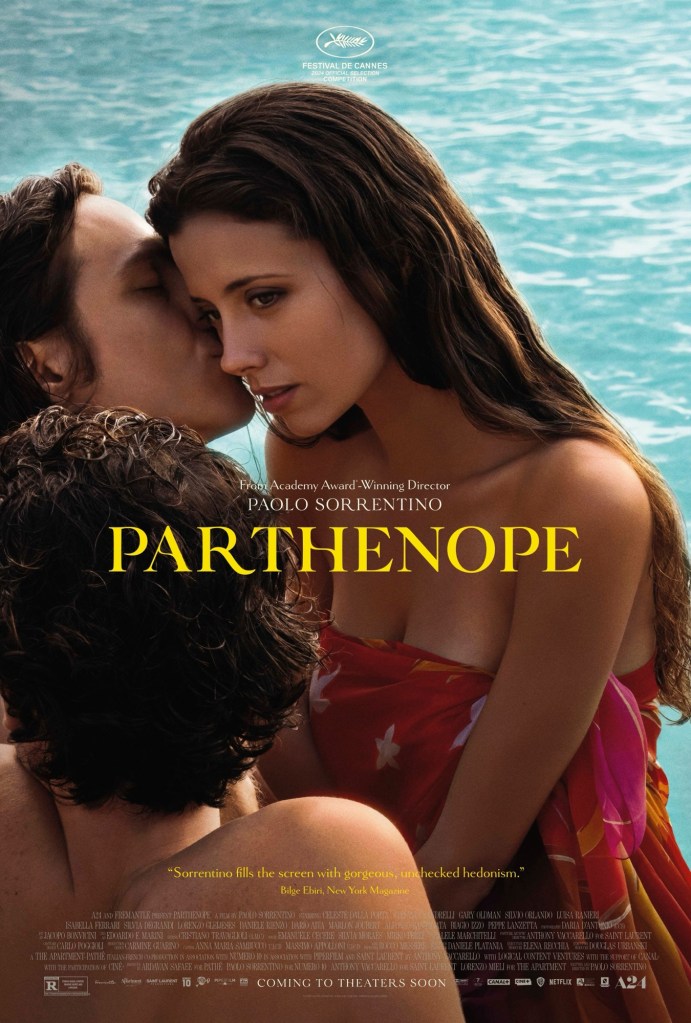
Parthenope Review


“Great actors, like great directors, do the same job. They are great observers of reality.”

-Paolo Sorrentino

Those quotes hold true to the craft of Sorrentino. He is a director that loops in beauty and presence in forms that feel connected to the purest quality. With a blend of dynamics, characterizations, and purpose, artistic craft shines in Parthenope. This film that takes place in Naples, Italy–a country that Sorrentino admires.  The humanistic value here feels vivid in its form of following its main character. With an array of ups and downs, Parthenope leaves marks of the challenges of moments portrayed and lightin the revelations revealed. All of it is through the eyes of the film’s main character…Parthenope (played by Celeste Dalla Porta).

The vibrations of scenery create the flow of Parthenope. As the film’s center, they are gorgeous in capturing the essence of Porta’s most ambitious roles. The plot is diverse, and the setting of Naples sets off a vibrant track. Parthenope is a woman of divine beauty—she has a lovely personality and dazzles the screen of her dynamic life. Continuity strolls through her journey with much to think about. She navigates her life throughher studies in Anthropology. This ties into her connection with her professor Devoto Marrotta (played by Silvio Orlando). She also navigates her companionship with Sandrino (played by Dario Aita) and Raimondo (played by Daniele Rienzo). She also has ambition to take the steps to become an aesthete because of writer John Cheever (played by Gary Oldman). On top of that, she has hopes to become an actress through her connection to Greta Cool (played by Luisa Ranieri). The many loopholes and avenues of Parthenope’s life are a journey of discovery—one that is bold and spellbinding in the thoroughness of Sorrentino’s artistic craft.

From the viewers perspective, it is like the performance of Porta is that of a creature finding open doors to beauty. “Beauty” isblended with light and creates a constructive pattern in Parthenope. The setting of Naples is one where the artistic life of one finding their track is diverse in the pattern of one finding themself. This is a journey that will take the breath away from its audience, especially through the moments where Parthenope questions her beauty and who she loves. They leave the audience to wonder who will benefit her in her journey to find a career or move toward a life that is fulfilling.

From Sorrentino, the presentation of one feeling alive and in the moment weaves the wonders of happiness and contempt into a complex tapestry. The question is where is it rewarding? Is it with her many moments of relationships? Is it with her studies? Is it with the fascinations of thinking of becoming an actress? The diverse range of places and choices are intentionally vast tocreate a correlation of unforgettable meaning.

Love finds new tones of language and empathy in Parthenope. A masterpiece of craftsmanship and looking at life in a warming,heartfelt perspective. The shifting of plateaus leads to unforgettable wonders. It does not dwell on finding a negative pattern, but the choices in Parthenope are bound to make an audacious impression. Four out of four stars for Parthenope.

The Brutalist Review


Writer and director Brady Corbet is the champion of his craft with The Brutalist. A jolt to cinematic ambience that is mind-boggling and daring. A film that is set up chronologically in acts to vividly compel its audiences to want more. Laid out with an overture, separate acts, and an epilogue, The Brutalist gives its audience a chance to refuel their brains. At a running time of three hours and thirty-five minutes, there is a fifteen-minute intermission.

This drama of wonders is all centered-on Laszlo Toth (played by Adrien Brody). Laszlo is an architect that is vivid with his craft. His wife is Erzebet Toth (played by Felicity Jones). Laszlo and Erzebet escape from the post-war Europe in the year of 1947. Laszlo’s goal is to rebuild with his fascinating architecture. It is a swift period where industries, businesses, and landscapes play a role in the profits for projects to start up. It is a journey that encounters trial and error, while also building legacies for a bigger meaning. In examining the performance of Brody, he is destined to be Laszlo. The dedication he conveys paints a portrait of artistic fascination where there are no bounds.

The film paces itself—Laszlo finds himself in struggles with rebuilding his reputation at first. Also, trying to reconnect with his wife to start a new beginning poses a challenge. Corbet’s writing and continuity are vast with many dreams floating through the mind of Laszlo—he wants a life of success, but his passion for architecture leads to discord on many fronts. The times are heavy with political conflicts tying into other stressors and creating a presence of darkness.  As Laszlo realizes he is in front of the Statue of Liberty, he becomes destined to create opportunity for those he soon encounters in The Brutalist. 

The dark and successful days of Laszlo battle each other once he begins to work with clients. He starts to do work with Attila (played by Alessandro Nivola). This is a steppingstone, but then he gets a more rewarding opportunity. He is offered a commission to design a grand modernist monument. The one who gives him this job is Harrison Van Buren (played by Guy Pearce). Harrison’s son Harry Lee (played by Joe Alwyn) is also involved. This provides Laszlo with food, shelter, and a place for his wife Erzebet, but he questions if this is all of what he truly wants. The themes of wealth and greed play a role in the turmoil of Laszlo’s vision. With it being the era of modern America, The Brutalist loops in technological factors of to bedeeply frightening, stressful, and invigorating. 

Laszlo is his own scholar—attempting to make his craft and vision of what he wants to be unforgettable begins to be more than he can bear. The film’s depiction of Laszlo finding his ways to ease his stress and anger create an eerie presence. There is a lot to take in with The Brutalist. With the factor of modernization moving forward (after World War II), The Brutalist is an evolving reality of success with a trail of happiness waiting to be fulfilled. However, can Laszlo succeed at what he is assigned? Can he trust the egotistical wealthy minds surrounding the Van Buren family? Can he make the right choices and trust that life will be safe for Erzebet? There are many moving parts in The Brutalist. All of which challenge their own demons poetically and cinematically. It is authentic in its form of depicting the idea of never giving up while also dealing with artistic endeavors that remain unsupported in the world of profit.

When projects go downhill, so do the attitudes and trust of Laszlo, The Van Buren family, and his wife Erzebet. This is because the home of Laszlo is in the hands of the Van Buren family. Laszlo wants to rebuild his reputation and wants to keep creating the future of what he sees in his mind, but with the lack of structure, his ego spirals like crazy and leads to drinking, drug usage, attitude problems. The Brutalist dazzles with emotions.

The intermission is what helps its audience rebuild their thoughts before they continue with the other acts of the film. With the trail of Laszlo hitting roadblocks, The Brutalist is one that will keep building foundations of wonder and questions. The era of modern America is presented in an audacious form that I have not seen before, and it is all through the eyes of the performance of Brody. The Brutalist carries cinematography and scoring perfectly to maintain the emotions of its audience. It is set to know the moments of lightness and darkness. Brody’s performance is a monster of grandeur, brutality, and brilliance. Four out of four stars for The Brutalist.

Babygirl Review


Nicole Kidman presents herself as someone who is voracious and power hungry. The title of Babygirl speaks for itself. Written and directed by Halina Reijn, the boundaries of the film go instantly awry. There is no filter to the film’s content or the norms to be violated. Babygirl is steamy! The more lines that are crossed, the more damage that is bound to be done.  Babygirl creates a dynamic where rules and superiors do not see eye-to-eye. Safety is only guaranteed when unwritten rules go unbroken. The writing has blurred lines in which violations lead to tension and the greater the risks, the more vivid the moments are. Babygirl is unlike anything I have seen before.

In the film, Kidman plays Romy, a well-known, successful CEO. She is persistent and always aiming to be at the top of her game. Her husband is Jacob (played by Antonio Banderas) and he works in the arts. The portrait is painted like they are one happy family until a young intern comes into her life. This intern is Samuel (played by Harris Dickinson) and he has a personality that is straightforward and belittling. He also plays his cards in a disturbing way to blindside. His nice guy attitude and his attention is irresistible for Romy. Soon, she finds herself in an affair with Samuel. With late night parties and secret hookups, Romy finds herself in bizarre place, both emotionally and on the job. It is only a matter of time before Romy and Samuel’s altered judgment lead to irreparable consequences.

As someone who grew up in and around professional business environments, Babygirl spoke to me and caused my head to swirl with thoughts about difficult workplace challenges. What are the penalties of making bad choices? Who is at fault? There is no positive advice in Babygirl. Both parties make poor choices, and the material portrays suggestive scenarios which are cinematically enticing and intriguing. The CEO status does not matter much in Babygirl, but the impact does.

The film has a theme of soul-searching which proves thought-provoking yet stressful and intriguing. The couple’s deep connection is morally wrong. The CEO’s ego finds itself in peril, and Kidman displays desires that she cannot control. Dickinson’s character has the upper hand as the dominant and Kidman plays the submissive. The competition for who pushes the boundaries harder is like watching a video game with two players trying to beat the levels of self-control.

The age differential causes lethal suspense in Babygirl. The writing focuses on the issues related to Kidman as a middle-aged executive and Dickinson as an evolving adult intern. There are ways in which both have an upper hand, but neither can escape the detrimental career and personal consequences of their actions. Babygirl is the death match of ageism played out in an office setting.

The entire film illustrates examples of the various violations possible in the workplace. The atmosphere and characterizations are bold and engrossing, especially when there are kinky games and threatening scenarios. The display of human darkness is immense and lead to on going instances of being blindsided.What will the outcome be for the CEO’s family? Will innocence and irresistibility lead to shocking and edgy discoveries?

Babygirl had me sold. It is a hard R with many revolving doors waiting to be opened. Kidman and Dickinson are a pair destined for extravagant destruction.  Audiences will be left thinking about how much reassessing will need to come into play givenhow out of hand the situation gets. Kidman and Dickinson are a combative duo fueling the fire with each other. Regardless of how insane it gets, it is superb. Three-and-a-half out of four stars.