Tag Archives: Angel Studios

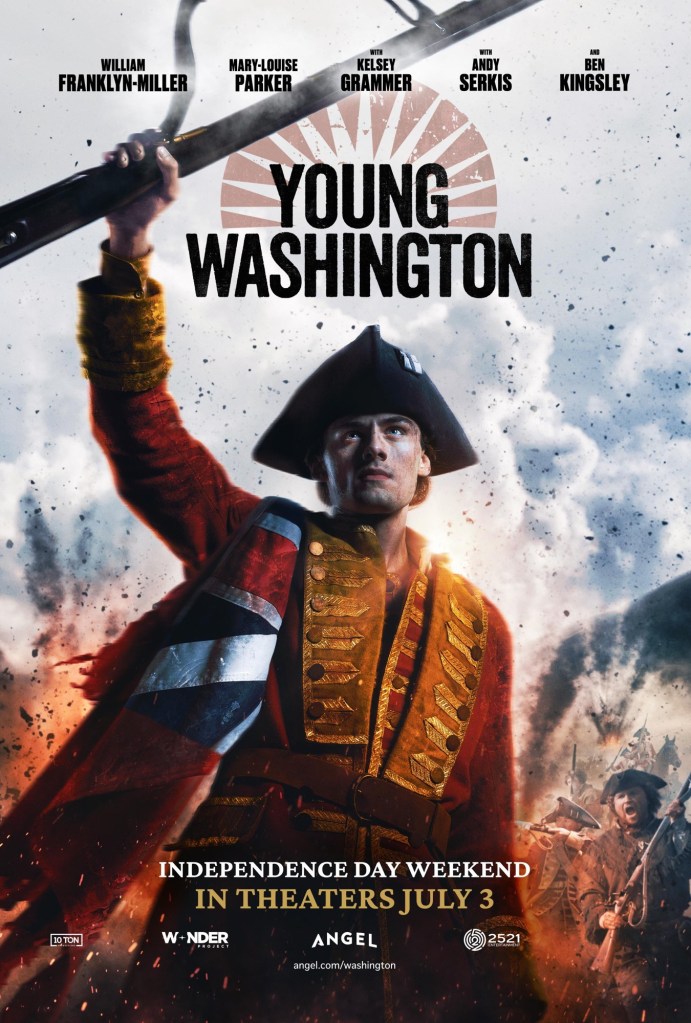
Young Washington Review


I am grateful that I had the opportunity to see the many first glimpses of Young Washington at CinemaCon back in April.Also, I was able to hear a few words from the lead William Franklyn-Miller—his performance in Young Washington soars with wonders. I had a feeling I was going to be sold on the full version of Young Washington, and I definitely was. This story of a rising leader presents many historic aspects. Simply spellbinding is how I define Young Washington.


The film is solid as it begins with George Washington and his journey taking on responsibilities of the many territories surrounding the different colonies. With much political sophistication, there is also a sense of surreal wonders. His mother, Mary Washington, is played by Mary-Louise Parker. The life of George is one that is unsettling, but redemption abounds. The era of the mid and late 1700s plays out in politics and the landscape of George’s growth.


Although the film lacks in some of its historic value, there is resilience and spectacle in the acting and the cinematography. Also, the dynamics of history and leadership are well played. The battles for the lands and the colonies are where Franklyn-Miller possesses the perfect attitude to play George Washington. As the film progresses, he speaks with Lord Fairfax, played byKelsey Grammer, as he owns much of the land. George finds inspiration from his half-brother Lawrence Washington, played by John Foss. Authority though, is where George struggles. He seeks to change the world, but he must fight hard for that leadership role.


The characterization around authority and equality all rumble in Young Washington. I found great inspiration, especially with the background story of Washington himself. His sidekick is Christopher Gist (Leo Hanna), and George takes many of his orders from Robert Dinwiddie (Ben Kingsley). Once George is on the frontlines in war, the film becomes a power boxing match between George and Robert, showing that political order may not always be the answer. With George viewed as the rookie, the film resorts to presenting his hero side much more.


The storyline and the performance of Franklyn-Miller compelled me, but my issue was that so much of the authority and leadership over George took over much of the writing. It focused a lot on making him look like he was someone who would never advance. Overall, the history of it all has blurred moments, but at the same time, spectacle exists with Young Washington.


The concept of values and the action of warfare make Young Washington appealing. There is a sense that it can find its following and find a way to be entertaining on the big screen. History with added warfare and early stages of one rising had me sold the most. This was not totally my favorite, but just above par. It is one of those films where my star rating falls at-two-and-a-half out of four stars.

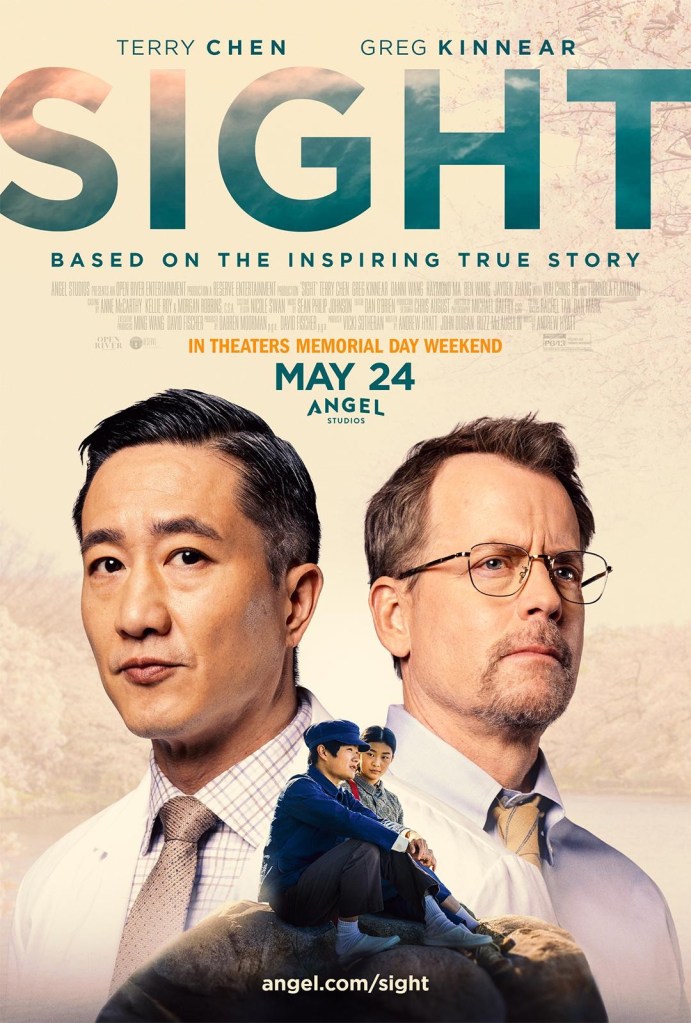
Sight Review


Empathy is faithful. There are lines between the levels of permanent, temporary, and risky. Sight is a film that parallels those values for a miracle. Written and directed by Andrew Hyatt, a revelation is one of realism. Sight is all about “realism” with monumental effects. The true story of Dr. Ming Wang provokes purpose in Sight. There is a broad and precise perspective. There are moments where the transitions struggle sometimes.

Terry Chen plays Dr. Ming Wang, and Greg Kinnear plays Dr Misha Bartnovsky. Ming is a Chinese Prodigy who grew up in China during the Cultural Revolution. Challenging events of Ming’s past had him around a blind individual. Ming found inspiration to restore people’s vision. His success has led him to become a world-renowned eye surgeon. His mentality is to the test. He is allowed to improve the vision of a young girl. Her name is Kajal (played by Mia Swaminathan). This procedure is risky. A young age means not much development.

What keeps coming to Ming’s mind is detrimental. Ming witnessed a horrific moment. Ming was a child. He was the witness of a stepmother blinding her adopted daughter. Sight’s writing finds its moments of shifting to the traumas of Ming repeatedly. It is thorough and faithful. The transitions between the present and the past just tended to throw me off in increments. It does give the notion that the procedure is risky for Kajal. With the help of Misha, Ming finds resilience in his research to create a miracle for those who are blind. 

Doing a procedure to change the view of life is presented with a surreal emotion in Sight. The thought of optimism is what is of importance. It is also an element that is a blur for Ming. With the human eye having many components to process, the complexity is mind-boggling. Can Ming create this miracle for Kajal?

The thought process of Ming is a layer of harrowing moments. He repeatedly thinks back to his past. He thinks about the time of his education, political tides, and the impact he has had on his own life. He feels that the past is the layer that can create an error in the procedure. Moving forward, he has a genuine heart.

There is a connection. There is also the sense that creating a permanent change for the better rises. Sight is a road of two directions. The first location is Ming and deep thought of his development. The second is the steps and the attention on the efforts to help Kajal gain her vision back. Sight soars with wonder. It leaves a mark of positive aspiration.

The center of creating enfranchisement dives into finding momentum poetically. The writing tries to over-examine moments. It thrives a heart of encouragement. The relationship between Ming and Misha (from the professional standpoint) creates that bind of medical studies. There are no results until a procedure is complete. Anxiousness of Sight has its eagerness as the moments of this task get closer.

My fascination with Sight is its context of persistence. Moments are blurred between transitioning (of the past and present), which creates the foundation of Ming’s successes. Ming dealt with political dynamics, but he fought to change lives. He does so by fixing the visions of his patients. When he does, they can see the many wonderful aspects of their own truly and indefinitely. Three out of four stars for Sight.