Tag Archives: Chicago Critics Film Festival

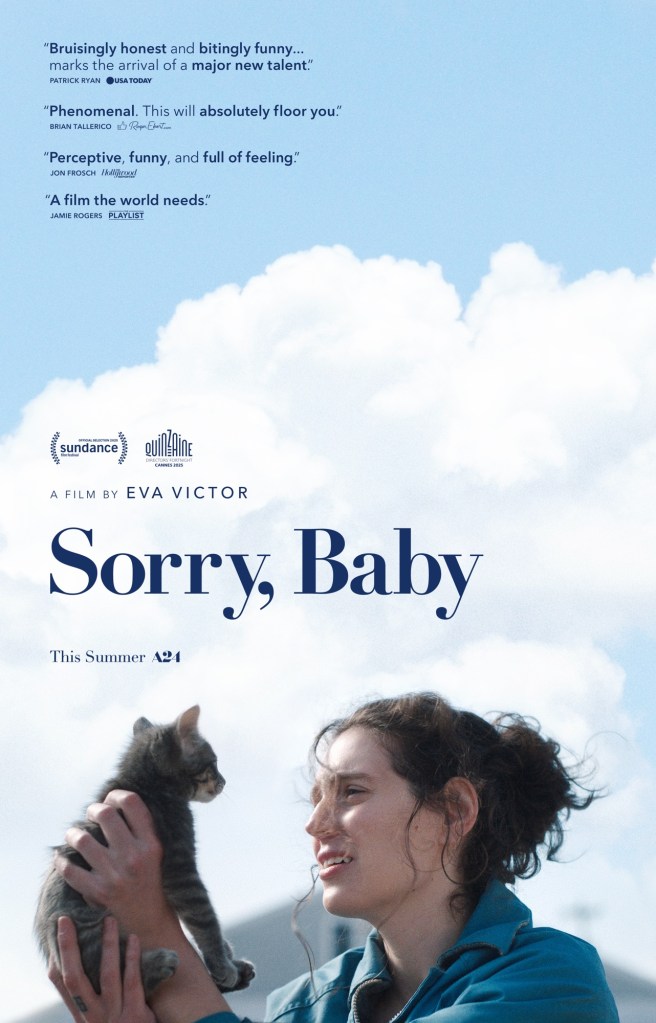
Sorry, Baby Review


This is a portrait that I was mesmerized by. It is a film that leads to curiosity as it explores human nature. Sorry, Baby leaves a trail of questions. Why do things happen? Why do people do what they do? Ultimately, how does the person who has been impacted keep a calm demeanor? Eva Victor is the writer, the director and the lead in Sorry, Baby. She gives everything to this performance. Her mental awareness and her ability to portray disconnect are impressive. Sorry, Baby shines in displaying matters of stress and relief. It is built upon a foundation of the steps it takes to go forward. The result is a landscape of trial and error that paints a clear picture of what it means to go with a gut-feeling.

Victor plays Agnes. She is working through the steps of completing her thesis to become an advisor. She shares a house with her close friend Lydia (Naomi Ackie), who is pregnant. Agnes and Lydia bond over their shared appreciation for hard work. For Agnes, however, her life takes a turn due to her thesisadvisor Preston (Louis Canceimi). Agnes is thriving the best she can her and then her world rotates once she meets Preston. While the audience does not see the tragic events, she has a harsh encounter with Preston involving assault.

Once the assault happens, the mood of Sorry, Baby understandably changes. Victor’s writing reflects the introverted mode caused by embarrassment and shame. Going forward, it begins to create a positive form of movement because Agnes keeps her head high and works through her emotions. She focuses on her thesis and leans on her friends, including Lydia. Then she finds herself at ease hanging around with her neighbor Gavin (Lucas Hedges). Sorry, Baby displays Oscar-worthy characterizations that soar with encouragement from the creative mind of someone who shows how growth from a harsh reality is possible.

The real-world scenario of Sorry, Baby leaves audiences with an influential reminder. Specifically, there is often something helpful to be learned from even a horrible encounter. At the same time though, it also shows how difficult it can be to talk about it. Victor’s writing showcases the sensitive layer of vulnerability that has the audiences hoping for better outcomes for Agnes. Her skills at writing, directing, and acting have led to a masterpiece.

With the harsh encounters creating anxiety in the film, the way Agnes deals with the post-event is thought-provoking. Does it scare her? Yes. Does it impact her? Yes. Does she open up about it? Not entirely. Her introverted personality and lighthearted attitude display that it is not about ruining one’s life, but about how one can move forward positively. Lydia’s pregnancy is one of the distractions for Agnes, and so is a cat she adopts. Slowly, the sweeter aspects of life fill the landscape in Sorry, Baby and light the way for an inspirational path.

There is turmoil, there is sadness, and Sorry, Baby turns despair into hope. Victor’s performance in all three roles (writer, director, actor) is one for the ages. The disconnect from reality is just the beginning and the steps to redemption are one-of-a-kind. Four out of four stars for Sorry, Baby.

Friendship Review


When I went into this movie knowing that it stars Paul Rudd, what instantly came to my mind was his film, I Love you, Man–primarily because of the concept of a lack of friendship. That film was a hard R comedy with many humorous moments. Friendship has both of those components, but in a darker narrative. It works to still be dark and mutually funny with its undertones. Friendship is one of the most audacious and vibrant films I have seen to date. A bipolar disorder goes to the brink of mania in Friendship.

Friendship is written and directed by Andrew DeYoung. As a director, he captures the mode of mid-life crisis hitting a plateau and then adding many levels on top of it. Friendship’s main character is Craig (played by Tim Robinson). Craig is an introvert with a normal life and family. His wife is Tami (played by Kate Mara), and his son is Steven (played by Jack Dylan Grazer). Craig realizes he has a new neighbor, Austin (Rudd). They begin a “friendship”, but then their relationship becomes competitive over success. However, it is more about Craig overcoming his introverted mode that is the key to the film’s built-up tones of humorous suspense and laughter.

The livelihood is the mix of the film’s layers of success and frustration that create patterns. Craig feels jealous easily, and Austin feels uncomfortable easily. Austin puts up a boundary, and Craig feels disconnected. When Craig gets to the lonesome stage, all bets are off when it comes to his level of maturity. “Maturity” does not exist in Friendship.  The way this is written and presented is a revelation that I found to be astonishing. That is because it keeps finding the components to topple laugh after laugh.

Friendship creates an outlook that makes its audience understand who is reaching the crazy stage. It may look like Craig at one point and then Austin at another. The times where it hits the fan for both of those scenarios are ones to thank Craig for. The wonder of fun is the instant and repeated curiosity to who will fall apart first or go into a tirade that is hard to forget. Robinson and Rudd are a duo of suburban dads, each trying to create a perfectionist personality.

Friendship continues to display how the behavior of Craig is creating a weird environment. This is where the writing continues to be captivating.  The responses are humanistic in nature.  Like Craig’s son and wife, they tend to shift off in their own direction. Craig continually tries with  them and Austin, yet his approach is quite invasive. Of course, though, it only leads to more boundaries. When that happens more disasters, including a scenario with a sewer tunnel, self-destructive behavior, and a lot more angry moments get unpacked. The many curiosities of frustration do provoke laughter with excellence in a bizarre direction  in Friendship.

 If I had to compare, I do feel that the film relates to real-life loneliness, especially in the context of Craig giving in repeatedly in order to feel some sense of satisfaction. That correlation is what stirs the pot with overlapping contingencies and where this screenplay creates the highest peak of disconnect in Friendship. Three-and-a-half out of four stars for Friendship.


Don’t Let’s Go to the Dogs Tonight (Chicago Critics Film Festival 2025)


This film paints a portrait of what reality is like for a younger individual to be faced with poverty. On some level this truthful portrait hurts, but at the same time, it is eerie. Written and directed by Embeth Davidtz, she is legendary as she also plays one of the leads. The pacing of the film in an austere setting is done artfully. The harsh environment spirals to reveal honesty.

The film is based on a memoir focused on a young girl named Bobo (played by Lexi Venter) who tells the story. Bobo is an eight-year-old living with her family on a Rhodesian (now Zimbwawe) farm. At a very young age, she is exposed to extreme poverty. Her mother is Mrs. Fuller (Davidtz). The film highlights hardship and politics in an era before technological advancements.

What came to mind while watching this film was the theme of working hard for a purpose. Don’t Let’s Go to the Dogs Tonight portrays inequality in a realistic way that creates empathy. The story demonstrates resilience. It is by far one of the best features presenting the effects of poverty during childhood. The film’s subject is a great discussion starter, because the audience gets to see the world through the eyes of an eight-year-old surroundedby drugs, harsh language, and parents who provoke objectionable behavior in a country where harsh conditions are the norm. When seeing this film at The Chicago Critics Film Festival, it moved me to think more politically and empathetically.