Tag Archives: Film reviews

Artists: Depression, Anxiety, and Rage (CUFF 31) Review


This is one of those rare experimental projects that channels real and inner thoughts. Artists: Depression, Anxiety and Rageexplores a new thought-process of how the world views mental health scenarios. Directed by Lydia Lunch and Jasmine First, their approach takes a deep dive into the realms of how people’s thoughts spiral out of control when they get into their own heads. Artists: Depression, Anxiety, and Rage is a train ride of feelings that reminds its audience to keep the thought of resilience in the back of their minds.

Artists are the central focus of the film. Literary authors,composers, poets, visual artists —everyone has a way of telling how they feel and putting it into art form. The stories behind what unfolds in the lives of many of the artists is a lot to take in. Some of the information they share may be too much to bear, however, it keeps bringing up the inspirational factor despite thedark subject matters. The three feelings in the title are just the beginning, there is a whole lot more to the stories of the artists.

This was a two-year project by Lunch and Hirst. One that brings spellbinding realizations and connections in all their interviews. All of the artists featured have a dark background which correlates to how their art is expressed in their chosen medium. Artists: Depression, Anxiety, and Rage is a film where audiences may have to have a thick skin to take in these stories. The world of truth has layers of meaning with a presentation that is haunting, yet mesmerizing.

The whole film is in black-and-white cinematography—a trait where the darkness feels appropriate. But it is also one where it feels questionable. Is there hope? Is there a light? How deep are the mental health issues for each artist? Can some crawl of their darkness and anguish? Can some learn how to use their artistic skills to help them grow out of this? There is light for everyone, but not everyone may see it through the film. Despite what may be unknown, Artists: Depression, Anxiety, and Rage reminds its audience that the whole world is only human in a breathtaking narrative. Three-and-a-half out of four stars.

Artists: Depression, Anxiety, and Rage will be playing in the 31stChicago Underground Film Festival. The festival runs from Wednesday, September 11th to Sunday, September 15th. Artists: Depression, Anxiety, and Rage will play on Saturday, September 14th at 4:30 pm, and Sunday, September 15th, at 2:30pm. Both showings will be at the Harper Theater. Go to https://cuff.org/for listings, tickets, and passes.
Seeking Mavis Beacon Review


Seeking Mavis Beacon is unique in its exploration of technologyWritten and directed by Jazmin Jones, the era of advancement (with technological moving parts) creates a pattern of appreciation—a fictional character for software aspiration. Seeking Mavis Beacon travels to the days when people found fascination in the software itself. The film tends to lack an invigorating component in its writing. It does an excellent job searching for the pieces of the development of Mavis Beacon. It just tends to be a sleeper.

The film presents Jones (herself) as the leader in finding the story of her project. She interviews people about the characterizations of Mavis Beacon. She searches for the ones who developed the fictional character and the software. As she navigates this journey, she realizes there is a background to how Mavis Beacon felt like a human being. Mavis Beacon has the technicality around the fictional character inspired by a legit person. That person is Renee L’Esperance. She was a model who was with part of Saks Fifth Avenue.

There is soul-searching that has value. The theories are in limbo. It brings in a lot of first-person focus before establishing its presence. The writing tried to capture more of the patterns of the director’s process. That is not a lacking element. The reality behind what the film was going into did not offer much. There is confusing artistry (that does not tune into the plot of the documentary well). It does a surreal job with interviews of individuals. The transitions of focus are not so fulfilling in Seeking Mavis Beacon. It is a documentary of a rushed quality.

There is a fascination for discreetness in Seeking Mavis Beacon. With the pros and cons of finding the beneficial sides (from a fictional character), the layers of fascination struggle to evolve. Seeking Mavis Beacon has invigorating aspects, but its fulfillment is dry. Seeking Mavis Beacon is a documentary where value feels incomplete.

To clarify, “value feels incomplete,” the details and interviews are diverse to many voices. The aspect of influence does not meet the eye. It is the software of a franchise where the appreciation vibes keep falling below the surface to keep its focus. It is not terrible. Seeking Mavis Beacon is complex to hold the attention of its audience. Two out of four stars.

Slingshot Review


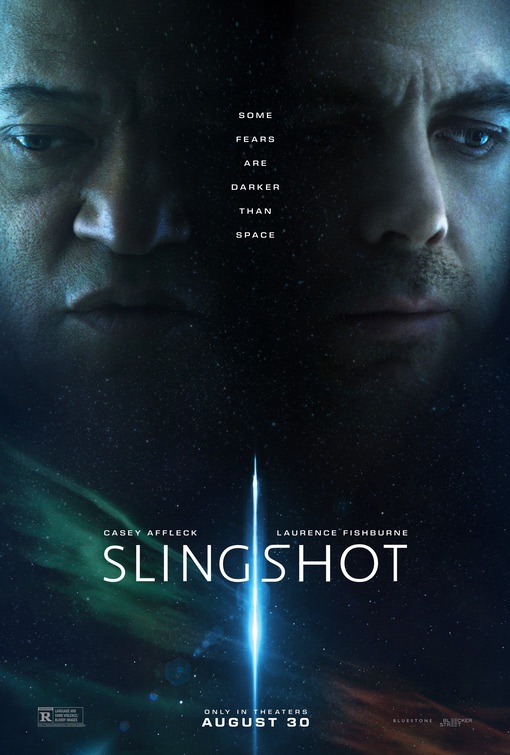
The title seems to be over-viewed as space peril. It has the odyssey and landscape of a vast setting to the moon. There is a sense of frustration and disconnect many miles away from home. Slingshot has all the legitimate innards for its plot of a mission. Sadly, it does not know how to pull off (its plot) cinematically. Directed by Mikael Hafstrom, the approach to mental conflicts (taking place in space) tries to be the moving part of a critical mission on a spacecraft. It comes around as compelling, but then it hovers to be shaky.

The film focuses on three astronauts: John (played by Casey Affleck), Captain Franks (played by Laurence Fishburne), and Nash (played by Tomer Capone). They are making their way to Saturn’s moon, Titan. The spacecraft has conflicts and underlying technical glitches. John and Nash question the mission’s continuation. However, with Captain Franks in charge, he insists they have no choice. He keeps pushing like it is required to complete what they started. The spacecraft continues to mess with the heads of the astronauts. John is the astronaut of purpose in Slingshot.

The film is a blur with its focus on John. He continually thinks about what home is. The woman he loves is Zoe (played by Emily Beecham). As John is tolerating turmoil on board, Zoe keeps floating in his mind. When that happens, the personal conflicts between Captain Franks and Nash keep deteriorating. The mental state of John and his vulnerability are the compelling factors in Slingshot.

Its writing has the sense of reconnection waiting to happen. It does a stellar job of shifting the moments of happiness, sadness, and hopelessness (through John’s thoughts). What is the film’s focus for John? Is it to get back home to Zoe? Is it for him to take his chances with reaching Titan? There are many vivid thoughts (out-of-focus) about John’s backstory.

As Slingshot has the continuity to seem that being in a spacecraft is the norm, it tries to rush its severe conflicts. Those are the ones with Nash and Captain Franks. The thought of making it home keeps falling to the lowest priority for Captain Franks. That messes with the mental states of John and Nash. However, it is redundant. The repeated use of the astronauts going to a coffin mode of hibernation frequently leads them to the same mediocre situation. That “mediocre situation” is at the standstill of their spacecraft in disagreement with their leader (Captain Franks).

With all these bizarre moving parts, Slingshotseems to try to grasp its feel as psychological. It does not know how to correlate its Tetris mode with a poorly written screenplay. The spacecraft, the world of outer space, and the environment are all wonderful. The characterization of focus is where the brakes hit a pause. The common ground of love (in the eyes of John) continues to be unclear in Slingshot. The reliance on boredom and agitation (in space) seems to take over to fill in the voids of dramatic depth. I still felt there were empty slots with no fulfillment. I rate it two out of four stars for Slingshot.