Tag Archives: Film reviews

The Front Room Review


Brandy Norwood (left) and Andrew Burnap (right) in The Front Room

The subject of being included in a family takes a clever turn in this unique classic. Directed by Max and Sam Eggers, The Front Room is a dark comedy that offers unexpected gems hidden below the surface. The writing of the film has plenty of twisted humor. It leaves the audience wondering how much tolerance there is for the situation. Brandy Norwood makes her return to a one-of-a-kind dark comedy. The Front Room will leave its viewers gasping with laughs and shocks. This is by far one of the craziest and most massive achievements I have seen from the Eggers’ brothers.

The film gears on Belinda (Norwood) and Norman (played by Andrew Burnap). They are a couple waiting for the arrival of their newborn baby. Their lives as a growing family begin to get more complicated. Norman’s stepmother Solange (played by Kathryn Hunter) moves in with them. She is rude, belittling, condescending, and obnoxious. Hunter plays the role of an old naggy woman extremely well.  Solange has no filter and is machine of negative words. As Belinda is trying to tolerate Solange, their home begins to hit all sorts of plateaus due to the aggravation that Solange causes daily. She constantly talks about respect and uses that as the reason she frequently puts Belinda and Norman down. She is also a religious fanatic. With Belinda and Norman awaiting their first-born child, how much of her abuse and unexpected, dramatic episodes can they tolerate? Solange is wicked and acts like a queen witch in their home which once belonged to her.

Given the frequent and repeated terror caused by Solange, The Front Room never stops exploring what reality would be like if people were in the same situation as Belinda and Norman. The film is a cinematic jolt of dynamic adrenaline. The sense of entitlement is on full display in the ongoing disagreements throughout The Front Room. The witch goes full throttle and her persistent effort to do everything she can to make Belinda lose her mind makes The Front Room a cohesive journey of bashing heads.

Audiences will get angry at Solange. They will feel her wrath. They will also feel the frustration of Belinda as she keeps struggling to put up with the bipolar patterns of Solange. Norman feels like he cannot do much, since Solange is his stepmom. It is clear, however, that he does not like her much. It is a situation where there are two against one, but Solange is very strong with her words and quirkiness which are enough to mentally burn Belinda and Norman out. The question is how their newborn will be raised around Solange and her intense personality and weird religious notions. The writing and continuity of disturbing cycles is at a championship level in The Front Room. The question is, can everyone just get along? Find out in The Front Room. It is a cinematic gem where the comedy lies within the cycle of tolerance. Four out of four stars.
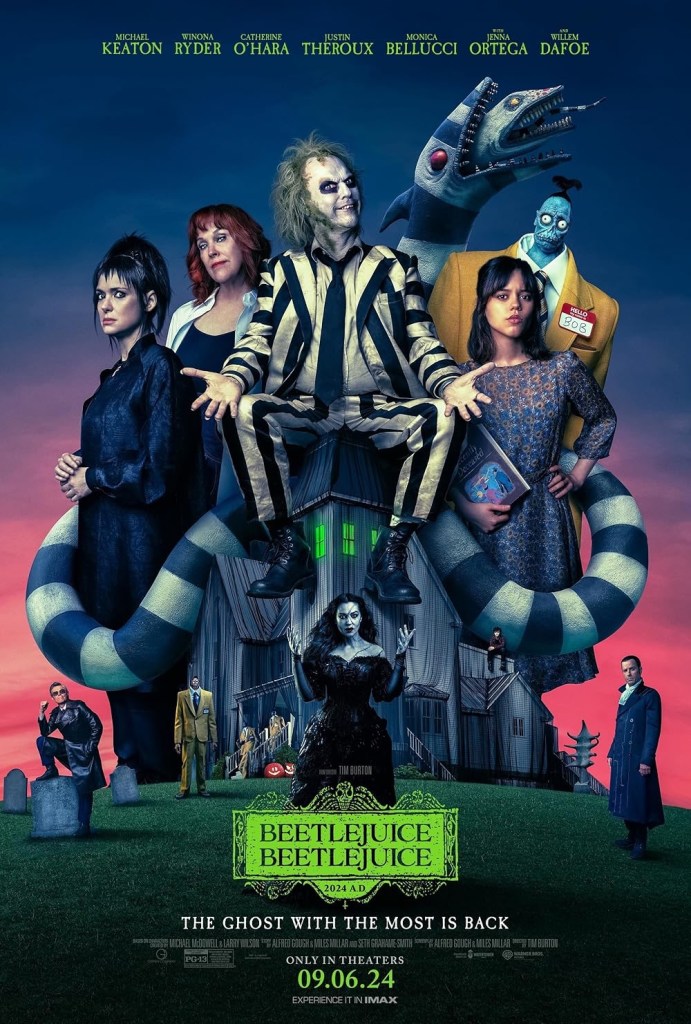
Beetlejuice Beetlejuice Review


The jams of amazement and creativity are still full of chills and haunting nostalgia. Director Tim Burton knows his audience. He knows where to find the twists, the turns, and the genius in unconventional moments. Beetlejuice Beetlejuice thrives with cleverness. Over three decades later, a beat is still not missed in Beetlejuice Beetlejuice. There is more that goes awry as adventure abounds in the world of Burton.

The film begins with the focus on Lydia Deetz (played by Winona Ryder), who I admire in this daring role. Lydia’s life has turned to having her TV series of paranormal activities. She is trying to dismiss that Beetlejuice (played by Michael Keaton) was part of her life. The dynamics of the characters offer more quirks and added value in Beetlejuice Beetlejuice. Lydia’s daughter is Astrid (played by Jenna Ortega). Lydia feels her life is a blur of nonsense. With Delia Deetz (played by Catherine O’Hara) still in the picture, Astrid feels her life is a joke until things change. Lydia decides she is going to marry her assistant Rory (played by Justin Theroux) on Halloween night? How much more of a headache can the various aspects of Astrid’s life be?

Beetlejuice is still around. The film does a stellar job at keeping its audience in motion with the many revolving layers of creepy darkness. Keaton delivers that grizzly, demonic, yet hysterical voice with all the excitement that fans crave. Keaton never misses the beat as Beetlejuice wants to be back in Lydia’s life despite her being opposed to the idea. With Astrid going into the portal of the Afterlife, all bets are off. Lydia must rely on Beetlejuice to help save Astrid’s life.

Burton keeps the characters on creative and jaw-dropping adventures. Interesting characters include the monster with the small head, Bob Shrinker (played by Nick Kellington), the fake detective, Wolf Jackson (played by Willem Dafoe), and one of the wicked ladies of the past, Delores (played by Monica Bellucci). Beetlejuice Beetlejuice is a continuation where spellbinding terror abounds. Keaton playing a guitar singing “I’ll be Right Here Waiting for You,” (by Richard Marx) showcases a unique way of connecting characters three decades in the making.

The Afterlife is the door into Burton’s visual and innovative world of a haunting emporium. Once the door of the Afterlife opens, there is instrumental formality because the Afterlife brings in an interactive storyline which proves magical. There are moving body parts, floating eyeballs, and shrunken heads—an enchanting array of Burton galore! The writing and lighting have not lost touch. Keaton and Ryder fulfill their destiny. What started back in 1988 finds a path to being reborn.

Is Lydia going to marry Rory? Is the Afterlife going to introduce and shift dynamics? What does Astrid want? Is there some good in the heart of Beetlejuice? Burton fills in connecting moments of what is love and lost. He is keen on bringing empathetic light into his writing and characterizations. There is a lot of that value in this film due to a new breed of peril combined with slightly over-the-top cheesiness. Still, the film delivers by staying on track and highlighting the gifts of Burton. Three-and-a-half out of four stars for Beetlejuice Beetlejuice.

1992 Review


The dangers of Rodney King’s era come with an added layer of pressure. 1992 has a trail of strain. There is a lot that goes bonkers. Directed by Ariel Vromen, the pattern is a boxing match between Tyrese Gibson and Ray Liotta (who died in 2022). The aptitude for vengeance reached for the sky in 1992. It is a film that falls in the era of the Rodney King riots. The added conflict is a heist. Who makes it out alive is the question in 1992.

Gibson plays Mercer, who has been released from prison. His priority is his son Antoine (played by Christopher Ammanuel). Mercer works at a factory. In the future, this is a rough dynamic. There is another mixed relationship. Liotta plays Lowell. Lowell has many years of a bad relationship with his sons Riggin (played by Scott Eastwood) and Dennis (played by Dylan Arnold). Its dynamics are faithful to the harsh times of the past. The reality of criminality (in the California setting) displayed a vigorous presence in 1992.

The conflict of the film is three moving parts. The riots outside, Mercer trying to keep Antoine safe, and a heist. The heist is in the operations of Lowell and his sons. Mercer feels taking his son Antoine to the factory (due to the riots) will help keep them safe. It leads them into a death match of survival. Lowell chooses to do the heist during the riots. This is the tactic because it creates a window where backup cannot stop their operation. Lowell wants to steal catalytic converters from the factory. The value is steep in the platinum of the catalytic converters. Chaos hits its anarchy once Mercer and his son are up against Lowell and his sons. It builds frequency with a clicking tock. The moving parts of the heist and the city going down under are a brawl. One that keeps audiences on the edge of their seats.

The madness of tension boils solid in 1992. The robbery hitting plateaus is the added layer of detrimental scenarios (calculated). The performance of Gibson and Liotta possesses the power of authority for the opposite circumstances. Gibson’s role is to protect his son, and Liotta’s role is to pull off a criminal operation with his sons. Both the choices of fathers lead to this unexpected circumstance. The only chance is to fight. Many punches go back and forth in 1992. The ruthlessness leaves a monumental mark of cinematic achievement.

In 1992, the stakes were critical. It begins with Mercer thinking the only safety conflict is the riots outside. He tells his son, Antoine, “We just got to stay the course.” That quote brings the dynamic to a ten-question level of safety concerns. When the audience thinks Mercer is keeping his son out of danger, they walk into it (at the factory). The rough population of the livelihood has density in 1992. Its environment with detrimental infrastructure links to resilience. “Resilience” is how choices have consequences, and how some choices of harshness must be made.

Who is more at risk? Is it Mercer’s son? Is it Lowell’s son? Do the riots create any more layers of questions? How many conflicts come around with the heist? Find out in 1992. Three-and-a-half out of four stars.