Tag Archives: Film reviews

Twisters Review


I find movies that focus on weather and peril fascinating. I went into Twisters with great expectations. Given the tornado-related events requiring taking shelter just days before the movie’s opening, I felt pumped. With tornadoes forming around the U.S. and weather watchers on high alert, I thought a rollercoaster of amusement was in store. Unfortunately, Twisters was an adventure that consistently loses its focus. The selling part of the film is that it stars Glen Powell and Daisy Edgar-Jones. Powell is rising with blockbuster projects, and Edgar-Jones is tackling more roles. Their characters are involved in a “twister” of madness.

The setting of Twisters is Oklahoma. This location is a tornado alley and provides the landscape for the film’s tension of treacherous territory. Powell plays Tyler Owens, a man with a following for broadcasting his journeys with storms and tornadoes. Edgar Jones plays Kate Carter, a former tornado-chaser and meteorologist. Kate’s colleague is Javi, played by Anthony Ramos, who develops a safety network. The season of tornadoes is immersive and evolving rapidly. The group comes together to figure out how to pan out the storm correctly. With differing opinions on the storms’ danger levels, the thrills lack the fulfillment that the audience anticipates.

Twisters tends to keep the focus on the performances of Powell and Edgar-Jones. Powell’s performance is street-smart while Edgar-Jones’s is book-smart. She plays her part with more seriousness than Powell does. With Powell driving a truck with fireworks, he is sort of like the Tom Cruise of storm chasing in Twisters. This leads to pure mediocrity in what could have been a more interesting portrayal. The pro side is that Edgar-Jones’s role serves a more rewarding purpose. The intelligence of her performance sparks some much-needed enthusiasm.

While reflecting upon the differences between the characters, my mind frequently drifted. What is the intent of the overused cool vibes in Powell’s performance? How is it beneficial to focus on tornado perils? Why does the film keep trying to tackle a bizarre dynamic as Oklahoma faces more severe consequences as the setting of the film? Twisters appears to care a lot more about its blockbuster characterizations than the plot itself.

The blurred continuity comes from a storyline with a mission that lacks structure. There is an inconsistent dynamic mixed with a bipolar weather rendezvous. What helps make up for some of the catastrophe is the background fundamentals regarding resources. Twisters does highlight the importance of safety and shelter. It is just not particularly vibrant in its presentation. Twisters is a rushed thriller with disconnected components. The meaning is somewhat lost amid various tactics involving weather, storms, and science which are ultimately inadequate.

The storms heighten the disasters in Twisters. Frustratingly, they are disappointing, even when they cause significant turmoil. Once that happens, the focus seems to shift to storm party mode for Powell. Edgar-Jones deserved a lot better for her key role in Twisters. The continuity just kept running into ineffective barriers. I rate Twisters just two out of four stars.
Sorry/Not Sorry Review


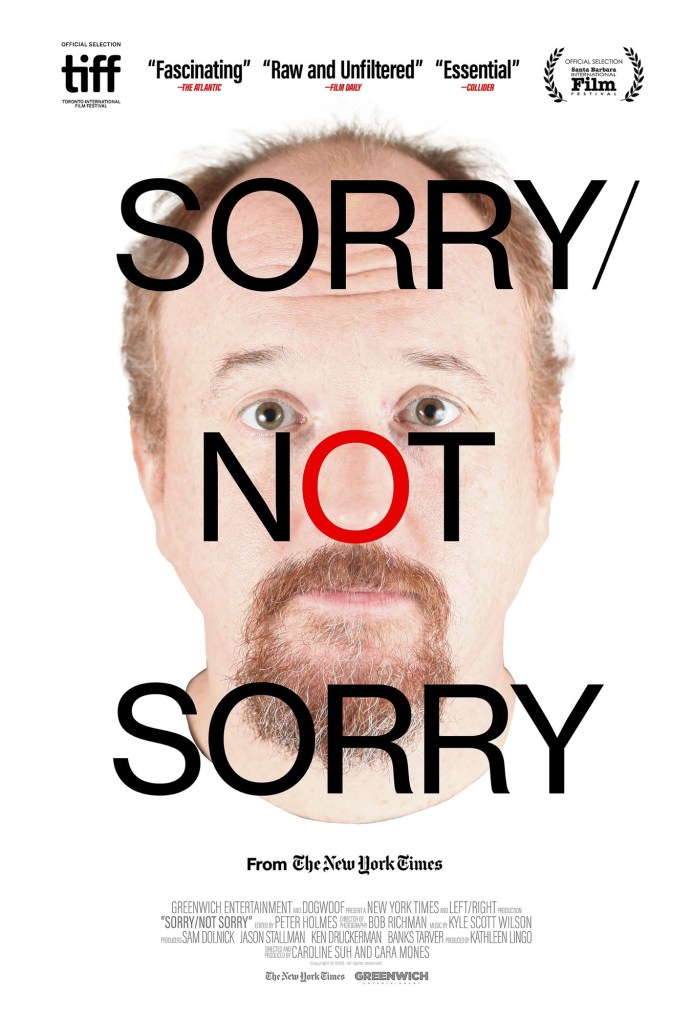
A documentary that sheds a dangerously truthful light on a comedic icon, Sorry/Not Sorry follows a trail of fame, patterns, and defamation. The #Metoo movement goes to the depths of honesty in a haunting matter in this film. Its focus is comedian Louis C.K. and the allegations against him regarding sexual misconduct. The title speaks for itself. I have seen Louis perform live three times in 2015, 2016, and 2021 (after his allegations and post-covid). Each of those times always left me with a different feeling of laughter. Sorry/Not Sorry linked me back to many of the times where I had once adored the works of C.K. and brought on some reflection.

Sorry/Not Sorry is a detailed documentary including many interviews with comedians and critics on the allegations against Louis C.K. The trend of what is hard to accept with Sorry/Not Sorry is that the weird events of Louis did in fact happen. The film jumps back to his comedy moments of him telling many of his jokes. The depiction captures him being very open and detailed about contentious stuff in his material. It then dives into events and scenarios leading up to the controversy around Louis.

It is all hard to watch. Normally with Louis, I would be used to laughing until my lungs hurt, yet Sorry/Not Sorry is not in that zone. These are true events not jokes.  The interview with Jen Kirkman is what haunted me the most, as she explains her early days as a comic and how she worked with Louis. The documentary presents a challenge in its storyline of the events of Louis C.K.  Its presentation seems to be one of disgust at how quickly tings can be forgotten when fame and money are involved.

The aspect of his material is a two-way street in Sorry/Not Sorry. Why would Louis go into detail about sexual topics within his acts after everything he went through? How does the funny feel good with the presence of the shocking realism of the surrounding topics? All are too graphic to go into detail, but the world knows his actions. The hatred vibes swirl here. Sorry/Not Sorry is a heartless documentary that throws buckets of despise to the max. 

The interviews though, do shine a light on the talent Louis had. That is his observations of messed up moments and life scenarios. The truth of which guts the audience. It is the fact that he admitted to the allegations against him. The film does dive into fame and brilliance, and then dives into questions. How did Louis get away with his actions? How was he able to rise backto fame? Sorry/Not Sorry is a dark documentary of admittance, failure and a questionable comeback.

This is not a film that is easy to take in. It is difficult to absorbas its delivery is filled with a lot of heavy material from victims and those who basically dismiss the accusations. I found the documentary to have patterns of anger and frustration going in a spiral. Sorry/Not Sorry is a title of admittance, but there is context that dives deeper than audiences realize. It keeps its calm approach to feel light-hearted. The film itself still aches from the harsh reality of truth with too much binding of emotions in a form that continues to be unnerving. Two out of four stars for Sorry/Not Sorry.

Touch Review


How long does love last? How many miles can be between people in love? How many memories does love inspire? Touch is a moving portrait with invigorating elements. Written and directed by Baltasar Kormakur, the film is based upon the novel by Olaf Olaffson. Touch is a journey of one young lover where reconnection creates a journey of compassion. Touch is mesmerizing and beautiful. The scenery in a place of escape filled with many memories boils over with positive feelings. Touch is culturally rich in the way it explores love and disconnect—finding moments of bonding that were once lost.

It is love at first sight that is enduring in a cinematic sense. The direction is authentic as is the film’s diverse writing. The direction begins with two young individuals, Kristofer and Miko. Palmi Kormakur plays Young Kristofer, Koki plays Young Miko, Egill Olaffson plays older Kristofer, and Yoko Narahashi plays older Miko. Most of the film is focused on Young Kristofer and Young Miko, and then Kristofer once he is a grown-up. Young Kristofer takes a job in an Asian restaurant at a young age, and he finds love while working in that restaurant. Miko becomes the love of his life. They become star-crossed lovers sharing true compassion towards one another.

It is fifty years later, and Kristofer spends his life in Iceland. The scenes take place just as Covid is heightening. Thoughts of Miko consume his mind. The focus of Kristofer crossing paths with Miko again delivers significant meaning in Touch. It is a vivid portrait that moves its audience. Touch is a title that may seem generic. Once the film is experienced, however, the title highlights the euphoric aspect of the word’s meaning. The film demonstrates how love and resilience have unique patterns, yet love can come most unexpectedly.

When Kristofer finds connectivity and learning in a new environment while he is young, many wondrous doors open for him due to his love for Miko. During an era in his life when things are shifting, Kristofer quits school to work in a restaurant. While he possesses a clever mind, he prioritizes his relationship with Miko. Their love is like a light turning on indicating good vibes moving forward.

Touch is simply wonderful. The film takes viewers on anexciting ride where love that was once lost is found again. Kristofer’s journey does not stop until he finds Miko again. Touch is one of the most breathtaking films of the year. Although it is subtle, the story successfully portrays continuity between the past and the present. Three-and-a-half out of four stars for Touch.