Tag Archives: IFC

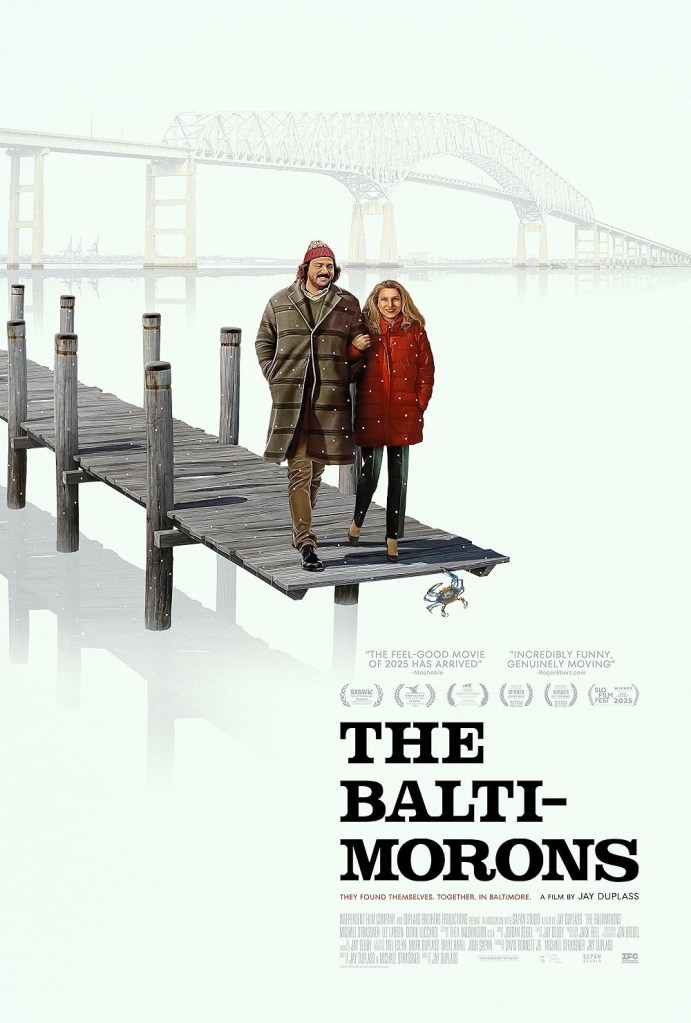
The Baltimorons Review


A gem where connections are found in unlikely places. A masterclass of comedy about finding meaning after loss. The Baltimorons is a Christmas miracle from the mind of Jay Duplass. Co-written by Michael Strassner who is also the lead In the film. The Baltimorons relies upon the formulaic approach involving someone trying to grieve and cope with disconnect on Christmas Eve. I have long admired Duplass. In this film, he showcases the ability to thrive in spite of what had been lost. The Baltimorons is a film I adore for its focus on someone trying to cope with his many frustrations while also trying to bring happiness to others.

This brilliant work-of-art takes place in Baltimore. The main character is Cliff who has a life filled with many struggles. He is dealing with sobriety, past issues with depression, while also trying to deal with the fact that his career in sketch comedy writing fell apart. Cliff is on the way to spend Christmas Eve with his fiancé Brittany (Olivia Luccardi), and her family. However, a dental emergency brings Cliff to the dentist. He meets Didi (Liz Larsen). Cliff overhears that Didi is having issues of her own, and after the dentist’s appointment, he talks her into going on many Christmas Eve adventures. During their time together they engage in conversations about life which lead to an interesting journey and mutual feelings of connection. The chemistry between Strassner and Larsen makes the film a success. Both characters are dealing with a loss of touch and wanting to feel warmth again.

Didi is a single, unhappy mom and Cliff is a depressed, frustrated soul. Duplass is amazing at creating this dynamic duo in an unlikely place at an unlikely time. He brings cinematic wonders exploring humanistic values to The Baltimorons. The conversations between the two are spot-on. The frustrations they encounter on their many adventures are witty and goofy. Duplass is so skilled at pulling off scenes of a mischievous nature. His talents allow him to transform the disconnect many people experience during the holidays into holiday cheer in The Baltimorons.

Throughout the unexpected trips which occur in The Baltimorons, the brilliant scenes warmed my heart and made me feel sentimental. The movie makes you think about how good it feels to have someone looking out for you…even if it is for just a few moments. The Baltimorons is by far one of the most cheerful, creative, and positive films I have seen this year. Although there are some elements which are for mature audiences, the theme of self-acceptance and working through problems shines deeply in The Baltimorons.

Duplass does not disappoint and neither does Strassner who steals the film. His persistence playing someone who is jumping over various hurdles makes viewers cheer for him as if he were working his way up to the finish line. The ultimate “win” would be for him to take advantage of the positivity that his new friend has shared with him and hope for it to turn into something fanciful. Four out of four stars for The Baltimorons.

Armand Review


When it comes to movies that revolve around parenting and adding the component of school, they are often written with the intention for its audience to pick a side. “Side” as in the elements of proper parenting, well-behaved children, and all the dynamics that go along with that. Then there is also the factor that much of what is seen is not true—presented in order to have its audience experience moments of feeling no forms of trust. Armand lacks “trust” in the strongest sense possible. Written and directed by Halfdan Ullmann Tondel, Armand is a drama that gives off a vibe of uncertainty that I especially felt with the film’s movement around the subject matter. It starts off as minor, and then gradually keeps introducing more moving parts to have you think otherwise. Armand is a blindsided direction into a dynamic of haunting value—as it tumbles toward the inevitable it becomes interesting, but also not so pleasant.

I did not expect pleasant themes with Armand. Especially with its plot structure. The film’s main character is Elisabeth (played by Renate Reinsve), and she is the mother of a young son, Armand. The film’s other characters of focus are Sarah (played by Ellen Dorrit Petersen) and Anders (played by Endre Hellestveit). They are also the parents of a son, Tom. The conflict occurs after an incident between Armand and Tom. Supposedly, Armand has assaulted Tom. This is a conflict that loops in for a two-hour intervention with Elisabeth and Sarah bashing heads. The boys’ teacher, Sunna (played by Thea Lambrechts Vaulen) struggles to keep the calm and find a better process to navigate the situation. It is one where two wrongs do not make a right, but sadly both sets of parents do not want to believe what the true scenario is. Disbelief is the cause of distrust.

The dramedy of Armand finds its opportunity to get even more detrimental when the higher authorities of the school must get involved in the matter. They are Jarle (played by Oystein Roger) and Ajsa (played by Vera Vljovic-Jovanovic). Both come together to think about where the issue remains at hand. However, the dynamics of the film and the individuality among the parents are what makes the film more serious than audiences expect.

The direction of the film has its moments where it makes a placefor joy and escapism, especially with the quirky personality from the performances of Reinsve and Hellestveit. Their behaviors and thought processes are questionable in the film’s matter. That is where the expansion of the problems to consider creates an underlying tone with more disturbing factors in Armand. The writing, along with the technological aspects of drama, is not only about finding a peaceful solution to a small problem at a school, but also to figure out if there are outside influences that may have led to such a problem with these two young boys. Is it a problem at home? Problems with parentalrelationships? Roads of darkness do not fade in Armand; they only create the puzzle to present the clearer portrait of what the matter may truly be. 

The puzzling fascination of Armand is all around the personality traits. Each conversation is one where the camera angles close in on the thoughts and perceptions of the characters. The setting of Norway also loops in a cultural feeling that leaves the audience curious about how matters of education and conflict are bound to be dealt with. It is subtle with its tone in broaching the subject of some realistic stressors.

Although it is not brilliant, it keeps its authoritative tracks to have presence. Conflicts of younger individuals boils over into many dynamics that spew repeatedly. There is no clear directionas to how the scenario should be handled. Armand does contain artistic value which levels responsibility in a fascinating light. Two-and-a-half out of four stars.

Skincare Review


Elizabeth Banks in Skincare

There is a beauty line that is in strange territory. It is reputation-wrecking. Skincare has the audacity of a threatening situation. Written and directed by Austin Peters, it is a thriller of uniqueness. It brings in the place where connections are bound to happen. Its location is California, and the opening brings in an array of gems and success. Style and make-up are the high tier. When the chance of competition arises, there is also the startling momentum of one’s career to face sabotaging elements.

The big star is Hope (played by Elizabeth Banks). Hope is a famous aesthetician with her studio. Her assistant is Marine (played by Michael Jae Rodriguez). Hope has the looks and the personality to sell in her world of success. Changes occur when an owner named Angel opens his boutique across from her studio. Hope receives notifications that her email account has sent many lewd messages. Hope also finds ads for being an escort. The deficits continue to climb. Hope’s life falls into a downward spiral on the brink of losing her studio. Her manic mode goes bonkers. She has the help of a friend named Jordan (played by Lewis Pullman), and she is willing to do whatever it takes to Stop Angel from wrecking her business or find out who is framing her.

It is a silly premise. Skincare does know how to make the detrimental situation clever and enticing. It is a thriller that throws many obstacles into the mixture of the conflict. It is a competition of ego and personality. Where does the line get drawn? The product line is Hope’s weakness because it is not her strong suit. Hope is cute and attractive. She can use that to her advantage. Unfortunately, it leads her to an awkward quid pro quo scenario. Hope has options to save her career, but the conflict is coming to the right decision. The more time passes (with lewd messages and hacked accounts), the continuance of reputation and fame burst into flames.

The stressfulness of the quirky setup is the scandal going to the extreme. The writing is straightforward. It has layers of graphic consequences. The focus of an aesthetician, the film is a murky satire with crinkles of make-up waiting to be purified. Publicity hits all kinds of angles and stresses. Hopes’ rent falls behind. Angel continues to make profits. While Angel is bringing in the revenue, Hope continues in her downfall.

The characterization of Banks is one of many manic and bipolar episodes. It does give its audience the chance to think about personality and professionalism. Is Angel truly her enemy? Does her level of fame mean she already has enemies? Are there people who have tried to take advantage of her before? The background of success is authentic. Skincare creates a reminder for its audience that a following has potential risks. Hope is bound to have her life threatened forever. Can she handle the moving parts properly?

It is wacky, present, and realistic. Skincare gets serious in moderation. It begins with joyfulness, and the hammer comes down in increments. The slapstick aspects are giddy sporadically. Regardless, it knows how to be a thriller, and it knows how to be amusing (while its audience is on the edge of their seats). Three out of four stars for Skincare.