Tag Archives: Neon

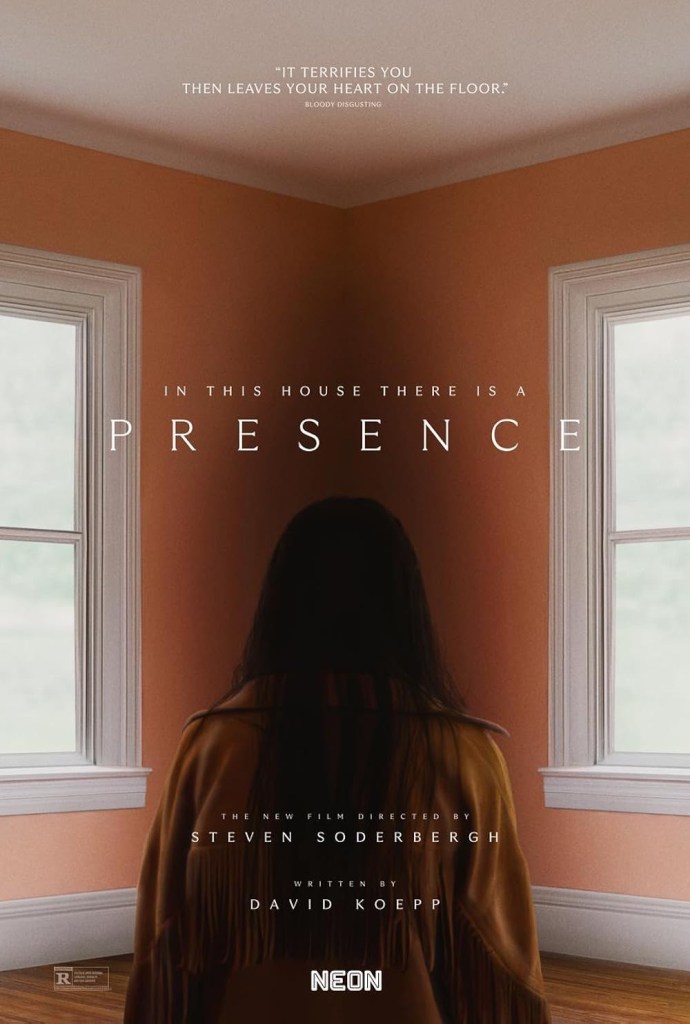
Presence Review


Director Steven Soderbergh makes the audience feel like they are the main character in Presence. Written by David Koepp, the story of a moving ghost and making the family the center of attention capture surreal value throughout the entire film. For clarification, the cameras and the whole frame are at the center of the film because every angle of the film moves during each moment of conflict or importance. While it is a bit shaky in some instances, the result is steady and perfect. Nothing even close to the shaky experience in The Blair Witch Project (1999). However, the film’s continuity and movement are clear and concise. I thought a lot about how Koepp’s writing feels like you’re following a story, and in this case it is through the moving angles of a hidden ghost.

The film is focused on a family that moves into a new home. The mom and dad are Rebekah (played by Lucy Liu) and John (played by Chris Sullivan). Their children are Chloe (played by Callina Liang and Tyler (played by Eddy Maday). Once the film begins, the dynamics of this family are captured effectively. Their disagreements weave back and forth through the motions of the camera (and the ghost is the camera.) However, they have a notion that their home is not normal, especially given frequent instances when the house is rumbling, and the lights are flickering. The audience is made to feel like they are the ones in control because of the way close-ups are used every time there are suspenseful moments. Soderbergh’s use of characterizations and realism are melded in a way that creates real stress and shocker moments for the audience given his careful direction of Presence.

As the camera/ghost weaves through rooms, the monumental lighting creates an atmosphere that highlights the characters. This produces anxiety in scenes when Chloe is with her boyfriend Ryan (played by West Mullholland). When they are together doing activities, the audience gets the sense that Ryan may be a bad influence. However, since the house can rumble, it feels as if the ghost is the protagonist preventing the antagonistic events in Presence. When Ryan has an evil plan, a rumble erupts. When there is a matter of concern, the camera pans closely on one of the characters. At the same time, the concern regarding what is making the house experience strange episodes is the central concern in Presence. The moving parts from the minds of Soderbergh and Koepp create a intriguing environment where outcomes are unpredictable, and tension spirals.

There are hidden events which may be the reason why there is a spirit lurking around the house.  There are hints in the story about someone who was important but lost. However, it leaves the audience hoping the invisible actions create more good than bad. The realistic human feelings are seen through the eyes of the invisible actions. This film takes a bold and new approach by Soderbergh which is genius and compelling. Three-out of four stars for Presence.

2073 Review


A future of chaos and technology blend in an uncontrollable pattern in 2073, a film that compiles itself as a documentary and a sci-fi thriller. The “documentary” component is the one with most sophistication in the film in and of itself. Written and directed by Asif Kapadia, the many global events which have happened in real-life play a key role in 2073. Society is the in-depth track of the film’s pandemic setting in its “sci-fi” direction. Even though it seems rushed and all over the place, the vast amount of knowledge, concern, theory, and true politics rise above and swiftly pull things together in 2073.

The film opens with a survivor, played by Samantha Morton. She is an individual living a life of peril after a global event has wiped out the many resources in the year 2073. She also narrates how her life once was before the world went awry due to many moving parts trying to make change, and most of the population not being on the same page. Issues such as AI, politics, and corruption are the pieces to the puzzle in 2073. The vastness of living on a thread digs deep, and then it transitions back to real-life events that have happened throughout the world today.

The archive footage side of 2073 makes its audience think back a lot to how the world is evolving. Despite the negative portrait painted, it is a film that speaks truth to how out-of-hand problems can be. This can be seen especially with robots taking over humans, technology outsourcing jobs, and the politics having the abuse of power to control what they see beneficial. Even though it is a context of harshness, 2073 feels like a fictional reality that can more than likely happen. It is just a matter of when.

The film links to names like Mark Zuckerberg, Boris Johnson, Steve Bannon, Donald Trump and more. It looks at many events the world has faced in the past and the ones it faces today. It focuses a lot on the markets, the evolving technologies, and economic inclines and declines. 2073 loops in the objective of the thought of a better future to sadly imply that the reality of what is truly ahead is not so great. The presence of facts and reality do make 2073 feel immensely engrossing. It is only a matter of time in 2073.

The storyline and writing of previous events happening and then jumping to the aftermath portion is a direction of interconnectedness. This is especially impactful when it showsthe events of the 1990s and the early and late 2000s. However, the timeline of detrimental consideration is the flaw of 2073. There is a point of creating a timeline and calculations for curiosity with the only conclusion being that each innovationcreates a form of depreciation around the world. Morton’s performance is the very last of that.

When it links back to Morton’s performance, the writing of the film creates the thought that the evolving technology of today is only depreciating resources going forward, since Morton’s role is one of a woman living in despair. “Despair” is a term of thorough meaning in 2073. I will say its presentation is engrossing, but in terms of thought process it continues into the tracks of the dark side of reality.

With the film transitioning between news footage from real-life events to a plot of survival simultaneously, it always has the thought for its audience about where their jobs may stand in the future. The film touches on operations of data, and then loops in how scanners in warehouses create people to be a label—the people’s performance are the data of success for a thrivingbusiness. The truth of technological factors having both a positive and negative impact loops in the truth of where the real world may be heading in 2073.

The film is vast in its tracks of evidence over its plot. Where does the story go for Morton’s performance? Why the suspensearound her life in particular? Is the archived footage the bigger problem to oversee? 2073 tends to have cliffhangers sporadically, yet it still remains on a track of enticement. Three out of four stars for 2073. 

The Seed of the Sacred Fig Review


What is more detrimental than politics and culture? Is it expectations? Is it faith? Writer and director Mohammad Rasoulof painstakingly challenges these subjects. The Seed of the Sacred Fig is an anxiety-provoking journey of morals and sacrifices. Political unrest is deep below the surface while ethics are backwards. The Seed of the Sacred Fig diminishes the impact of its main character.

The story takes place in Tehran. The focus is on Iman (played by Missagh Zareh), a judge, husband, father, and liar. Iman hides political secrets for the safety of his job and his family. His wife is Najimeh (played by Soheila Golestani), and his daughters are Rezvan (played by Mahsa Rostami) and Sana (played by Setareh Maleki). The dynamic in the house is fueled by unrest thanks to the orders from Iman. His role involves bending the rules by creating propaganda in order to provide a home for his family.

The tension between politic and two worlds colliding is extraordinary. The conflicts in the authoritarian government are what fuel the frustration and lack of faith for Iman and his family. Their unsettling reality provides an intriguing structure. Iman knows they are in danger, but his career comes first, and his family knows it. His daughter’s rebelliousness causes The Seed of the Sacred Fig to go down a suspenseful rabbit hole. Once a gun goes missing, the clock of political corruption starts ticking.

With Iman’s gun missing, his job is on the line, and so is his family. The writing and continuity of the film made my head race with thoughts. Some people keep secrets to protect the ones they love, but other secrets open doors to darker alleys. The frustration of Iman’s daughters and his wife makes him question their respect and loyalty. They see the war in the media and know their dad is part of the chaos. The concepts of betrayal and sacrifice play off each other in The Seed of the Sacred Fig.

The film’s direction displays a portrait of tension and realism given the various events occurring which shift the characterizations. The Seed of the Sacred Fig does a stellar job of tying in the political factors to create suspense. With the many choices facing Iman, his world is rolled over as his expectations rotate. Who truly suffers?

The cultural components in the film form a connective and deceitful bond. The Seed of the Sacred Fig carries elementswhich reach their limits. With the family feeling brainwashed, the fight to find their voice delivers a breathtaking force. A powerful battle for change, honesty, and loyalty ensues. Iman’s fate is presented as non-negotiable, but his family may feel there is a way around that given their suffering. The Seed of the Sacred Fig is compelling, shocking, and politically empowering. It is one of the best thrillers of the year! Four out of four stars.