Tag Archives: Netflix

Luther: The Fallen Sun Review


There are many detective thrillers that the world loves. Many of these movies involve politics, corrupt governments or businesses, and people who want “payback”—for those who betrayed them. There are some, however, who know how to plot their comebacks with an even more punishing effect. When there is someone like John Luther (played by Idris Elba), who many know from the series Luther, Luther can cause irreparable consequences when he is seeking redemption. There is a lot of redemption in Luther: The Fallen Sun.

In this film, Luther is in prison. Disgraced and disgruntled, his anger feeds the destruction that is to come when he makes it out of prison. With the detective’s anger built up inside, he does what he can to remain cool as he spends his days in prison. His tactics come into play sooner because there is a serial killer using all kinds of tactics to label his targets and continue a rapid killing spree. When a killer is using sextortion and blackmailing skills to get what he wants, this is the type of sadistic behavior that Luther is bound to put an end to. The killer is David Robey (played by Andy Serkis). As the strange and dangerous deaths spread through London, Luther breaks out of prison to track down Robey. Luther has assistance, including Odette Raine (played by Cynthia Erivo), Martin Schrenk (played by Dermot Crowley), and Corinne Aldrich (played by Hattie Morahan). The film is full of codes, twists, and suspects that are all good tracks for Luther to take down Robey, but it is deadly. Robey is smarter than Luther thinks, but is he as strong as Luther?

Technology is used in Luther: The Fallen Sun to step up its terror and suspense. Unfortunately, I still felt like the film was just an extended episode of the TV series. It was invigorating in some moments, but the twists seemed repetitive. To an extent, however, repetition is what keeps fans invigorated in both the series Luther and the movie. While the technological aspects are there, they don’t really heighten the experience of having this on the big screen. It felt almost like TV but just a little more suspenseful given a heavier trail of deadly situations.

The writing is almost like someone had overcome writer’s block, or just jumped back into writing after a hiatus. The film starting with Luther in jail and then jumping out to catch a killer is somewhat shallow. There isn’t much evidence to recap why the film takes this approach. Although the TV series came to an end back in 2019, I was surprised that the anticipation and excitement did not hold up in this movie. A recap for the audience would benefit this film. Especially given that some viewers may have watched the series, but others did not. There is no clear structure for this movie’s introduction. In short, the writing could have been stronger to give more emphasis and a more elaborate picture of all the events that happened before this film.

To recap, this thriller is visually stunning. The story flows for vengeance and violence. The story navigates towards trying to blockbuster, but it will not feel like one. The lighting and cinematography are too much like the series. While that is alright, there is no need to push for big picture distribution if the movie is not of that quality. I love British crime series, but Luther: The Fallen Sun struggled to speak to me. Enticing in some moments, but overall, a blur of many catastrophes. Two stars.
White Noise Review


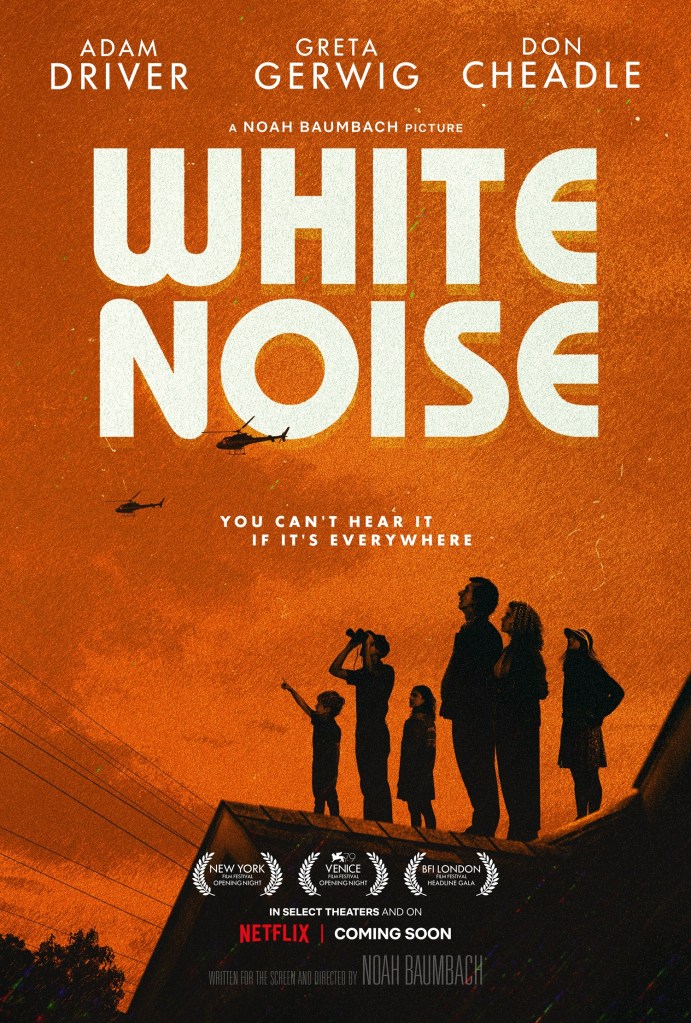
White Noise is a film directed by Noah Baumbach. It is one of his first films that is a book adaptation. It is much different than what audiences are used to from his previous projects. The film begins with actor Don Cheadle doing a lecture on cinema arts. Baumbach is known to start his films with characters that have intellectual mindsets. The beginning of White Noise also showcases the traits of characters related to some of Baumbach’s previous projects. Baumbach always knows how to make the smart characters problematic in his films. Adam Driver plays a college professor and is the king of strong words in White Noise. This is one of the film’s lighthearted features which plays into the quirks and frustrations of the characters in this dark comedy about an apocalypse.

White Noise has that classic family vibe in a bizarre way. The family is quirky and their dynamic is off. The town the movie is set in is retro. Baumbach’s approach to sci-fi adds more than enough detail. His setting is saturated and despite its comical scenery, it fits the mediocre apocalypse that is the center of the film.

White Noise takes place around a contemporary American family setting. The audience is introduced to Jack Gladney and his wife Babette (played by Adam Driver and Greta Gerwig). Jack’s career as a professor in addition to his responsibilities as afather become problematic. Jack teaches theoretical types of courses most of which discuss history and Hitler. His colleague,Murray Siskind (played by Don Cheadle), teaches the same types of courses. Their theories of voices and communications are subjects of debate between them, and their strong revelations grow into an apocalypse.

The film reveals that the town is at risk of toxins. A train disaster marks the start, but despite the severity of the situation, Jack and Babette act like their children should not be concerned for their safety. White Noise is presented in Baumbach’s interesting mode of characterizations. He does not follow a serious approach (as many would assume). The clouds set the problems in motion and the danger warning is “Cloud of deadly chemicals.”However, there is more danger than just the environment being at risk in this film.

Jack and Babette evaluate the situation with their children and try to remain subdued. White Noise is a journey of a family adapting to a natural disaster. In some scenes, the conflicts are mediocre at best. The crazy and entertaining scenes are when additional life-problems evolve after discovering the dangers of the toxic events.

With all the silly tangents in White Noise, the movie hasBaumbach’s signature style. That style includes the family sticking together, no matter how challenging their circumstances may be. That reminded me of his previous films like The Squid and the Whale (2005) and Marriage Story (2019). Of course, those were more serious films. This time around, audiences canexpect to laugh more because the responses to shocking discoveries are not so upsetting.

White Noise does have some bigger conflicts. Its quirkiness, however, continues throughout the film. This could be an end-of-the-world scenario as Jack and Murray even tie their theories to the apocalypse. Do their theories mean anything positive? White Noise is a film of revelations all due to one chaotic disaster. It is not great but still offers an enjoyable time. Three stars for White Noise.

The Pale Blue Eye Review


This is the third time Christian Bale has starred in a film directed by Scott Cooper. The first time Bale played a steel mill worker trying to save his brother in Out of The Furnace (2013). The second had Bale playing an army captain in Hostiles (2017). Now, in The Pale Blue Eye, he plays a detective in the 1830s.

The premise of The Pale Blue Eye focuses on Detective Augustus Landor, played by Bale. The characters also include include West Point Cadet Edgar Allan Poe, played by Harry Melling, and Jean Pepe, played Robert Duvall. These three are the most important characters surrounding the film’s trembling terror of a crime spree.

In The Pale Blue Eye, Det. Landor is assigned to investigate a murder of a West Point cadet, and he recruits Poe to help him with the investigation. Many people assume the cadet died by suicide, but the evidence makes the case creepy for Landor and Poe, and time is of the essence in solving the case.

With Bale’s role as Det. Landor, expect a great amount of realism. Landor is a widower with alcohol issues, and the case grows to be more and more dangerous for him. I found myself wondering whether Landor could mentally handle the murder case. Duvall’s character, Pepe, is a philosopher who helps the detective understand the writing and symbolism clues tied into the murder case.

The twists and turns for Landor and Poe in The Pale Blue Eye are inevitable, and there are interesting political and religious aspects to the investigation. There may even be a cult involved in the cadet death, and that murder is just the beginning. The 1830s is an era where lanterns are flashlights, and there are of course no computers. The lack of technology means the case must be solved thorough calculations and logic.

The cinematography in The Pale Blue Eye gives the film a very eerie feel. The film is saturated with darkness, and it’s set in the fall and early winter with forest scenes and snow, which is unsettling. An interesting aspect of the era is that despite the lack of modern communication, whatever is said, seen, or heard is thrown right into the open; there is little confidentiality. So who can be trusted? Join the mystery and find out. Three stars for The Pale Blue Eye.