Tag Archives: Netflix

Ballad of a Small Player Review


Director Edward Berger switches up the tension from religion to gambling. After the success of Conclave, his direction takes on a new anxiety-provoking approach. At the same time, the layers in this story tend to crumble in matters that do not feel successful. Ballad of a Small Player explores addiction fueled by getting byand takes place in Macau. It is adrenaline-fueled with numerous conflicts, yet the film’s writing repeatedly falls out of focus. While there are elements of dark comedy which fuel suspense, they don’t always work with the subject of poker in the film. If viewers are expecting a thriller to feel like Casino or 21, Ballad of a Small Player is several notches below.

The film’s main character is Lord Doyle, played by Colin Farrell. He narrates the beginning of the film and talks about his experiences playing poker. He has gambled his life away…no matter the cost, his brain is always wired to win. Despite the negative consequences, he still feels success awaits him. Eventually, casinos and hotels start to inform him of invoices and piling debts that must be repaid. This leads Lord Doyle to gamble more and seek out bigger competitions in hopes thestakes are higher which will allow him to pay off his debts.

Lord Doyle finds a lifeline from a mysterious individual named Dao Ming, played by Fala Chen. There may be hope for Lord Doyle to have a Plan B and put his bad karma behind him. However, it is not that simple for Lord Doyle due to a detective on his tail. The private investigator is named Cynthia Blithe and is played by Tilda Swinton. Lord Doyle’s drinking, gambling, and pursuing various solutions creates a bipolar rollercoaster ride that feels like mayhem with intermittent layers of boredom. I found the scenes of Farrell waking up hungover boring. The film relies too much on addiction scenes over ones focused on solutions.

The help of Dao offers some hope for Lord Doyle. Unfortunately, Lord Doyle’s assorted conflicts are a trainwreck. I appreciated the film’s tone, but the melancholy aspect feels like a flowing volcano due to the sheer madness of drowning in a bad state of mind. Overall, this is Berger’s film in which trying to blend substance abuse with comedy is ultimately not very successful.

The theme of gambling is where the tone of the film carries a political aspect with a purpose for Lord Doyle. Many of his debts are ones that can go on record which create interesting dilemmas and outstanding conflicts for the audience to think about. Berger’s direction lays out a vast landscape of choices leading down rabbit holes involving multiple consequences. The dynamics between Farrell and Swinton are like a comedicversion of Catch Me If You Can, but with a low B rating. Their roles are somewhat silly, but the film itself is quite clever. There are simply too many of the conflicts which get wrapped up too easily. Therefore, I give this film two out of four stars.
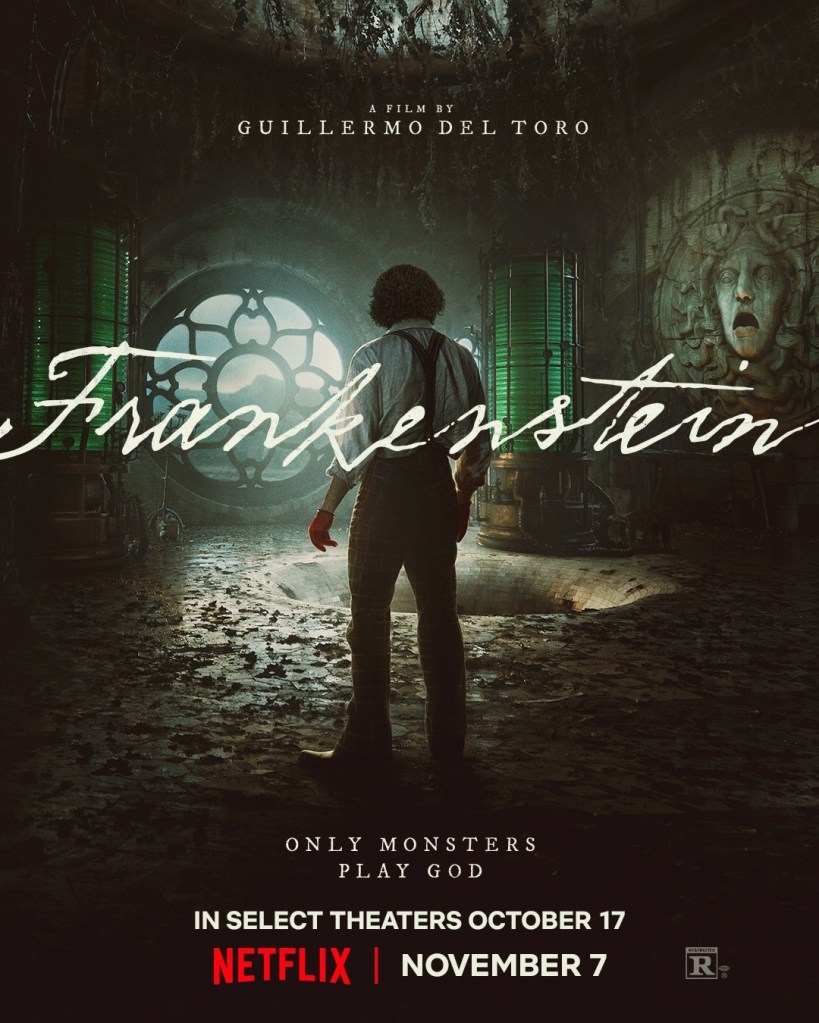
Frankenstein Review


The mind of Guillermo del Toro finds creative connections in a powerhouse effort which includes wonders of cinematic imagination unlike any other. From the worlds of Pan’s Labyrinth, The Orphanage, and Pinocchio, he creates new meaning with Frankenstein, one where an emergence of lights evolves, but the political aspects regarding humanistic value fall in the middle.

To provide context, this is not your common Halloween-type Frankenstein film. This one has a storyline with emphasis which gives the monster meaning. There is a strong sense of purpose in del Toro’s direction. The madness in this breathtaking storyline takes viewers on a journey of suspense and amazement filled with mind-boggling grandeur. The creator and monster both have their own story. Frankenstein should be seen on a big screen over the Netflix platform, because the big-screen experience will amplify del Toro’s immersive surreal portrait.

The plot focuses on Victor Frankenstein (Oscar Isaac). He is a scientist with a clever mind but also cruel with a massive ego. He has a history of inventions as well as trials of deceit. There are many political feuds with Victor. The setting is the 19thcentury, and the film focuses on Victor’s creation of a monster. With the help of his assistant Harlander (Christoph Waltz), some moving parts begin to go awry. The scientific aspects of the film have a backstory starting with Victor trying to run from what he has created. He ends up with sailors and begins to tell them why he is running from his creation—the film proceeds in acts from that point forward.

One captivating part of the film is the fact that it uses cinematics to lay out the events which provide context of how terror evolved. It also loops in Victor as the victim. Guillermo del Toro is accomplished at introducing enemies as the source of material for major emphasis in his projects. He is not afraid to bring out the worst of his characters and shine the light of terror with aftermath upon them. This situation comes into play for Victor in Frankenstein after creating The Creature (that is the character’s name, played by Jacob Elordi). He slowly develops humanistic attributes, but with Victor treating him like a slave, his monstrous avenues begin to expand rapidly. The Creature begins to feel love for a girl named Elizabeth (Mia Goth). With Victor, however, the life of The Creature is a living nightmare. Victor’s prison-like lifestyle fuels The Creature’s desire for ravenous vengeance.

Frankenstein is quite an enjoyable thrill ride. The story is very well-written and extremely well directed. All The Creature wants is to feel loved. His creator, Victor, wants to feel accomplished for his creation. Where do they both find happiness? Given the difference between being a real live human being and a man’s creation, del Toro creates a unique vision of life filled with many wonders in his version of Frankenstein. Suspense, love, lust, and ego all combine into cinematics which result in incredible genius. Four out of four stars for Frankenstein.

A House of Dynamite Review


Written by Noah Oppenheim and directed by Kathryn Bigelow, A House of Dynamite is a politically fueled thriller where uncertainty lingers. It is also one of those films that gambles with political affiliations and tactics. Throughout the film, there are weaving moments between different political sectors which bring up questions as the audience flows through the journey of it’s intense scenario. Bigelow knows how to keep the volume turned up with A House of Dynamite.


The film has an all-star cast including Idris Elba (as POTUS), Rebecca Ferguson (as Captain Olivia Walker), Gabrial Basso (as Jake Baerington), and Tracy Letts (as General Anthony Brady). All of these characters serve a purpose in A House of Dynamite. They are the heroes who stand on the front lines and make calls about how to handle an attack. At the same time though, the risks and politics come into play for interference. This is where the writing and directing of this screenplay takes the cake to new levels of suspense.

The film begins with an unidentified intercontinental ballistic missile flying in the sky. Many believe that it is a test, but the reality is quite clear. Olivia Walker comes in to monitor the threats. It is recognized as an ICBM launch.  More high-ranking officials come into play. POTUS is the president, General Anthony Brady is a senior military officer at United States Strategic Command, and Jake Baerinton is the Deputy of National Security and together, they must communicate to figure out what calls to make in terms of standing by or engaging in an attack. At the same time though, political feuds only add fuel to the fire. A House of Dynamite is a film where gambling is about truly getting the numbers right before making a decision.

The film has writing that jumps between different countries and political components with a lot of play with Asia, Russia, and Korea. These are places where resources tend to overlap and have political aggravations. Throughout the film the ones on the frontline continue to negotiate, but at the same time, the safety of people becomes more limited as choices begin to have delays. The options of how to protect are complicated to analyze. Bigelow brings all the political factors that topple each other vividly to burn up the screen with hierarchy that serves a bigger purpose. I respect her for this though, because she paints a portrait of how some real problems of the world truly do not get resolved.

This is a powerhouse with political rollercoaster ride moments that continue the intensity. So much in A House of Dynamite is filled with precious moments at risk which create the foundation of how far hierarchies will go in the name of a call. I was hooked on the film. A lot of it was not only about the politics, but also by how the demographics come into the picture. To clarify, the fingers get pointed at countries such as North Korea or Russia—that is the portion of the film where the disagreements create the landscape to make the timing of the essence.

The performances of Ferguson, Baerington, and Elba I felt gave the most meaning to A House of Dynamite. Their calls and sensitivity levels present the humanistic value of fear whichweaves in and out of the scenario in fragments. There in lies a worldwide phenomenon of concern. A House of Dynamite soars with success. Realism has a clear portrait of unidentified solutions and many questions that continue to search for answers. Three-and-a-half out of four stars for A House of Dynamite.