
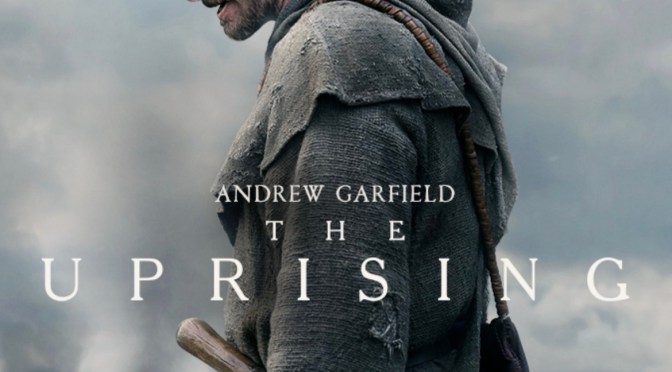
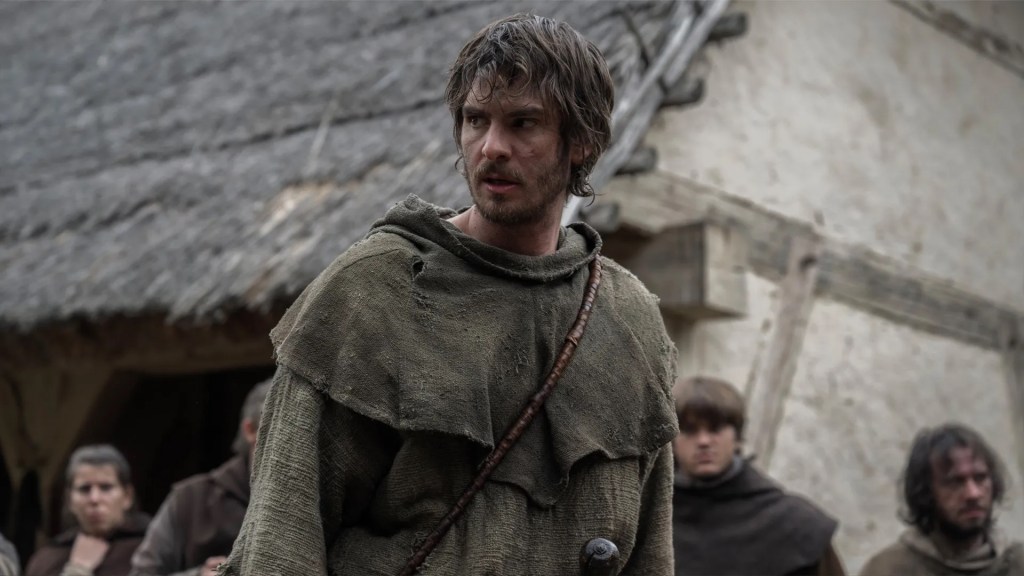
Written and directed by Paul Greengrass, he dives with realism into the medieval era. Greengrass directed the films in The Bourne series as well as films based on actual events ranging from United 93 to Captain Phillips. His writing is strong and surreal as it builds momentum as it delves into peril and corruption while oozing with vengeance. The Uprising brings the audience to England in the year of 1381, a time when there are unfair wages and taxes so living is not up to par. One peasant stops at nothing to find the light. Andrew Garfield plays the hero, Ploughman. He is the king of a rebellion who stands up against a young King with a disgusting ego.
The young King is King Richard II, played by Woody Norman. He is cynical and full of arrogance. Norman thrives in the role of the pompous King well and dazzles with the wrath of vengeance. Garfield’s Ploughman wants justice for the people in the rebellion. His friends John Ball (Jamie Dornan), Wat Tyler (Cosmo Jarvis), and Alyce (Thomasin McKenzie) stand with him. They travel through political tides and try to work out plans to get King Richard II to offer a form of freedom, but there are many hurdles and lots of lies. There is war waiting regardless of the outcome. Greengrass knows how to write about preparing for an attack and how to create the anticipation for his audience to know a battle is coming.
The momentum for anarchy spiraled in a similar fashion to United 93. Both films have signs that there are elements which are not right, and that fighting must be taken into consideration. In United 93, it involves the passengers versus the ones who have taken over the aircraft. In The Uprising, it is the peasants fighting for peace and a better life. The Uprising is about an unforgettable alliance. Once a war begins, there is no going back.
What fuels the film is Norman’s two-faced performance. He plays a King who wants to appear benevolent while refusing to suppress the power-hungry demons within him. He also feels a need to impress the lady by his side, Countess (Katherine Waterston). As Ploughman continues down the path to help his people talk the King into better resources, Greengrass’s writing reminds viewers that there is the chance of blindsiding to come. Just when it seems like positivity might abound, there is ravaging violence. Betrayal has a wicked aftermath leading to a climax with a spellbinding redemption.
What makes The Uprising so dazzling is not only how the conflict is written, but the amount of counsel that surrounds the King. His team fills his mind with anticipation. He finds moments to try to convince the peasants he is destined to change lives, but his team reminds him otherwise. Greengrass is the master of spiraling personalities.. I found The Uprising to be one of the best medieval-era films of the year. Four out of four stars.
 Movies with Tarek