All posts by Tarek Fayoumi…The Paterson of his Craft!

I am someone who strives to become a professional critic. I watch and review many movies. I view the eyes of movies as something as an art form. I have followed many critics over the years, but once I was thirteen I knew writing film reviews was going to be my passion. I learned from watching multiple episodes of Ebert And Roeper in my teen years, and then in middle school I began writing film reviews for a newspaper club. I am also an avid fan of the arts of Chicago including Theatre, Comedy, and music. Films, however, are my primary focus.

“The End of The Tour” Review


end_of_the_tourjason segel and meJason Segel and Me!

maxresdefault

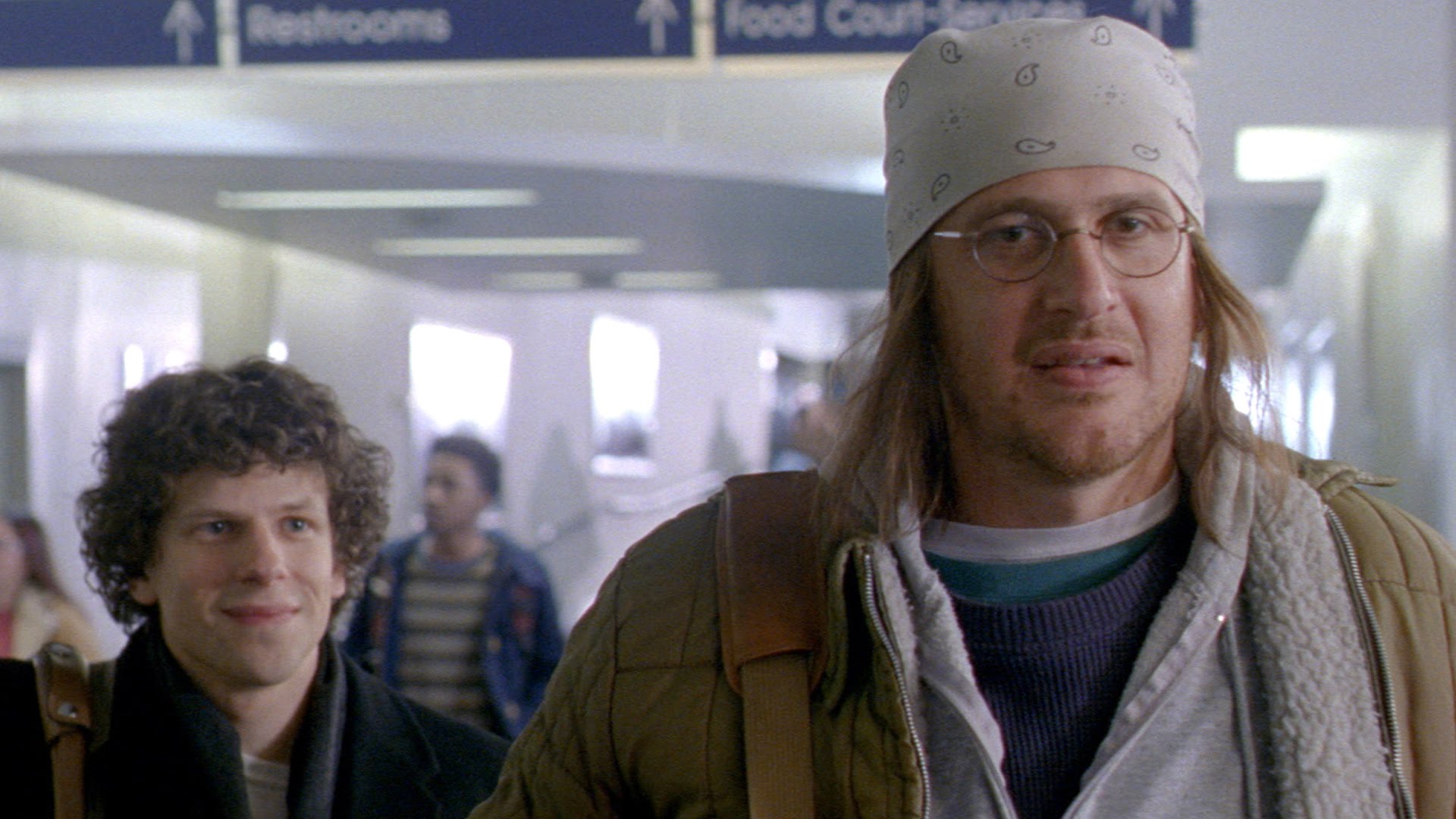
Even though “The End of the Tour” is receiving positive buzz right now, I was lucky to get to see it back in April at the Roger Ebert Film Festival in Champaign, Illinois. I also met the lead Jason Segel. As I walked into this movie not knowing very much about it, I ended up being enthralled by the film’s meaning, acting, and its story. Director James Ponsoldt creates a true story that is destined to be a cult classic. In the discussion after the movie at the festival, I was moved by the discussion between Ponsoldt and Segel. However, I am now going to explain the movie a bit and why it stands out as a masterpiece.

A Journalist named David Lipsky (Jesse Eisenberg) is set to do a five-day interview with David Foster Wallace (Segel). The goal for Lipsky is to get an idea of Wallace’s background, his hobbies, and what he does in his daily life. This is all right after Wallace’s 1996 publication of his novel Infinite Jest. However, as the days go by, Lipsky and Wallace become quite close as Lipsky conducts a series of interview questions. They have their awkward, yet fun moments, they are connecting, and for Lipsky, he feels that Wallace is like a brother to him. The relationship between the two is touching where viewers will feel enlightened at the end of the movie.

There are times of frustration between the two. Some of the information that Wallace shares with Lipsky is quite open about his life. I will not give details of what that sacred information is. That is something that you will have to find out if you watch “The End of the Tour.” Overall though, it is about coming out of your shell. That is something that Wallace and Lipsky find themselves doing at times of conversations with each other. When they do that, they feel they are creating a bond that will change their lives forever. The different tones of their frustrations can be something that makes better in the end.

“The End of The Tour” is essentially about friendship. Lipsky may just be a journalist that wants to write a story to build his ego, but he has a lot of heart. He demonstrates having a heavy heart in the scenes where he proves to Wallace that he is a reasonable and honest guy. Wallace may be a hippy, lazy, but auteur writer, but has a very creative mind and has a lot of positive personality for Lipsky to absorb.

Lipsky will have a brilliant story on spending his time with Wallace. His story will be successful. However, to find out how successful it is, that is something for you to find out. “The End of the Tour” simply cannot be missed. I think it is one of Ponsoldt’s best. The best since his previous film “The Spectacular Now” (2013).
“The Stanford Prison Experiment” Review


stanford

The real story of “The Stanford Prison Experiment” is about how Doctor Philip Zimbardo wanted to see the psychological aspects of a prison re enactment of Stanford University. The experiment was suppose to last for two weeks, and it only lasted six days due to how the violent behavior of the students (who portrayed guards and prisoners) were impacted. The experiment led to students wanting psychological treatment and had nightmares for long periods of time. Zimbardo insisted on letting suspenseful situations get more out of control as a way to lead to results of his experiment. As Zimbardo saw the negative behavior through his own eyes, he decided to end the scenario early. The goal of the movie, however, was to capture the harshness of the scenario, rather than the psychological result of it.

Zimbardo turned a hallway of Stanford University into a prison. He got bunks, designed places for the guards, and assigned policies in regards to how guards can treat the prisoners. The guards push the prisoners to the limit though. They are quite horrid, intense, and vulgar towards the prisoners where it messes with the prisoners minds. Therefore, the movie has good acting, good plot structure, but there is no result of the psychological purpose of what Zimbardo is trying to find with what he has created for just volunteer students. Things go ballistic.

Doctor Philip Zombardo (Billy Crudup) assigns guards and prisoners based on their interview questions. The main guards are Christopher Archer (Michael Angarano), Anthony Carroll (Moises Arias), and Karl Vandy (Nicholas Braun). They are guards that are a recipe for disaster. The main prisoners are Daniel Culp (Ezra Miller), Peter Mitchell (Tye Sheridan), and Jeff Hansen (Johnny Simmons). These prisoners are heavily impacted by the guard’s behaviors. The prisoners and guards both have a generous amount of time to think about their behavior for the next two weeks. However, both of the parties decide to abuse the privilege. The guards start first with verbally abusing the prisoners consistently. This makes the prisoners become rebellious. Zimbardo does not think of ways to calm down the conflicts between the two parties, he wants to let the intense situations get out hand to be able to find a result for his psychological study.

Zimbardo has many options to calm down his victims he has chosen. Instead he ponders with agitation, discomfort, and hope. He does this because he wants something big out of it. He would then feel like the experiment was all for nothing. I will not give any more information away regarding the judgment of the characters. That is something for viewers to see (if they choose to view this brutally intense thriller).

The guard moments are heavy with language, brutality, and being outspoken. This is all ran by Archer. He is the guard that wants to be a guard just to have the authority and to feel like he is the Big Kahuna.

Despite the film’s violence, “The Stanford Prison Experiment” is vast with cinematography, acting, and plot development, but there is not a good solution to the movie. Since “The Stanford Prison Experiment” is a true story I would have liked to view the film for its psychological purpose, rather than just violence after violence. Overall, I will say two and a half stars.

“I Origins” Review


i origins karen and ian I_Origins_poster

Though the film stars the big celebrity from “Boardwalk Empire” Michael Pitt, the sci-fi drama “I origins” has a sense of grief and deception. The film begins with Pitt narrating his studies of molecular biology, his family, and the study of a particular eye that changed his world. The film brings us to his journey of a particular eye that starts when he is a PhD student. He is at a Halloween party, goes to the rooftop for fresh air, sees a random girl, and asks her to take a picture of her eyes. That girl propositions him romantically and vanishes. This somewhat strange encounter brings Ian (Pitt) to be on odds with himself and his beliefs on his studies of eyes.

The movie won at Sundance Film Festival in 2014. This makes “I Origins” one of the most creative and anticipated sci-fi movies of 2014. Given its meaning, its message, and its climax, it is a puzzle of created from one dramatic death, it will leave viewers stumbling with questions towards the end of the movie. Yet it did not so great budget wise, but director Mike Cahill is creative, bold, and vast with his focus of this sci-fi movie, as the suspense of “I Origins” takes place.

The movie is about Ian; a molecular biologist that has on obsession with the eye. He meets a girl on a rooftop, takes a picture of her eyes, and then she vanishes. A few years later he runs into her again and they finally meet like civilized people. Her name is Sofi (Astrid Berges-Frisbey). They fall in love and they get married. However, when Ian takes her to his lab to prove an experiment that he believes is appealing, she is not fond of it. The behavior shift leads to disasters; disasters so bad where Sofi dies in an elevator. Ian begins to become depressed; he starts to work less in his lab, does not have an interest for science, then all of a sudden his lab aid Karen (Brit Marling) comforts him. Ian falls in love for a second time with Karen and they get married and have a baby.

As the years go by, Ian gets ready to return to the study of Sofi’s eye. With his intense research with his wife Karen, they realize there is someone in the world that has the same eyes as Sofi. For Ian this means, “The eye can be a window to the soul.” This discovery puts him back in his place and he stops at nothing to solve the mystery of the girl he once loved until her accidental death on their wedding day.

This all happens with massive drama. At first, Ian is against the idea of discovering what Sofi left behind. Karen is for the idea, but Ian wants to focus on loving Karen and not thinking about Sofi. Karen and Ian have their moments of arguing about doing the research, but Karen has hopes that Ian is a genius. This finally leaves Ian to travel and find the girl who might have Sofi’s eyes.

Ultimately, “I origins” is a landscape of science, drama, and love. Viewers may see the film to gear on religion based on the scientific beliefs of Pitt’s character. Either way though, religion is not much of the focus of “I Origins” the focus is the discovery of the eyes of someone that died. The characters are not your average big name Hollywood actors, the film is not a blockbuster, but the script is well written and it’s a heavy, yet captivating concept. This movie is like a psychological movie mixed with science; with scientific results that will shock viewers at the very end.

Three and a half stars!