Peter Hujar’s Day Review


This is an authentic film that pays attention to details. It finds its realism and stays on point. Directed by Ira Sachs, this is a true story that captures every essential aspect of someone telling a story. Peter Hujar’s Day plays out on an intriguing landscape. The cinematography has lighting that fuels the story with rapidly changing structures. It takes viewers on a deep and vivid journey. Overall, Peter Hujar’s Day is purely spectacular thanks to a mesmerizing performance by Ben Whishaw, who wasdestined to play Peter Hujar. It is a film about a long conversation between Peter Hujar and Linda Rosenkrantz in 1974. Rachel Hall plays Linda Rosenkrantz.  New York in the 1970s provides the perfect backdrop for a discussion that goes deep. The spiral of words in this story about the life of Hujar is spellbinding.

The film begins with Linda doing the interview with Peter on a cassette recorder. In the era before digital recording, Peter and Linda have tea and eat meals between takes. Peter continues to go deep about his many moments taking photographs of different people. It is an enlightening experience that makes audiences wonder how artists find their narrative. At the same time, it makes viewers wonder how art is created in an otherwise introverted life. Throughout Peter Hujar’s Day, the story prompted a variety of interconnected thoughts. The performances of Whishaw and Hall are the epitome of grandeur. 

I have had the opportunity to see both Whishaw and Hall in person. I saw Whishaw on stage in London in Waiting for Godotin 2024. I saw Hall on the Red Carpet at the Cannes Film Festival for The BFG in 2016. Watching them both in Peter Hujar’s Day felt natural, because they both display humanistic characteristics in their acting while portraying lead roles in this type of film. Peter Hujar’s Day is a one-of-a-kind movie. Hall is amazing playing the journalist seeking every deep word for her story. Whishaw is wonderful playing the photographer trying to be an open book while telling his story.

Peter Hujar’s Day has the New York art scene written into it right below the surface. The streets and city lights are the backdrop of Peter’s story. As the conversation goes forward, the moments of darkness come in and out of Peter’s mind. The writing of Peter Hujar’s Day carries a narrative that helps audiences appreciate how human minds can weave emotionally up and down, especially when so much energy is given to a craft, and nothing comes of it. Peter Hujar’s Day is a joyful wonder of amazement and a real treasure. It is a little too short though. There could have been more to the story, and the film felt a bit incomplete since it only runs for about seventy-six minutes. Overall, however, that timing is made up for by its artistic brilliance. Three out of four stars.

Now You See Me: Now You Don’t Review


Hard to believe that nine years has passed since the gang of magic have last been seen. Now they are taking on a new mission. They want to steal a diamond. After Now You See Me: The Second Act, the fun of magic, twists, and illusions reach new levels. I went in with mixed expectations but walked out more dazzled than I had anticipated. Now You See Me: Now You Don’t is a film where the cards are shuffled, but the outcome is more successful than audiences might think. 

The Horsemen are back! Jesse Eisenberg as J. Daniel Atlas, Woody Harrelson as Merritt McKinney, Dave Franco as Jack Wilder and Isla Fisher as Henley Reeves. After being on the run from the law and using their magic skills to make bank, they reunite for a mission involving diamond heists, but more want to be part of the mission this time. There are three new young individuals joining on their heist journey. They are Bosco (Dominic Sessa), Charlie (Justice Smith), and June (played by Ariana Greenblatt). The evil nemesis is played by Veronika Vanderberg (Rosamund Pike). Can the Horsemen utilize their magic and tactics to help their new proteges stay out of trouble, and maintain their reputation? A lot is on the line in Now You See Me: Now You Don’t.

This sequel has a lot of adventures. I loved how the direction goes to places all around Europe and talks about theories to consider when utilizing magic and the mind in creating areas. So many of the tricks are just illusions, but this film creates areas of irony to maintain the adventure  and develop meaning.  The rapid escapes are still around, and so much of the heists and twists are non-stop.

Now You See Me: Now You Don’t is a rather joyful continuation. Not amazing, but well worth the time. It is like an interactive escape room that does not end. Also at the same time, it felt good to see the illusion of magic and relativity finding forms of connection, because there is always something to magic that may or may not add up. Three out of four stars for Now You See Me: Now You Don’t.


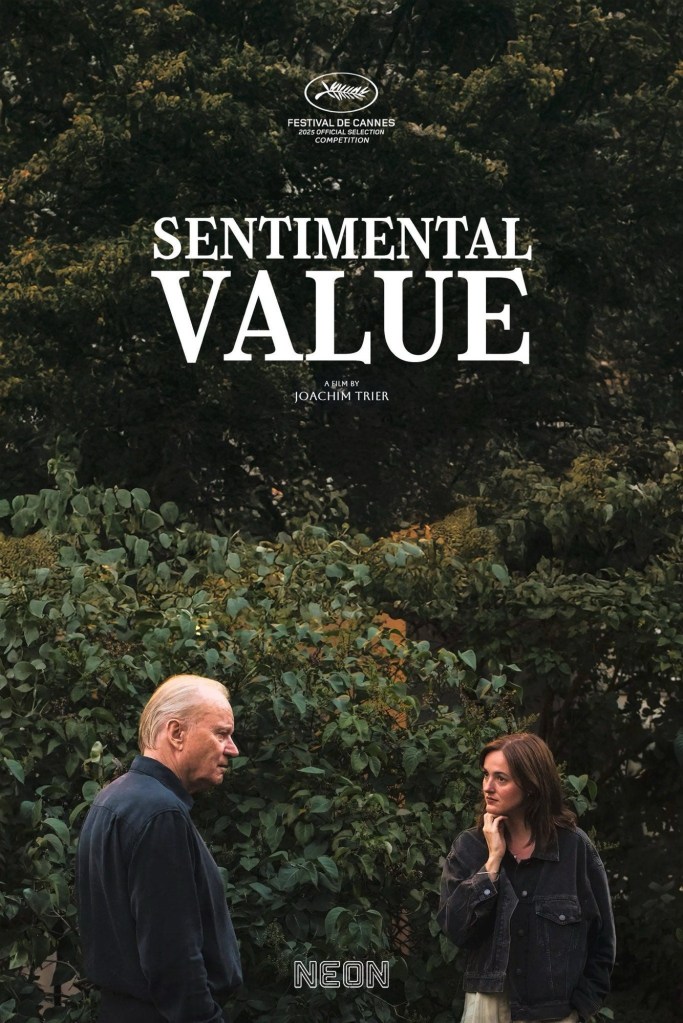
Sentimental Value Review


This film is an achievement of humanistic approaches with an artistic natural vibe to the writing. Sentimental Value is a title that speaks for itself. Directed by Joachim Trier, he takes the life of a family and the arts to a new level where disconnect and reality present mental and emotional challenges. It is stunning, audacious, and breathtaking. So many human emotions are on full display and interesting layers of art are out of this world in Sentimental Value.

The life of directors has many ups and downs in this story about a family who is curious about finding out where the focus lies. The main characters are sisters, Nora Borg and Agnes Borg Pettersen (Renate Reinsve and Inga Ibsdotter Lilleas). Their father is Gustav Borg (Alexander Stellan Skarsgard), an accomplished director. All three of these individuals find themselves at the heart and mercy of disconnect as well as a tumultuous relationship caused by their success in the cinematic and theatrical world. There is so much pressure on the sisters from their father, Gustav. Nora finds herself encountering hurdles and struggling to adapt. Gustav comes around a lot more frequently in their lives. At the same time, however, Nora and Agnes work on achieving happiness while they share their lingering disconnect. In the meantime, their father is on the search to make art come to life in his new project.

The film goes from scenes showcasing success to theatre stages and the movies. Suffering from their past comes into play, and at the same time there is love that is present. The feelings stirred by the story can be hard to feel. Trier fuels emotional component hard in Sentimental Value. At times, it gets to the point of making audiences ponder why some people push themselves to the limit.

The new star that Gustav is working with is a young actress named Rachel Kemp (Elle Fanning). She is working on building a following. Gustav’s daughters find themselves a bit jealous of her and she ends up right in the middle of all the chaos and family drama. The complex elements of becoming successful are manipulated by the father. Sentimental Value portrays howfavoritism can have serious consequences. The film reveals some astonishing truths and is a unique arthouse film that I found worthy. Three-and-a-half out of four stars.

Treating cinema in many forms of art!