
The brutality of real-life events hits hard with Naza. This is probably one of the most thought-provoking, yet hard to watch films I have endured this year. With the reflection on war in Iran and Gaza, the real-life events continue today. The film is only eighty minutes, but every second feels like a moment of searing truth. It is a film that is hard to watch, but also spellbinding.That is because everyone who is interviewed is anonymous, but they tell their side of the stories of the destruction happening in Gaza. Directed by Yuval Abraham, he is the one who conductsthe interviews. The film has gotten a lot of attention in festivals ranging from the Venice International Film Festival, the New York Film Festival, the Zurich Film Festival, and more—the importance of context is what makes it hard to not look away.
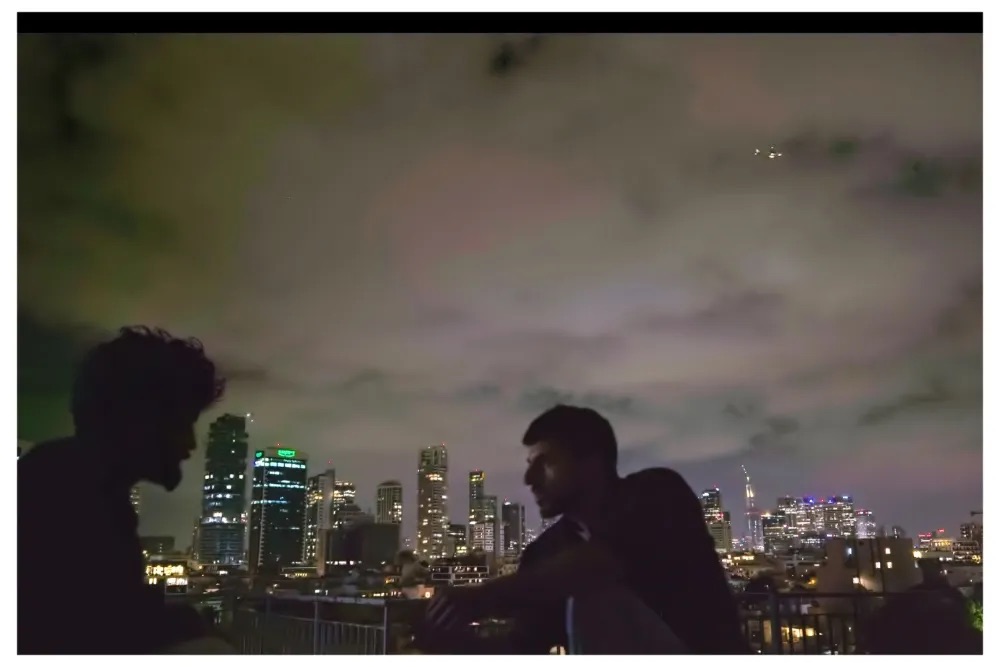
There is no easy way to explain Naza. It is all around controversial and each word from the interviews made me linger in sadness and frustration. At the same time, hearing the truthfelt like a revelation. That is because it made me think of how those being interviewed feel about their choices, and what role they play in it. Abraham captures all the moments and is deep-in-thought with the many responses he receives from his many questions. He conducts his interviews on a rooftop building in Tel Aviv, and all of them are done at night. The words he hears will change lives around the world. The topic of massacres, politics, and all is what makes Naza controversial, but also a breathtaking ride where irreparable consequences cannot be undone.
Yuval Abraham captures a lot of information about why the attacks happen and why particular populations are targeted. Much has to do with private home settings, and class of people. There is a scenario of a demographic that feels scientific with data. Without sharing much info, I will say there is a geographical monopoly—regions are targets for reasons and unfair advantages. This is where there is a political point of discord that I felt during Naza. Even though I felt saddened by what was discussed, the honesty throughout the interviews continuously shook me and was a hit of reality.
There is a moment that goes back to Gaza in 1970—an era when phones were becoming a technological amazement in that region. That moment makes us think about how much phones can do for families. However, many years later, the tracking of them can have many purposes—including negative ones. The thought of technology used to target and kill is the sad connection in Naza. The ability to track individuals is the advantage that has a deeper meaning of harsh news. It can be unbearable.
The night effect makes the film feel that the darkness has a bigger purpose, it creates the feeling of solitude. It is a safe time and place for red flag scenarios to be discussed. The rooftop interviews have a vividness to them that makes one wonder who else might be watching or listening. Magnificent elements of darkness with no limits and real truths are why Naza is one of the best films of 2026. Three-and-a-half out of four stars.

